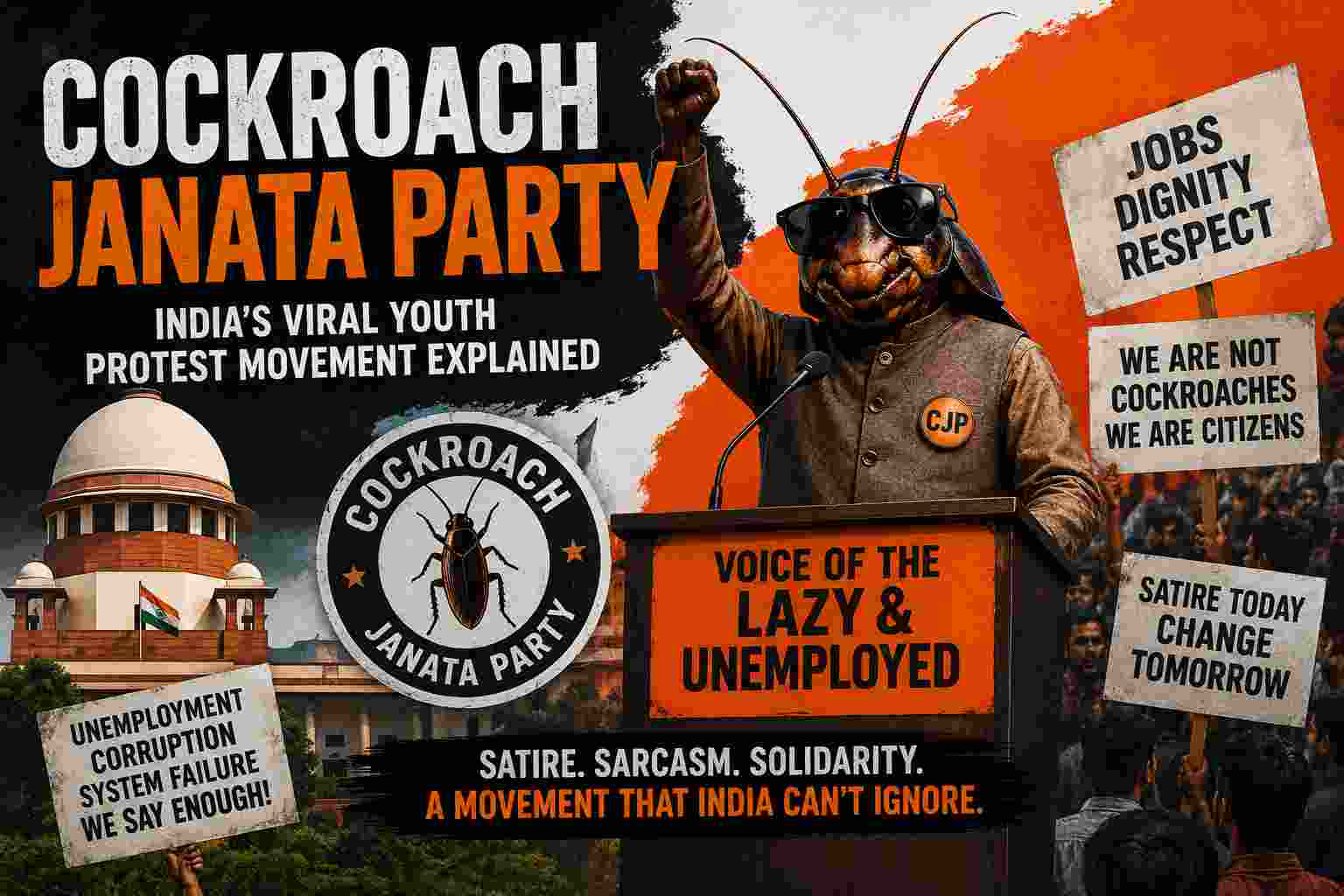
A new digital movement called the “Cockroach Janata Party” (CJP) has exploded across Indian social media, transforming from an online joke into a larger political conversation about unemployment, youth frustration, free speech, and institutional accountability. What started as satire is now being discussed by politicians, activists, students, and millions of social media users across the country.
The movement gained traction after controversial remarks linked to Chief Justice of India Surya Kant triggered widespread backlash online. Many young people interpreted the comments as insulting unemployed youth and activists, leading to the creation of the satirical “Cockroach Janata Party.” Within days, the movement reportedly attracted over one lakh supporters and massive engagement on platforms like Instagram and X.
What Is the Cockroach Janata Party?
The Cockroach Janata Party is a satirical online political movement created as a response to comments that were widely perceived as comparing unemployed youth to “cockroaches.” The movement uses humor, memes, sarcasm, and political commentary to express frustration over unemployment, corruption, and the treatment of young Indians in public discourse.
Despite its humorous branding, the movement quickly evolved beyond memes. It launched social media accounts, a dedicated website, and a five-point manifesto that mixes satire with real political criticism.
The phrase “Voice of the Lazy & Unemployed” became one of the campaign’s most shared slogans online, resonating strongly with Gen Z users frustrated by job scarcity and rising economic pressure.
How the Controversy Started
The controversy began after remarks attributed to Chief Justice Surya Kant during a public discussion on youth and activism. According to multiple reports, the comments suggested that unemployed youth often become social media activists, RTI activists, or media critics who “attack everyone.” Many social media users interpreted the language as offensive and dismissive toward unemployed Indians.
The backlash intensified rapidly online. Memes flooded platforms like X and Instagram, with users reclaiming the “cockroach” label sarcastically. Soon after, the Cockroach Janata Party emerged as a symbolic protest movement.
Later, Chief Justice Surya Kant clarified that his remarks had been misquoted and were intended to criticize individuals using fake degrees and unethical practices, not unemployed youth in general.
However, by that point, the online movement had already gained major momentum.
Who Founded the Movement?
The movement is widely associated with Abhijeet Dipke, a public relations student at Boston University and former volunteer connected to political social media campaigns in India. Reports state that Dipke launched the satirical campaign impulsively after seeing the controversy unfold online.
In interviews, Dipke explained that the project initially started as humor but quickly transformed into a larger platform for frustrated young Indians. According to reports, the movement crossed tens of thousands of supporters within just a few days.
Why the Movement Went Viral
Several factors contributed to the explosive popularity of the Cockroach Janata Party:
1. Rising Youth Unemployment
India’s unemployment debate has become increasingly emotional among younger audiences. Many graduates struggle with limited job opportunities, competitive exams, and financial instability. The movement tapped directly into those frustrations.
Young users felt the satire represented their anger toward institutions and political systems that they believe ignore their struggles.
2. Meme Culture and Gen Z Humor
The movement used internet culture effectively. Instead of traditional political speeches, it relied on memes, parody posters, exaggerated slogans, and sarcastic membership campaigns.
This approach made political discussion accessible to younger audiences who often engage more with humorous digital content than formal political messaging.
3. Anti-Establishment Messaging
The manifesto included controversial and provocative demands targeting political defections, media ownership, women’s representation, and electoral accountability. While many points were clearly satirical, others reflected genuine public frustrations.
The movement positioned itself as representing people who feel ignored by mainstream politics.
4. Celebrity and Political Attention
Several politicians and public figures publicly interacted with the movement online, further boosting its visibility. Social media engagement from political personalities added legitimacy and media attention to what began as a meme campaign.
The Cockroach Janata Party Manifesto
One major reason the movement gained attention was its unusual manifesto. Reports suggest the manifesto combined satire with sharp criticism of political and institutional systems. Some of the widely discussed proposals included:
- Stronger action against political defections
- Expanded representation for women in Parliament
- Greater accountability in media ownership
- Electoral transparency reforms
- Criticism of post-retirement political appointments
Although many proposals were exaggerated for satire, they sparked serious discussions online about governance and democratic accountability.
Social Media’s Role in the Movement
The Cockroach Janata Party demonstrates how digital activism in India is evolving. Unlike traditional political campaigns, the movement spread almost entirely through social platforms.
Instagram reels, memes, parody graphics, and viral tweets helped the campaign reach millions within days. Online communities amplified the message faster than conventional political organizations could.
Experts say the movement reflects a broader trend where internet humor becomes a tool for political criticism and public mobilization.
Satire or Serious Political Movement?
The biggest question surrounding the Cockroach Janata Party is whether it remains satire or evolves into something more serious.
At present, the movement has no official electoral structure or traditional political organization. Most analysts still view it as a symbolic online protest movement rather than a real political party.
However, its rapid growth reveals deeper public dissatisfaction among sections of India’s youth population.
Political observers note that even satirical movements can influence public conversations, shape narratives, and pressure institutions to respond to public anger.
Why the Debate Matters
The Cockroach Janata Party phenomenon is not just about memes. It reflects larger national concerns, including:
- Youth unemployment
- Distrust in institutions
- Political frustration
- Online freedom of expression
- The growing influence of digital activism
The controversy also highlights how quickly social media can transform public outrage into organized online movements.
In modern India, internet satire is increasingly becoming a form of political participation.