The future of India’s Unified Payments Interface (UPI) has become a major topic of discussion after the government introduced amendments to the Payment and Settlement Systems (PSS) Act. Reports suggesting that users may soon have to pay for UPI transactions created widespread confusion across the country.
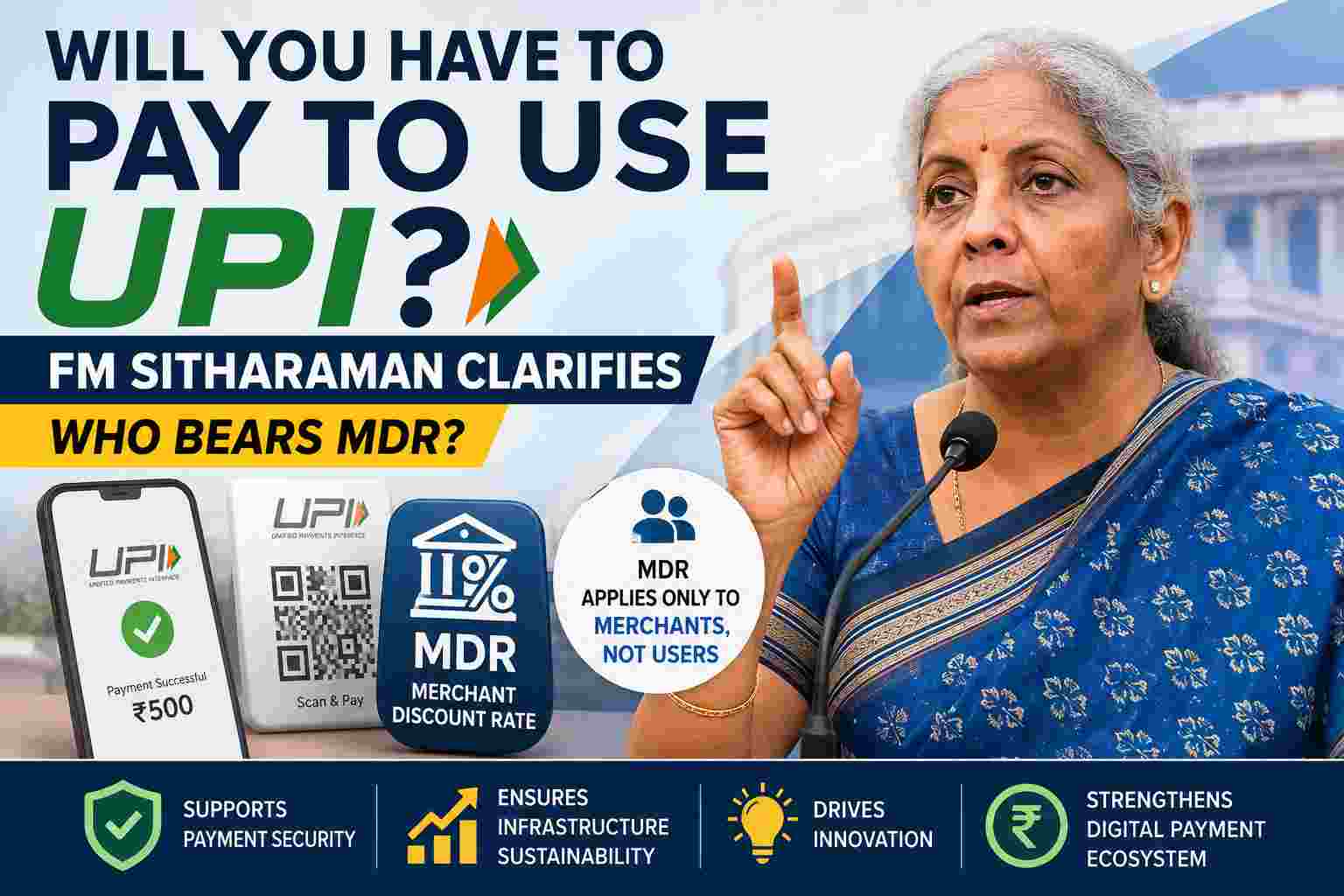
However, Finance Minister Nirmala Sitharaman has clarified that UPI users will not be charged directly if Merchant Discount Rate (MDR) is introduced in the future. According to the Finance Minister, MDR is a charge applicable only to merchants—not customers. She also emphasized that no final decision has been taken regarding the implementation of MDR on UPI transactions.
This article explains what MDR is, why the government is considering changes, what the proposed law means, and how it could affect consumers, merchants, banks, and digital payment companies.
What Is UPI?
Unified Payments Interface (UPI) is India’s real-time digital payment system developed by the National Payments Corporation of India (NPCI). It allows users to instantly transfer money between bank accounts using mobile applications such as Google Pay, PhonePe, Paytm, BHIM, and other UPI-enabled apps.
Since January 2020, UPI transactions have generally been free for both consumers and merchants because the government introduced a zero-MDR policy to encourage digital payments across India. This policy played a significant role in making UPI the country’s most popular payment method.
Today, UPI processes billions of transactions every month and has become an essential part of India’s digital economy.
What Is Merchant Discount Rate (MDR)?
Merchant Discount Rate (MDR) is a fee paid by merchants to banks and payment service providers whenever they accept digital payments.
This fee helps payment companies cover expenses related to:
- Payment processing
- Banking infrastructure
- Fraud prevention
- Cybersecurity
- Technology upgrades
- Customer support
- Innovation in payment systems
Historically, merchants paid MDR for debit card and credit card transactions. However, after the government introduced zero MDR for UPI and RuPay debit card payments in 2020, payment providers stopped receiving this transaction-based revenue from those payment methods.
Why Is MDR Being Discussed Again?
India’s digital payment ecosystem has expanded at an extraordinary pace over the last few years.
While users enjoy free UPI services, banks, fintech companies, and payment service providers continue investing heavily in:
- Server infrastructure
- Payment security
- Fraud monitoring
- Compliance systems
- New technology
- Customer support
Many industry experts believe the current zero-MDR model is financially difficult to sustain over the long term without an alternative revenue source.
For this reason, the government has proposed amendments that would give it the legal authority to introduce MDR for selected digital payment modes in the future if required.
What Did Finance Minister Nirmala Sitharaman Clarify?
Finance Minister Nirmala Sitharaman responded to claims that ordinary citizens may have to start paying for UPI transactions.
She clarified several important points:
- MDR applies only to merchants.
- Customers or end users would not directly pay MDR.
- No final decision has been made on introducing MDR.
- The decision will be considered only after Parliament completes the legislative process.
- The UPI and Services Steering Committee, headed by NPCI, will examine the matter before any implementation.
According to the Finance Minister, any future MDR would help banks and fintech companies strengthen payment infrastructure, improve innovation, and enhance transaction security for all users.
Does the New Bill Introduce UPI Charges Immediately?
No.
One of the biggest misconceptions is that Parliament has already imposed charges on UPI.
That is incorrect.
The proposed amendment does not introduce any fee immediately.
Instead, it creates a legal framework allowing the government to decide later whether specific electronic payment systems should attract Merchant Discount Rate.
In simple terms:
- No immediate UPI charges have been announced.
- The bill only provides future flexibility.
- Any decision would require additional government notification after the law comes into effect.
Will Consumers Have to Pay for UPI Transactions?
Based on the Finance Minister’s clarification, ordinary UPI users are not expected to pay any direct fee.
MDR is designed as a merchant-side charge.
That means:
- Customers sending money through UPI would continue making payments without directly paying MDR.
- Merchants accepting payments may become responsible if MDR is introduced.
However, economists point out that businesses facing higher operating costs could choose to adjust product pricing in the future. Whether this happens would depend on market competition and business decisions rather than the MDR policy itself.
How Could Merchants Be Affected?
If MDR is introduced in the future:
Large businesses may:
- Pay a small percentage on eligible UPI transactions.
- Factor payment processing costs into business expenses.
- Continue accepting digital payments because of customer convenience.
Small businesses may:
- Receive exemptions if the government decides to protect smaller merchants.
- Continue benefiting from simplified digital payment acceptance.
Several reports have suggested that any future MDR framework may primarily focus on larger merchants rather than small neighborhood shops, though no final policy has been announced.
Why Do Banks and Fintech Companies Support MDR?
Banks and payment companies argue that maintaining India’s massive digital payment infrastructure requires continuous investment.
Revenue generated through MDR could help fund:
- Better payment security
- Faster transaction processing
- Fraud detection systems
- Artificial intelligence-based risk monitoring
- Infrastructure expansion
- Innovation in digital payment technologies
Supporters believe this could make India’s digital payment ecosystem more sustainable over the long term.
What Happens Next?
Before any MDR policy can be implemented:
- Parliament must complete the legislative process.
- The amended law must come into force.
- The government must issue any required notification.
- The NPCI-led steering committee will review and decide the MDR framework.
- Details such as eligible transactions, merchant categories, exemptions, and applicable rates would need to be officially announced.
Until these steps are completed, UPI users should not assume that charges have been imposed.
Frequently Asked Questions (FAQs)
Is UPI becoming paid?
No. There is currently no decision requiring users to pay for UPI transactions.
Will customers pay MDR?
According to Finance Minister Nirmala Sitharaman, MDR is meant for merchants, not customers.
Has the government already imposed UPI charges?
No. The proposed amendment only creates legal authority for future decisions. It does not introduce charges by itself.
Why is the government considering MDR?
The aim is to create a financially sustainable digital payment ecosystem that supports infrastructure, security, and innovation.
Will small merchants have to pay?
No final framework has been announced. Reports indicate the government may consider protecting smaller merchants, but official rules are yet to be released.