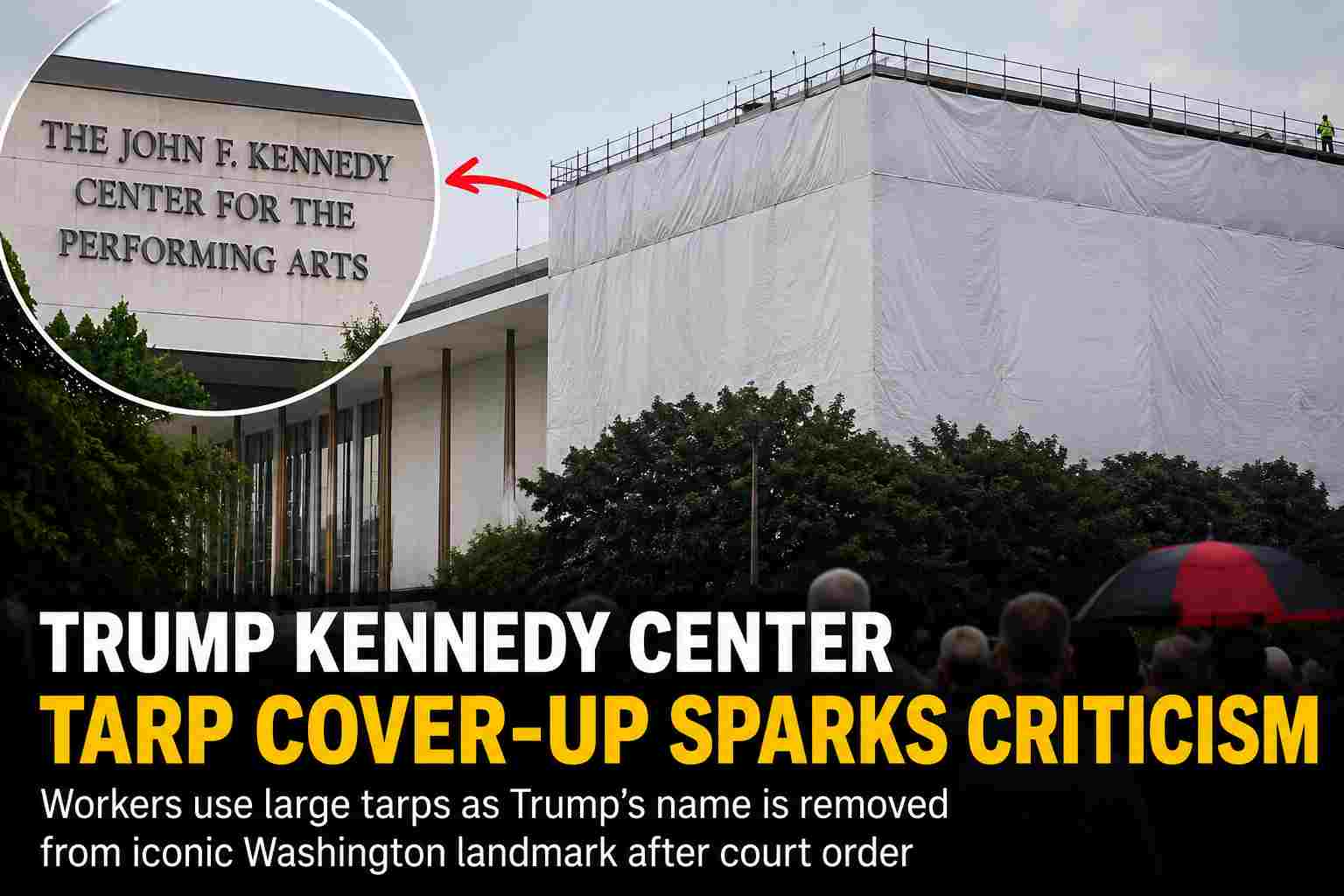
The removal of Donald Trump’s name from the John F. Kennedy Center for the Performing Arts has sparked a new controversy after workers used large tarps to conceal the operation from public view. Images and videos of the covered scaffolding quickly spread online, leading to criticism and renewed debate over the highly disputed rebranding of one of America’s most important cultural institutions.
Trump’s Name Removed Following Court Orders
Workers began removing Donald Trump’s name from the Kennedy Center facade in Washington, D.C., after federal courts ruled that the renaming was not legally authorized. Judges determined that only Congress has the authority to officially change the name of the national memorial dedicated to President John F. Kennedy. Appeals seeking to delay the order were rejected, leaving the Kennedy Center with no option but to comply.
The removal operation took place during the early hours of the morning. Scaffolding was erected around the building, and a large white tarp was placed over the work area, preventing observers from seeing the letters being taken down.
Why the Tarps Sparked Criticism
Although the physical removal itself had already attracted public attention, the use of tarpaulin coverings generated a wave of criticism on social media and among spectators gathered outside the venue.
Critics argued that hiding the process created the appearance of secrecy and symbolism. Some commentators described the move as an attempt to shield an embarrassing moment from public view, while others mocked the operation as unnecessary. Videos showing the covered scaffolding quickly circulated online, with users making sarcastic remarks and questioning why the work needed to be concealed.
People present outside the Kennedy Center reportedly shouted phrases such as “Cover up!” and “Cowards!” while watching workers carry out the court-ordered removal.
Background Behind the Kennedy Center Renaming
The controversy began in late 2025 when a Trump-appointed board voted to rename the institution the “Donald J. Trump and John F. Kennedy Memorial Center for the Performing Arts.”
The decision triggered strong reactions from lawmakers, artists, and cultural organizations. Critics argued that the move violated federal law and undermined the Kennedy Center’s historic identity as a memorial honoring President John F. Kennedy.
Representative Joyce Beatty filed a legal challenge, arguing that the board lacked the authority to alter the institution’s official name. Federal Judge Christopher Cooper later agreed, ruling that only Congress possesses the power to make such changes.
Kennedy Center Already Removed Trump’s Name Online
Before workers began dismantling the exterior lettering, the Kennedy Center had already started removing references to Trump’s name from its website, social media accounts, and official documents in preparation for complying with the court ruling.
Executive Director Matt Floca later confirmed that all required changes had been completed and that the institution had fully followed the court’s instructions.
Public Reactions Highlight Deep Political Divisions
The event drew crowds despite rainy weather and thunderstorms. Supporters of the court ruling celebrated the removal as a restoration of the Kennedy Center’s original identity, while critics of the decision argued that Trump’s leadership had helped attract donors and support renovation plans for the aging complex.
The dispute has become part of a larger debate over Trump’s influence on Washington institutions and his efforts to reshape several cultural and government landmarks. Plans for extensive renovations and governance changes at the Kennedy Center have also faced lawsuits and public scrutiny.
Future of the Kennedy Center Remains Uncertain
While the building’s historic name has now been restored, questions remain about the center’s long-term direction. Renovation proposals, management changes, and continuing political disputes have left uncertainty surrounding the institution’s future.
For now, however, the iconic venue once again officially bears the name of President John F. Kennedy, bringing an end to one of the most controversial chapters in the history of America’s national performing arts center.