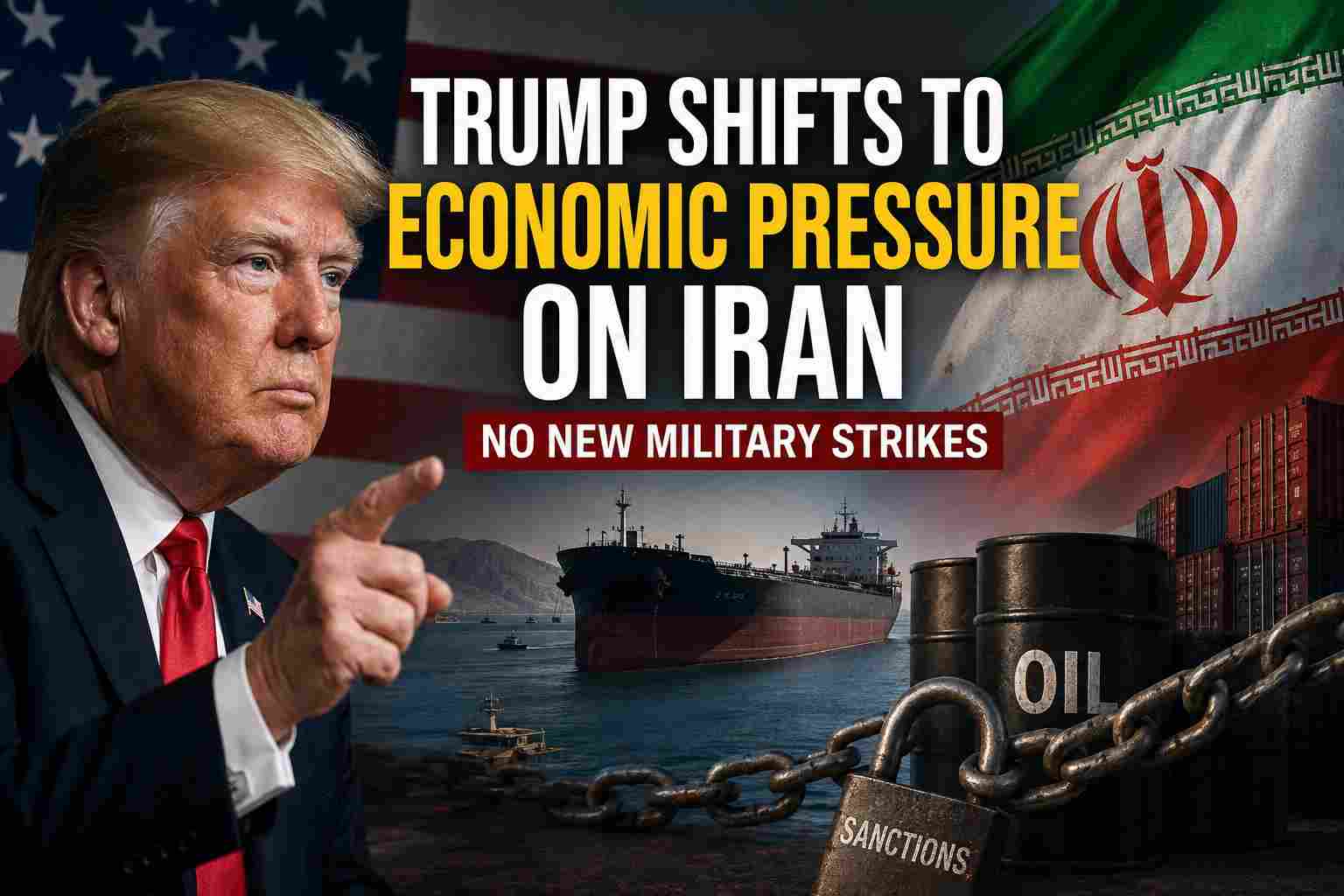
US President Donald Trump has indicated that Washington is increasingly relying on economic pressure rather than launching another major round of military strikes against Iran, signaling a possible change in the way the United States is trying to force Tehran toward an agreement.
In an interview reported on August 9, Trump described the current US approach as relatively restrained and said Washington was watching the effects of economic pressure on Iran. His comments come after months of conflict, sanctions and a US naval blockade that have placed additional strain on Iran’s economy.
The shift does not mean tensions between Washington and Tehran have ended. Military activity, disagreements over the Strait of Hormuz, sanctions and unresolved diplomatic demands continue to make the situation highly uncertain.
Trump Puts Greater Emphasis on Economic Pressure
Trump’s latest comments suggest that the United States may be giving economic measures more time to produce results rather than immediately expanding military operations.
The US president has pointed to the worsening financial conditions inside Iran as evidence that the pressure campaign is having an impact. He has cited high inflation and growing difficulties facing the Iranian government as part of his argument for maintaining economic pressure.
According to reporting on the interview, Trump said the United States was monitoring the economic consequences of the conflict rather than aggressively pursuing another immediate military escalation.
This approach gives Washington another way to pressure Tehran while potentially reducing the risks associated with expanding direct military operations.
Why the US Naval Blockade Matters
A major part of Washington’s strategy is the naval blockade that has been in place since April.
The blockade has placed additional pressure on Iran by restricting maritime activity and affecting the country’s ability to operate normally through important regional shipping routes. Trump has presented the blockade as one of the factors contributing to Iran’s economic difficulties.
For Iran, the economic consequences are particularly significant because the country depends heavily on energy exports and international trade. Restrictions affecting shipping can increase the cost and difficulty of moving oil and other goods while adding further pressure to an already strained economy.
For Washington, meanwhile, economic pressure offers a way to influence Tehran without immediately committing to a wider military campaign.
Strait of Hormuz Remains at the Center of the Crisis
One of the biggest unresolved issues is the Strait of Hormuz, a strategically important waterway connecting the Persian Gulf with the Gulf of Oman.
The strait is critical to global energy markets because large volumes of oil and other energy products move through the region. Any prolonged disruption can create concerns about supply, transportation costs and energy prices around the world.
Talks involving Oman have focused on reopening the waterway to commercial shipping. Recent discussions have reportedly moved toward arrangements concerning a new shipping route and the coordinates that vessels could use. Iran’s foreign ministry has indicated that negotiations had reached an advanced stage.
However, Tehran has linked a full reopening of the waterway to broader demands directed at the United States.
Iran has called for Washington to change its approach, including demands connected to the naval blockade, military operations and compensation for wartime damage. These conditions remain a major obstacle to reaching a comprehensive agreement.
Why Oil Prices Are Important for Trump
The economic impact of the Iran conflict is not limited to Iran.
Any prolonged disruption around the Strait of Hormuz can affect international oil markets because traders closely watch developments in one of the world’s most important energy corridors.
However, oil prices have recently stabilised compared with earlier periods of heightened concern. Al Jazeera reported that prices were trading slightly above $75 a barrel, reducing some of the immediate pressure on US consumers.
That development could make it easier for the Trump administration to maintain economic pressure on Iran.
If energy prices remain relatively stable, Washington may have greater room to pursue sanctions and other economic measures without facing the same level of domestic pressure that could arise from a sharp increase in gasoline and energy costs.
Iran’s Economic Problems Are Becoming a Key Part of US Strategy
The economic situation inside Iran has become an increasingly important part of Washington’s calculations.
US pressure is aimed at making it more difficult for Tehran to finance its government, military activities and international operations. Sanctions and restrictions on trade can affect government revenues, access to foreign currency and the ability of businesses to operate internationally.
Trump has argued that Iran is already experiencing severe economic difficulties.
However, economic pressure does not automatically guarantee a political agreement. Governments under sanctions can sometimes respond by changing trade routes, seeking alternative partners, tightening domestic controls or refusing to make concessions that they consider unacceptable.
That means the effectiveness of Washington’s strategy will depend not only on how much economic damage Iran experiences, but also on whether Tehran believes making concessions is preferable to continuing the confrontation.
Previous Ceasefire Failed to Resolve the Main Disputes
The current situation follows a ceasefire that was reached in June but later collapsed.
Disagreements over control and access to the Strait of Hormuz became part of the wider dispute, contributing to the resumption of fighting. Since then, the conflict has continued through a combination of military activity, economic restrictions and diplomatic efforts.
Iran has also continued intermittent attacks against US bases in countries including Kuwait, Bahrain and Jordan, according to Al Jazeera’s reporting.
The wider regional dimension adds another layer of uncertainty. Groups aligned with Tehran have also taken actions affecting maritime security and regional shipping, increasing concerns about whether the conflict could spread beyond direct US-Iran confrontation.
US and Israel May Not Have Identical Priorities
Another important factor is the relationship between Washington and Israel.
Recent reporting has indicated differences over how quickly the United States should seek to reduce fighting across several regional fronts, including Gaza and Lebanon.
A greater US focus on economic pressure could therefore have implications beyond the US-Iran relationship.
If Washington wants to limit further military escalation while using sanctions and diplomatic pressure to reach an agreement, it may face difficult decisions about how closely its strategy should align with Israel’s security objectives.
The situation could become particularly complicated if military incidents continue while diplomatic negotiations remain unresolved.
What Trump’s Economic Strategy Could Mean for Iran
If Washington continues prioritising economic pressure, several consequences are possible.
1. Greater pressure on Iran’s finances
Continued sanctions and restrictions could further limit Iran’s access to international financial networks, foreign currency and export revenues.
2. More pressure on the Iranian government to negotiate
If economic difficulties become severe enough, Tehran could face stronger incentives to reach an agreement with Washington.
3. Increased pressure on ordinary consumers
Economic sanctions and disruptions to trade can also affect households through higher prices, shortages and reduced purchasing power. The economic consequences of the conflict therefore extend beyond governments and military institutions.
4. Continued uncertainty for energy markets
Even if oil prices remain stable for now, any major development around the Strait of Hormuz could quickly change market expectations.
5. Greater importance for diplomacy
If Washington is deliberately avoiding another major military escalation, negotiations could become increasingly important in determining the next stage of the conflict.
What Happens If the Strait of Hormuz Remains Restricted?
The future of the Strait of Hormuz could become one of the most important indicators of whether the current pressure strategy is succeeding.
A sustained reopening would reduce some of the risks facing international shipping and energy markets. It could also create an opportunity for broader negotiations between Washington and Tehran.
On the other hand, continued restrictions or a renewed escalation could increase pressure on global shipping and energy markets.
For businesses involved in oil, transportation, shipping and international trade, the situation remains particularly important because even the expectation of disruption can influence prices and insurance costs.
Is the US Moving Away From Military Action?
Trump’s latest comments suggest a preference for allowing economic pressure to work before pursuing another major military operation.
However, it would be premature to interpret the remarks as the end of the military dimension of the conflict.
The United States continues to have military capabilities in the region, while Iran has continued military activity and has maintained demands that Washington change its current policies.
Trump’s comments therefore appear to represent a shift in emphasis rather than a complete end to military pressure. The administration is giving economic and diplomatic tools greater importance while keeping the broader confrontation unresolved.
The Bigger Economic Picture
The Iran crisis has developed into more than a conventional military confrontation. It is also an economic struggle involving sanctions, oil exports, maritime trade, shipping routes and international energy markets.
For the United States, economic pressure can potentially weaken Iran without the immediate costs and risks of expanding military operations.
For Iran, however, accepting US demands could have significant political and strategic consequences. Tehran has therefore continued to push for its own conditions, including changes to US military and economic policies.
The outcome will depend heavily on whether both sides can find enough common ground to reopen negotiations and resolve the dispute over the Strait of Hormuz.
What to Watch Next
Several developments will be particularly important in the coming days and weeks:
- US-Iran negotiations: Whether indirect talks make meaningful progress.
- Strait of Hormuz: Whether a practical arrangement for commercial shipping is reached.
- US sanctions: Whether Washington introduces additional economic restrictions.
- Oil prices: Whether energy markets remain stable or react to renewed tensions.
- Military activity: Whether either side resumes major attacks.
- Regional involvement: Whether attacks or maritime restrictions expand to other countries.
- US-Israel coordination: Whether differences emerge over the pace of de-escalation.
Each of these factors could influence whether the conflict moves toward diplomacy or another period of military escalation.