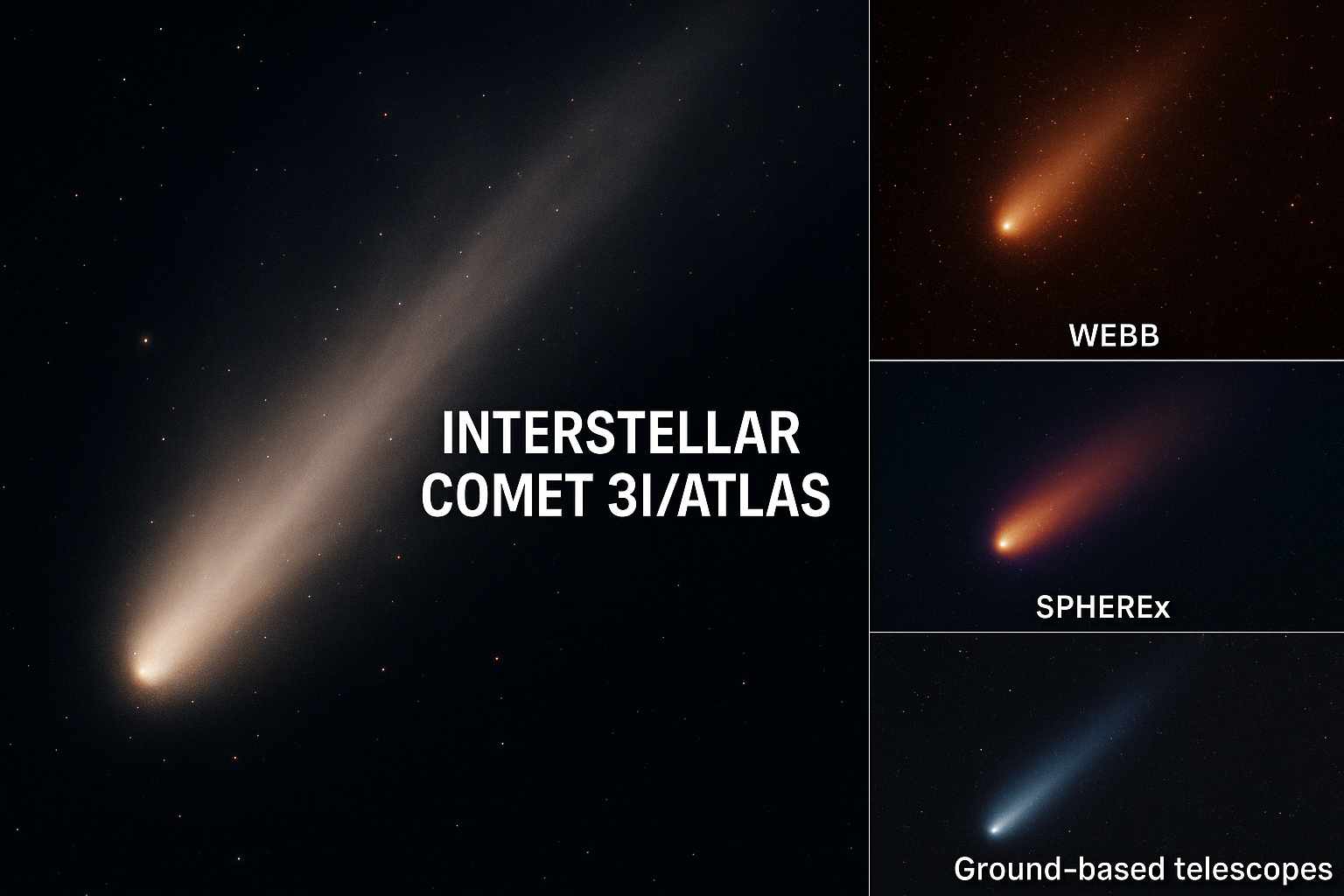
NASA has announced a special live event to share a wealth of new imagery of Comet 3I/ATLAS, the interstellar comet that has captured the world’s attention. Collected from a suite of NASA spacecraft and Earth-based telescopes, these observations are giving us one of the most comprehensive looks yet at this rare visitor from beyond our solar system.
What Is Comet 3I/ATLAS?
Comet 3I/ATLAS is only the third interstellar object ever confirmed to enter our solar system — meaning it did not originate within our Sun’s orbit but came from deep space. It was discovered by the ATLAS (Asteroid Terrestrial-impact Last Alert System) survey telescope on July 1, 2025. Because of its hyperbolic trajectory, scientists are especially interested in its properties.
According to NASA, 3I/ATLAS will not come dangerously close to Earth — its closest approach is around 170 million miles. It recently made a perihelion (closest approach to the Sun) at about 1.4 AU, just inside the orbit of Mars.
Why These Images Are Significant
This campaign of observations is remarkable because NASA is using a diverse fleet of instruments to observe the comet from many angles and wavelengths. Some of the key assets involved include:
-
Hubble Space Telescope: On July 21, 2025, Hubble imaged the comet when it was ~277 million miles from Earth. The image revealed a teardrop-shaped dust cocoon around a solid icy nucleus.
-
James Webb Space Telescope (JWST): Webb’s Near-Infrared Spectrograph (NIRSpec) detected a coma dominated by carbon dioxide, along with water ice, CO, and other molecular signatures.
-
SPHEREx Mission: This mission observed the comet over a span of days, providing crucial spectral data on its composition.
-
Mars-Orbiting Assets & Rovers: Instruments on spacecraft around Mars and rovers on the surface are also contributing observations, enabling a multi-perspective study.
-
Ground-based Telescopes: In addition to space telescopes, ground observatories are participating, giving complementary data.
New Insights from the Images
From the combined observations, scientists are learning a lot about what makes 3I/ATLAS special:
-
High CO₂ Content: Webb data suggests the comet’s coma is unusually rich in carbon dioxide compared to typical solar system comets.
-
Dust and Ice Structure: Hubble’s images show a solid, icy nucleus wrapped in a dense envelope of dust — a “cocoon” that may be actively shedding material.
-
Trajectory and Origin: Its hyperbolic path confirms its interstellar origin, making it a precious sample from outside our solar system.
-
Physical Size: Based on Hubble and other measurements, the estimated diameter of 3I/ATLAS’s nucleus could be anywhere between 0.44 km and up to 5.6 km, though different methods yield different bounds.
The Upcoming NASA Live Event
To share these groundbreaking images, NASA is hosting a live event on Nov 19, 2025, at 3 p.m. EST from the Goddard Space Flight Center. The event will stream on NASA+, the official NASA website, and YouTube, and even on Amazon Prime.
Key participants include:
-
Amit Kshatriya, NASA Associate Administrator
-
Nicky Fox, Associate Administrator of the Science Mission Directorate
-
Shawn Domagal-Goldman, Acting Director of the Astrophysics Division
-
Tom Statler, Lead Scientist for Solar System Small Bodies
During the event, both members of the public and media will have opportunities to ask questions (via #AskNASA on social media).
Why This Matters for Science
Studying 3I/ATLAS is a unique opportunity:
-
Window into Other Star Systems: Since it comes from outside our solar system, its composition may reflect the conditions in its parent star system.
-
Comet Diversity: Observing how this comet behaves (gas production, tail formation, outgassing) could expand our understanding of what interstellar comets are made of, and how they differ from comets born in our own system.
-
Interdisciplinary Collaboration: The wide variety of instruments—space telescopes, Mars spacecraft, ground observatories—demonstrates how modern astronomy brings together many missions to study a single object.
Key Challenges & Open Questions
Even with this wealth of data, many mysteries remain:
-
Why is the CO₂-to-water ratio so high in its coma? Does it indicate a very different formation environment?
-
How stable is the dust cocoon seen by Hubble? Is it shedding rapidly, or is it more persistent?
-
Will more high-resolution data from Mars orbiters or rovers be released soon? Some reports suggest that images captured during its Mars flyby may not yet be publicly released.