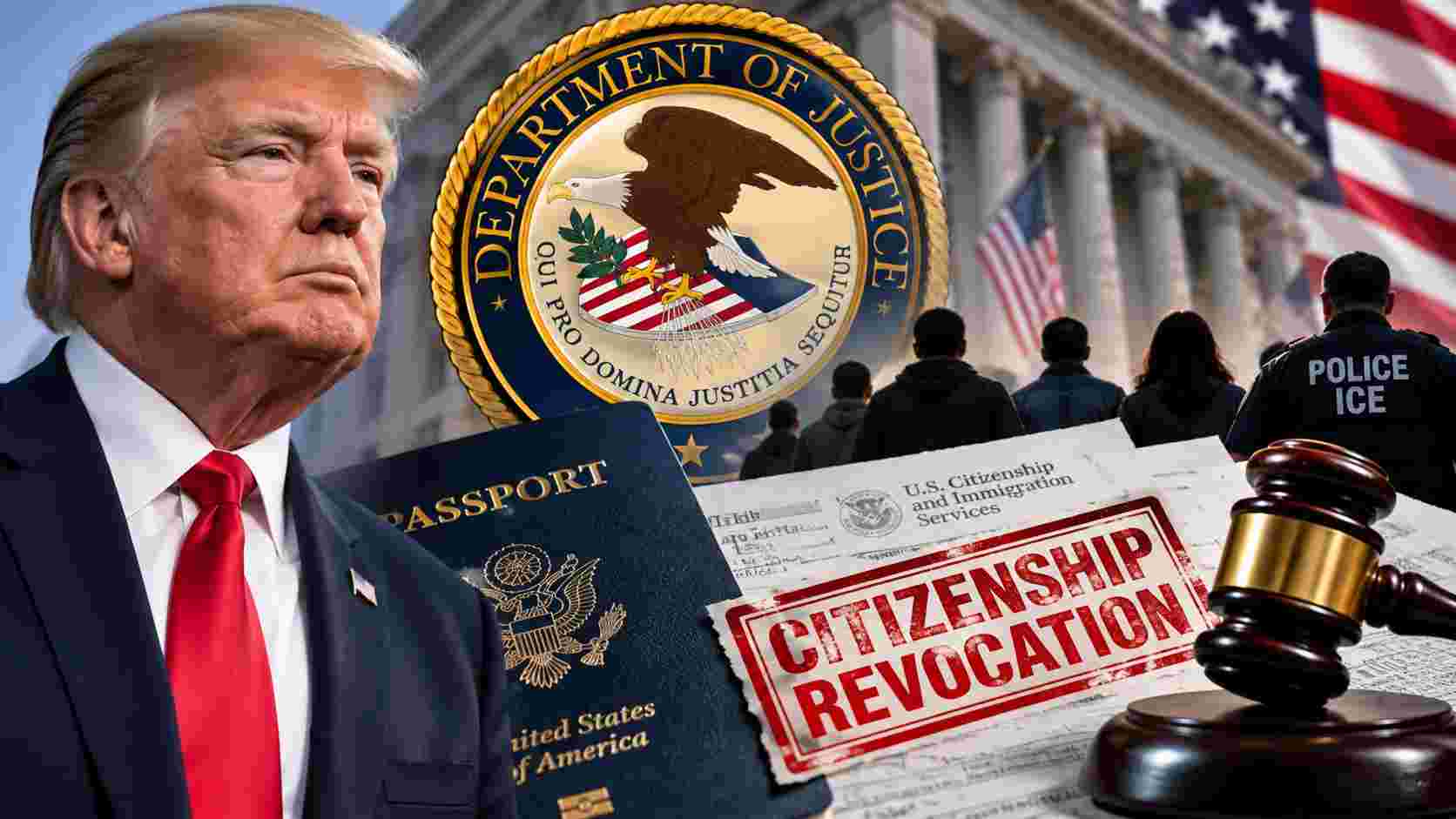
The U.S. Department of Justice has launched a new wave of denaturalization cases against 40 naturalized Americans, marking one of the most significant coordinated efforts in recent years to revoke citizenship that the government alleges was obtained unlawfully.
The Justice Department announced the cases on October 5, 2026, saying the individuals are accused of obtaining U.S. citizenship through fraud, concealment of material information, willful misrepresentation or other circumstances that allegedly made them legally ineligible for naturalization. The cases were filed across federal courts around the United States.
The cases involve a wide range of alleged conduct, including immigration and identity fraud, undisclosed criminal activity, financial crimes, sexual offenses, tax fraud and national-security-related offenses.
Importantly, filing a denaturalization complaint does not mean that the defendants have already lost their citizenship. These are civil court proceedings, and the Justice Department must establish the legal grounds for revocation. The DOJ itself emphasized that the claims contained in the complaints are allegations and that there has not yet been a determination of liability in these cases.
What the Justice Department Announced
According to the Justice Department, the latest group consists of 40 naturalized U.S. citizens whose cases were filed in federal district courts across the country.
The department described the filings as the largest volume of denaturalization complaints submitted during a single period under the current Trump administration. The cases span 19 federal judicial districts, including courts in California, Florida, Texas, Virginia, Maryland, Arizona, Georgia, Colorado, New York, Pennsylvania, Ohio, Indiana, Connecticut and Washington, D.C.
The DOJ says the central issue in the cases is not simply whether a naturalized citizen later committed a crime. Instead, prosecutors generally allege that relevant criminal conduct, immigration history, identities or other material facts existed before or during the naturalization process and were concealed or misrepresented, or that the individual otherwise was not legally eligible to naturalize.
That distinction is important because naturalized citizenship cannot ordinarily be revoked merely because someone commits a crime after becoming a citizen.
What Is Denaturalization?
Denaturalization is the legal process through which the U.S. government seeks to revoke citizenship previously granted through naturalization.
Under 8 U.S.C. § 1451, the federal government may bring proceedings to revoke naturalization when it alleges that citizenship was “illegally procured” or obtained through concealment of a material fact or willful misrepresentation.
In practical terms, the government may attempt to show that a person was never legally eligible for naturalization in the first place, or that important information was deliberately hidden or falsely presented during the immigration and citizenship process.
The Justice Department’s Office of Immigration Litigation is responsible for coordinating and handling federal civil denaturalization litigation.
A federal judge, rather than the executive branch acting alone, ultimately decides a civil denaturalization case.
Cases Include Espionage and National-Security Allegations
Among the most prominent individuals in the latest group is Jinchao Wei, a China-born former U.S. Navy sailor.
Wei enlisted in the Navy in 2021 and obtained U.S. citizenship in May 2022 through provisions allowing expedited naturalization for qualifying members of the armed forces.
According to the Justice Department, Wei began conspiring to sell U.S. military information to China before receiving citizenship. He was later convicted in August 2025 of offenses including espionage and conspiracy to commit espionage and received a 200-month prison sentence.
The government is now seeking to revoke his citizenship, alleging, among other grounds, that his naturalization was illegally obtained and that material information was concealed during the process.
Another case involves Ping Li, a China-born naturalized citizen. The Justice Department says Li pleaded guilty in 2024 to conspiring to act as an agent of the Chinese government without notifying the U.S. attorney general.
Federal authorities alleged that Li provided information to China’s Ministry of State Security concerning subjects including Chinese dissidents, pro-democracy advocates and U.S.-based organizations. The government is now asking a federal court to revoke his naturalization.
Identity and Immigration Fraud Are Major Parts of the Cases
A substantial number of the complaints involve alleged false identities, previous deportation proceedings, fraudulent marriages or immigration histories that prosecutors say were hidden from authorities.
One case involves Balwinder Singh, a native of India. The Justice Department alleges that Singh used different identities in immigration applications before eventually obtaining permanent residence and becoming a U.S. citizen in 2009.
According to the DOJ, fingerprint evidence connected the applications, and the government has filed a seven-count complaint seeking revocation of his citizenship based on alleged misrepresentations and unlawful acts.
Another case involves Ahmad Bahar Khattak, a Pakistan-born naturalized citizen. The government alleges that he used multiple identities over several decades and failed to disclose a previous exclusion order when later obtaining immigration benefits and citizenship.
The allegations have not yet been established as liability in the denaturalization proceeding.
Other cases similarly involve accusations that defendants concealed previous deportation orders, used fraudulent documents, entered sham marriages or misrepresented family relationships in order to obtain permanent residency and eventually citizenship.
Criminal Conduct Before Naturalization Is Another Focus
Several cases involve people who were convicted after becoming citizens for conduct that the government says occurred before or during their naturalization process.
The timing matters.
For example, the government is seeking to denaturalize Norma Patricia Esparza, a Mexico-born naturalized citizen. According to the DOJ, Esparza committed conduct leading to a voluntary manslaughter conviction before becoming a citizen but failed to disclose the relevant conduct during naturalization proceedings. She was convicted after becoming a citizen and sentenced to six years in prison.
Another defendant, Juan Jose Egusquiza-Vasquez, was convicted in 2013 of sexual battery involving a minor. The DOJ says the underlying conduct occurred in 2008, before he applied for naturalization in 2010 and became a citizen in 2011.
The government alleges that he concealed the conduct when answering questions about whether he had committed an offense for which he had not been arrested.
The latest cases also include defendants whose underlying conduct involves tax fraud, money laundering, securities fraud and other offenses.
Financial Fraud Cases Are Also Included
The Justice Department is not limiting its denaturalization strategy to violent crimes or national-security matters.
Ralph Nabavi, an Iran-born naturalized citizen, is among the defendants targeted in the latest round.
The DOJ says Nabavi pleaded guilty after being charged with tax evasion involving millions of dollars in income. According to the department, the conduct began before he became a U.S. citizen in 2014.
The government alleges that the criminal conduct and statements made during the naturalization process meant that he failed to satisfy citizenship requirements and concealed material information.
Arnouse Merlien, a Haiti-born naturalized citizen, is another defendant. The Justice Department says she participated in a tax-refund fraud conspiracy during the period leading up to her 2016 naturalization and was later convicted.
Again, the relevant question in the denaturalization proceeding will be whether the legal requirements for revoking her naturalization are established in federal court.
Trump Administration Has Expanded Denaturalization Enforcement
The latest cases are part of a much broader denaturalization campaign under President Donald Trump’s administration.
In June 2025, the Justice Department’s Civil Division issued an enforcement memorandum instructing attorneys to prioritize and “maximally pursue” legally supportable denaturalization cases.
The policy identified multiple priority categories, including national-security cases, war crimes and human-rights violations, gang and cartel activity, undisclosed felonies, human trafficking and sex offenses, violent crime, financial fraud and cases involving material misrepresentations during naturalization.
The expansion became increasingly visible during 2026.
On June 8, the Justice Department announced denaturalization actions against 17 naturalized citizens. Another 10 cases were announced in July. On August 3, the DOJ announced 25 additional complaints and said that 123 civil denaturalization complaints had been filed since January 20, 2025 — which it described at the time as the most in recorded department history.
The latest group of 40 cases demonstrates that the administration’s denaturalization initiative is continuing to expand.
Can the Government Simply Take Away Someone’s U.S. Citizenship?
No. A Justice Department announcement or complaint does not by itself cancel a naturalized citizen’s citizenship.
For civil denaturalization, the government must go to federal court and establish a legally recognized basis for revocation.
Federal law permits revocation when naturalization was illegally procured or when citizenship was obtained through concealment of a material fact or willful misrepresentation.
U.S. Supreme Court precedent has also imposed important limits on the government’s ability to revoke citizenship.
In Maslenjak v. United States, the Supreme Court addressed the relationship between false statements and obtaining naturalization, explaining in the criminal-denaturalization context that a falsehood must have a meaningful connection to the acquisition of citizenship — for example, because truthful disclosure would have resulted in denial or would have led officials to discover disqualifying information.
Legal scholars and civil-rights advocates have emphasized that citizenship carries especially strong constitutional protections. The Brennan Center for Justice notes that courts have historically required a demanding evidentiary showing in civil denaturalization proceedings because of the seriousness of taking away citizenship.
Does This Affect All Naturalized U.S. Citizens?
The filing of these cases does not mean that naturalized Americans generally face automatic review or loss of citizenship.
The legal focus of denaturalization is whether citizenship was unlawfully obtained or whether material facts were concealed or intentionally misrepresented during the process.
The Justice Department’s own guidance says decisions to pursue civil denaturalization should depend on the facts and circumstances of individual cases and that not every case potentially falling within a priority category necessarily warrants litigation.
Naturalized Americans also possess the same fundamental U.S. citizenship status as other citizens once they have lawfully completed naturalization. Denaturalization is an exceptional legal remedy requiring a federal legal process rather than an administrative decision simply canceling someone’s citizenship.
What Happens to the 40 Defendants Now?
The newly filed complaints begin or continue federal civil litigation rather than immediately terminating citizenship.
The defendants can contest the government’s allegations and legal arguments in court. Judges will then determine whether the Justice Department has met the legal standard required to revoke each person’s naturalization.
Outcomes therefore may differ significantly from case to case.
Some defendants named by the DOJ have already been convicted of separate criminal offenses, while other portions of the government’s denaturalization claims remain allegations that must be established in the civil proceedings.
That distinction is particularly important when reporting on the cases: a criminal conviction already entered by a court is different from the government’s separate allegation that the conviction, underlying conduct, immigration history or statements made during naturalization legally justify revoking citizenship.
Why the Latest Cases Matter
The October filings represent another major escalation in the federal government’s use of denaturalization as an immigration and law-enforcement tool.
Historically, denaturalization has been comparatively uncommon in modern America. The Brennan Center reports that from 1990 through 2017, the United States averaged about 11 denaturalization cases per year, with many involving concealed serious criminal activity or human-rights violations.
That makes the scale and pace of the current campaign notable.
The Trump administration argues that aggressive enforcement is necessary to protect the integrity of U.S. citizenship and prevent people who allegedly obtained naturalization through fraud or concealment from retaining citizenship.
At the same time, the growing use of denaturalization is likely to remain under close legal scrutiny because citizenship is one of the most consequential legal statuses the federal government can seek to revoke.
For the 40 people named in the latest Justice Department announcement, the immediate development is therefore not that their citizenship has already been taken away. Rather, the federal government has asked courts to determine whether the circumstances under which they obtained naturalization meet the strict legal requirements for revoking it.
The cases will now move through federal courts, where the government’s allegations, supporting evidence and each defendant’s response will determine whether any individual ultimately loses U.S. citizenship.