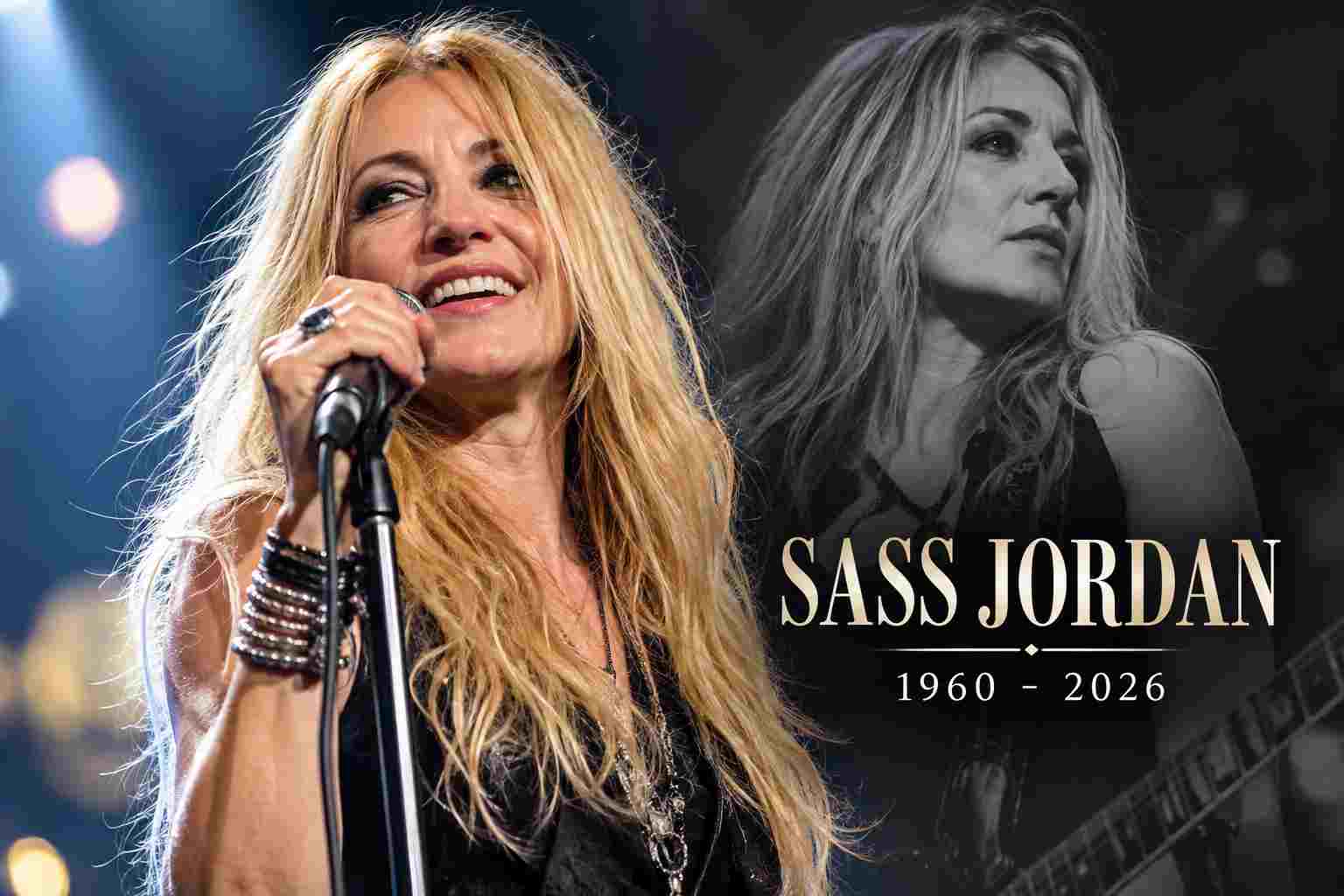
Canadian rock and blues singer Sass Jordan, whose powerful vocals and commanding stage presence made her one of the most recognizable voices in Canadian rock, has died at the age of 65.
Jordan died peacefully on October 2, 2026, surrounded by loved ones, according to a statement from her family. The family remembered her as an extraordinary source of energy and joy whose influence extended well beyond her recordings and performances.
A cause of death has not been publicly disclosed.
Her death comes only weeks after her team announced that she was stepping away from professional commitments for the remainder of 2026 because of what was described as a serious medical condition. Several scheduled performances were subsequently cancelled so she could focus on her health and recovery. No further details about that condition were released publicly.
Jordan leaves behind a career spanning nearly four decades, including hit rock records, a JUNO Award, international touring, acting work, a memorable run as a judge on Canadian Idol and a later-career return to the blues.
Who Was Sass Jordan?
Born Sarah Jordan on December 23, 1960, in Birmingham, England, Jordan moved to Montreal with her family when she was three years old. Montreal would become central to both her identity and her development as a musician.
She began singing and playing guitar while still young and was performing with bands in Montreal clubs by her teenage years. Before becoming a solo artist, Jordan worked with musicians in the local scene and developed experience as both a singer and songwriter.
Her recording career began taking shape during the 1980s. She contributed vocals to other projects and gained early songwriting recognition before turning her attention toward establishing herself as a solo performer.
That decision would eventually make her one of the most prominent female rock singers to emerge from Canada during the late 1980s and early 1990s.
‘Tell Somebody’ Launched Sass Jordan’s Solo Career
Jordan’s debut solo album, Tell Somebody, was released in 1988.
The record introduced a wider audience to the raspy, blues-influenced rock voice that would become her trademark. Its title track reached No. 11 in Canada, helping Jordan gain national attention and substantial exposure on Canadian music television.
Her breakthrough was recognized by the Canadian music industry the following year.
At the 1989 JUNO Awards, Jordan won Most Promising Female Vocalist of the Year. She would later receive Female Vocalist of the Year nominations in 1990, 1993 and 1995, according to the official JUNO Awards database.
The award helped establish Jordan as an important new voice in Canadian rock at a time when the genre remained heavily male-dominated.
‘Racine’ Became Her Defining Album
Jordan’s career reached another level with her second studio album, Racine.
Released in 1992, the album became the biggest commercial success of her career and produced several songs that became closely associated with her, including “Make You a Believer,” “I Want to Believe,” “You Don’t Have to Remind Me,” “Goin’ Back Again” and “Who Do You Think You Are.”
Billboard Canada reports that Racine sold an estimated 450,000 copies worldwide, including about 100,000 in Canada. “Make You a Believer” reached No. 11 on Billboard’s Mainstream Rock chart.
The success of Racine helped move Jordan beyond the Canadian market and strengthened her reputation internationally.
Her sound combined hard rock with blues, soul and roots influences rather than fitting neatly into a single genre. That mixture, along with her distinctive vocal delivery, became a defining part of her career.
Sass Jordan and Joe Cocker on ‘The Bodyguard’ Soundtrack
Another important moment arrived in 1992 when Jordan recorded “Trust in Me” with Joe Cocker for the soundtrack to The Bodyguard.
The film, starring Whitney Houston and Kevin Costner, produced one of the most successful movie soundtracks of its era and gave Jordan exposure to an enormous international audience.
Her growing profile also led to opportunities to perform alongside or support major rock acts including Aerosmith, The Rolling Stones, AC/DC and Van Halen.
Those appearances placed a Canadian artist who had started in Montreal clubs on stages connected with some of the biggest names in international rock.
‘Rats’ and Another Major Rock Chapter
Jordan followed Racine with Rats in 1994.
Although it did not match the commercial scale of its predecessor, the album produced several notable songs.
“High Road Easy” reached No. 6 on Billboard’s Mainstream Rock chart and No. 9 in Canada, while “Sun’s Gonna Rise” reached No. 7 in Canada and became Jordan’s first appearance on the Billboard Hot 100.
The Rats period also created an important connection between Jordan and a musician who would later become one of rock’s best-known drummers.
Sass Jordan Helped Give Taylor Hawkins an Early Break
A young Taylor Hawkins played drums in Jordan’s touring band during the 1990s, before his later work with Alanis Morissette and his rise to global fame as the drummer for the Foo Fighters.
Hawkins was around 22 when he joined Jordan’s touring band in 1994. The experience became an important early professional opportunity in his career.
The connection remained meaningful years later.
A recording from that period was eventually released as Live in New York Ninety-Four, documenting Jordan’s 1994 touring band with Hawkins on drums. Jordan described the later release as an opportunity to honor Hawkins following his death in 2022.
The relationship is an important part of Jordan’s wider legacy: her influence was not limited to the music released under her own name but also reached younger musicians who worked alongside her.
Sass Jordan Became a Familiar Face on ‘Canadian Idol’
A new generation of Canadians came to know Jordan through television.
When Canadian Idol launched in 2003, Jordan joined the judging panel and remained with the program throughout its six-season run.
Her role expanded her public profile beyond rock audiences and made her familiar to viewers who may not have followed her earlier albums.
Rather than appearing only as a veteran performer looking back on an established career, Jordan became part of a program focused on discovering and evaluating new Canadian singers.
Her experience as a performer, songwriter and touring musician gave her a perspective built from decades of working inside the music business.
Her Career Extended Beyond Albums and Television
Jordan’s creative work was not limited to recording and reality television.
She portrayed Janis Joplin in the stage production Love, Janis and also appeared in productions of The Vagina Monologues. Her career additionally included acting and other television work.
She continued releasing music after her biggest 1990s commercial period, including Get What You Give in 2006 and From Dusk ’til Dawn in 2009.
In 2017, she revisited the album most closely associated with her breakthrough by releasing Racine Revisited, featuring newly interpreted versions of songs from the original record.
Sass Jordan’s Return to the Blues
The later years of Jordan’s recording career brought her increasingly close to the blues influences that had long been present in her singing.
She released Rebel Moon Blues in 2020, an album combining her interpretation of blues material with an original song, “The Key.”
The record debuted at No. 5 on Billboard’s Blues Albums chart, demonstrating that Jordan could still reach new audiences decades after her initial breakthrough.
She followed it with Bitches Blues in 2022.
The two albums represented more than a late-career stylistic experiment. They brought Jordan’s naturally gritty vocal style into a musical setting closely aligned with the blues and roots influences that had shaped her throughout her life.
Health Issues Led to 2026 Concert Cancellations
In September 2026, Jordan’s team announced that she would be unable to continue performing for the remainder of the year.
A statement accompanying the cancellation of a September 17 performance in Dryden, Ontario, said Jordan was dealing with a “serious medical condition” and had been advised to step away from professional commitments to focus on her health and recovery.
Jordan died on October 2.
While the earlier announcement confirms that she had been experiencing a health problem, no official cause of death has been released. It would therefore be inaccurate to claim that a particular illness caused her death unless her family or representatives provide further information.
Tributes Remember a Powerful Voice and Personality
Following news of her death, musicians and others who worked with Jordan began sharing tributes.
Keyboardist Mike Garson, who performed with Jordan during A Bowie Celebration tours, remembered both her unmistakable singing voice and her personality, describing her as a musician with a strong spirit, musical instinct and sense of humor.
Other musicians also highlighted Jordan’s influence on Canadian music and the space she helped create for women in rock.
Her importance came from more than chart positions. Jordan built a career across changing eras of the music industry while moving between hard rock, blues, television, theatre and live performance without abandoning the vocal style that made her immediately recognizable.
Sass Jordan’s Legacy in Canadian Rock
Sass Jordan’s career stretched from Montreal’s club scene to major international tours, hit records and national television.
Tell Somebody established her as a rising Canadian artist. Racine transformed her into a major rock performer. Rats extended that success, while her work with musicians such as Joe Cocker and Taylor Hawkins connected her career to a much broader chapter of rock history.
Later, Canadian Idol introduced her to a new audience, while Rebel Moon Blues and Bitches Blues demonstrated that she was still willing to explore the roots of her sound decades into her career.
Jordan is survived by her husband Derek Sharp, daughter Stella Jordan-Sharp, stepdaughter Brianne Sharp and brother Daniel Jordan, according to her publicist’s statement. Her family has requested privacy while thanking fans for the support and music they shared with her throughout her career.
For Canadian rock, Jordan leaves behind a catalogue shaped by a voice that could move naturally between hard rock, soul and blues—and a career that helped widen the space available to women in the genre.