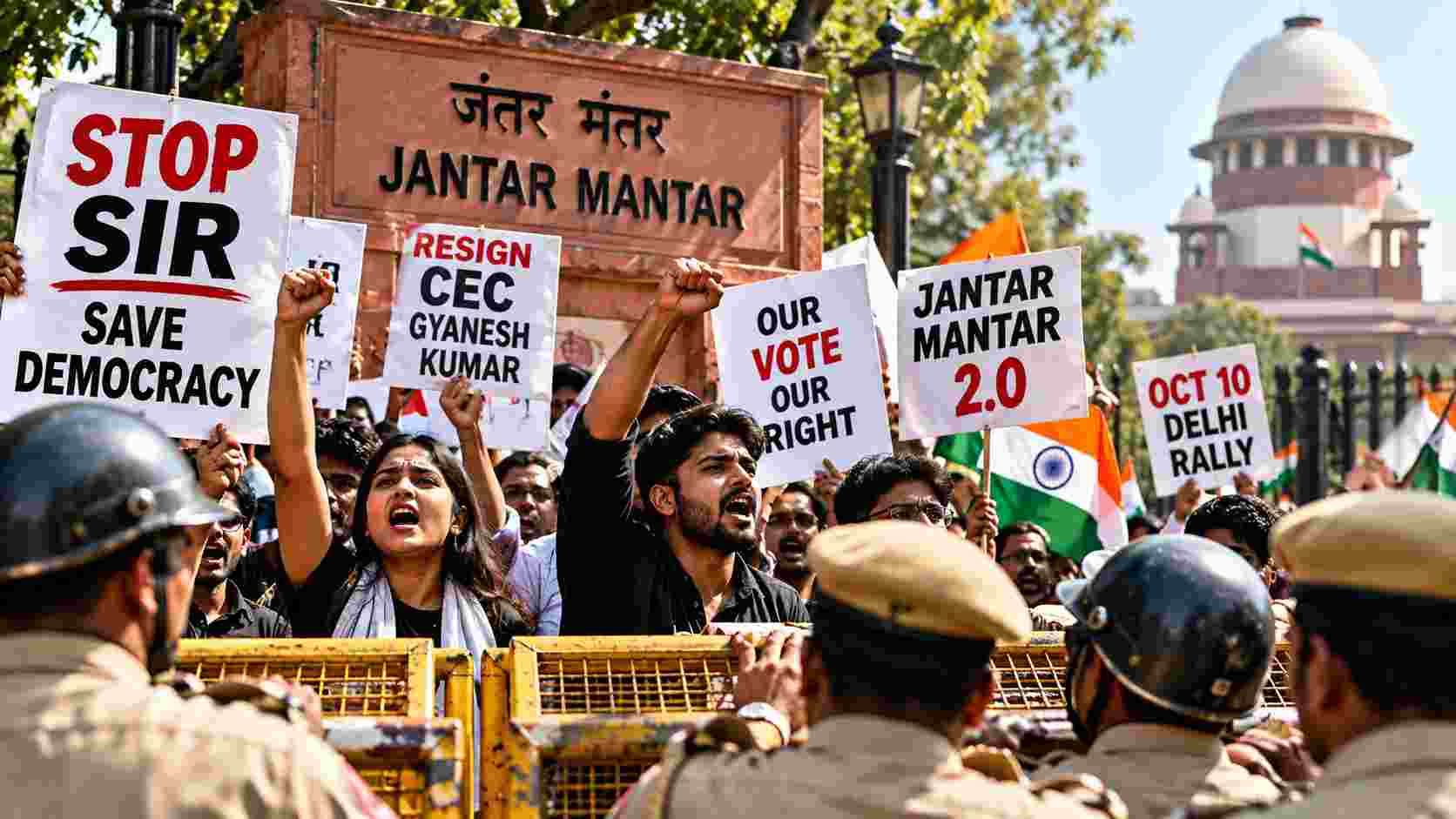
New Delhi, October 5, 2026: A political and youth-led protest over India’s electoral-roll revision has entered a new phase in the national capital, with demonstrators repeatedly attempting to reach Jantar Mantar while police restrictions, barricades and detentions have kept much of the mobilisation on surrounding roads.
The protests, which began in Delhi on October 2, centre on demands for the resignation of Chief Election Commissioner (CEC) Gyanesh Kumar and objections to the Special Intensive Revision (SIR) of electoral rolls. Protesters and opposition groups have alleged that the revision process has resulted in eligible voters being removed from electoral lists and have questioned the Election Commission’s handling of the exercise.
The Election Commission and the Bharatiya Janata Party (BJP) have denied allegations that the voter-roll changes were designed to benefit the ruling party. The Election Commission has defended the revision exercise as part of its responsibility to maintain accurate electoral rolls.
The confrontation has increasingly become about more than the SIR itself. Questions over the right to peaceful protest, the use of prohibitory orders in central Delhi, police handling of demonstrators and the functioning of the Election Commission have all become part of the wider dispute.
Why Are Protesters Gathering Near Jantar Mantar?
Jantar Mantar has long served as one of New Delhi’s best-known locations for political demonstrations and public campaigns. In the latest agitation, however, protesters have repeatedly faced barricades and security deployments before reaching the main protest site.
Delhi Police denied permission for a demonstration planned over the SIR issue and tightened security in central Delhi. Restrictions under Section 163 of the Bharatiya Nagarik Suraksha Sanhita (BNSS) were imposed around the area, limiting unauthorised gatherings, demonstrations and processions.
More than 4,000 police personnel were deployed in and around New Delhi during the initial phase of the mobilisation, according to reports. Multiple layers of barricades were installed around Jantar Mantar and roads including Janpath, Ashoka Road, Sansad Marg and other nearby areas. Drones and CCTV monitoring were also used as part of the security arrangements.
As a result, much of the protest activity has taken place outside or on approaches to the designated protest site rather than inside Jantar Mantar itself.
That distinction has become politically significant: protesters argue that they should be allowed to demonstrate peacefully at a recognised protest venue, while police have cited law-and-order concerns and restrictions on unauthorised gatherings.
Detentions Mark First Days of Protest
The first several days of demonstrations saw repeated confrontations between protesters and security personnel.
On October 2, groups of students, activists, opposition supporters and other demonstrators attempted to move towards Jantar Mantar. Police stopped groups at different points in central Delhi and detained protesters.
Following the demonstrations, Delhi Police registered three FIRs in connection with attempts to hold protests in the area. Two were registered at Parliament Street police station and another at Connaught Place police station.
The following day, the protests continued.
Around 150 people, including All India Students’ Association (AISA) national president Neha Bora, activist Yogendra Yadav and senior advocate Prashant Bhushan, were detained as demonstrators again attempted to reach Jantar Mantar, according to The Indian Express.
The agitation continued for a third consecutive day on October 4. Different groups, including student organisations and political workers, held or attempted marches in central Delhi.
More than 120 people were briefly detained during Sunday’s demonstrations, according to a Hindustan Times report. Police maintained that permission had not been granted for the protests, while protesters accused security personnel of using excessive force. Police said minimum force was used to control the situation.
Reuters reported that thousands of youth protesters and opposition supporters participated in demonstrations in Delhi and Mumbai over the weekend, showing that the dispute had expanded beyond a single protest site.
What Is the SIR Controversy?
At the centre of the agitation is the Special Intensive Revision of electoral rolls.
An electoral-roll revision is intended to update voter lists by adding eligible voters, correcting inaccurate information and removing entries that no longer meet legal requirements.
Critics of the current exercise, however, have alleged that large numbers of legitimate voters have been excluded or placed at risk of exclusion. Opposition groups have also claimed that the process could influence future elections.
Those allegations remain contested.
The Election Commission has rejected accusations of wrongdoing, while the BJP has denied claims that the voter-roll exercise was designed to provide it with an electoral advantage.
The controversy intensified after The Indian Express reported that Election Commissioners Sukhbir Singh Sandhu and Vivek Joshi had recorded objections on at least 14 occasions over approximately 10 months to decisions or orders concerning electoral-roll management.
The reported disagreements involved issues including voter registration and deletion, changes connected with Form 6 and management of electoral-roll systems.
The Election Commission has disputed suggestions that these disagreements meant its final decisions lacked consensus. It has maintained that members can express different views during internal deliberations but that final Commission decisions are taken unanimously.
That distinction is now part of a broader legal debate over how decision-making power should operate within the three-member Election Commission.
Supreme Court Enters the Debate
The controversy reached the Supreme Court on October 5.
Petitions before the court questioned the functioning of CEC Gyanesh Kumar and challenged aspects of the SIR process. Among other issues, petitioners sought scrutiny of whether certain decisions attributed to the Commission had been taken without the required agreement of the other Election Commissioners.
A bench headed by Chief Justice of India Surya Kant considered the matter.
The Supreme Court declined to immediately suspend Gyanesh Kumar through an interim order and sought responses from the Election Commission, including the CEC and the two other Election Commissioners.
The development is significant because the underlying dispute now involves not only street protests but also questions before the country’s highest court about the Election Commission’s institutional decision-making process.
Separately, the Supreme Court on October 5 agreed to list a plea seeking directions to Delhi Police to permit peaceful protests at Jantar Mantar. The plea argued that students, citizens and political representatives were not being allowed to hold peaceful demonstrations. The court agreed to examine the matter after checking whether similar petitions were already pending.
Allegations Involving Treatment of Journalists
Another controversy emerged from the demonstrations after three women journalists accused police personnel of sexual harassment during protest-related police action.
Delhi Police said the complaints had been forwarded to the Crime Branch for a detailed investigation. Authorities have said evidence, including available video and CCTV footage, would be examined as part of the inquiry.
The allegations have added another dimension to the demonstrations, with journalists and protesters gathering outside Parliament Street police station and demanding action.
The allegations remain under investigation and should not be treated as established findings unless confirmed through the inquiry or subsequent legal proceedings.
Why ‘Jantar Mantar 2.0’ Is Gaining Attention
The phrase “Jantar Mantar 2.0” has become associated with plans by the Cockroach Janta Party (CJP), a youth-led organisation that has been mobilising supporters over the Election Commission controversy.
CJP founder Abhijeet Dipke has announced plans for a larger demonstration in Delhi on October 10 if Gyanesh Kumar does not resign.
The organisation says it intends to hold a peaceful protest and has called on supporters from across India to travel to Delhi.
The planned mobilisation follows a large demonstration at Mumbai’s Shivaji Park and several days of protests in Delhi.
CJP has demanded Gyanesh Kumar’s resignation, opposed the SIR exercise and called for changes concerning the institutional framework governing the Election Commission. Its accusations against the CEC and Election Commission are political allegations and have not been established as findings of wrongdoing.
The October 10 call nevertheless creates a potential flashpoint because security restrictions around Jantar Mantar are already in place and recent attempts to reach the site have resulted in detentions.
A Protest Increasingly Focused on Democratic Space
What began as an agitation focused primarily on electoral rolls and the Election Commission has expanded into a wider debate about democratic institutions and public protest.
For protesters, the argument is that citizens should be able to challenge the actions of constitutional institutions and assemble peacefully at a designated protest site.
For authorities, the immediate question involves maintaining security and enforcing restrictions on gatherings that have not received permission.
The resulting situation has produced an unusual dynamic: Jantar Mantar remains the symbolic destination of the movement even when protesters are unable to physically reach it.
Barricades, nearby roads, detention buses and police stations have consequently become part of the protest landscape.
October 10 Could Be the Next Major Test
Attention is now turning to October 10, when CJP has called for supporters from across the country to mobilise in Delhi.
The scale of participation, the permissions granted or denied by Delhi Police, security restrictions in central Delhi and any further judicial developments will determine whether the planned demonstration actually reaches Jantar Mantar.
The Supreme Court proceedings will also be closely watched. The court has sought the Election Commission’s response rather than granting the immediate suspension of the CEC sought by petitioners, meaning the substantive legal questions remain unresolved.
At the same time, the Supreme Court’s decision to consider a plea concerning permission for peaceful demonstrations has brought the question of access to Jantar Mantar into the judicial arena as well.
For now, the agitation remains active, the allegations surrounding the SIR remain disputed, and October 10 is emerging as the next important date in a political confrontation that has moved from electoral-roll questions to the streets, police stations and the Supreme Court.