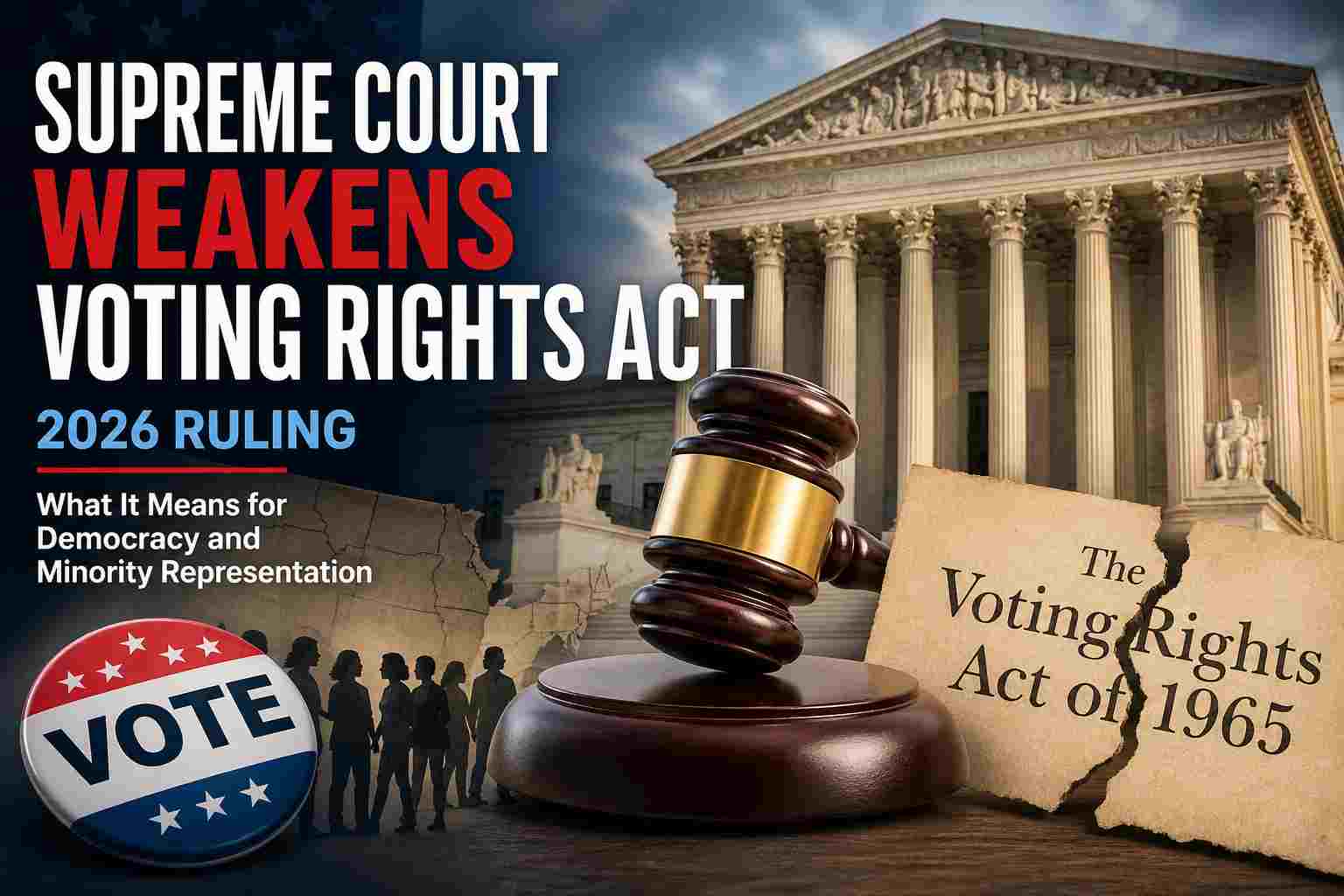
The United States Supreme Court has delivered a landmark decision in 2026 that significantly reshapes the future of voting rights and political representation. In a deeply divided 6–3 ruling, the Court’s conservative majority limited the power of one of the most important civil rights laws in American history—the Voting Rights Act of 1965.
This decision is already being described by legal experts, political analysts, and civil rights groups as a turning point that could redefine electoral fairness, minority representation, and the balance of political power in the United States.
Background: What Is the Voting Rights Act 2026?
The Voting Rights Act (VRA), passed in 1965 during the civil rights movement, was designed to eliminate racial discrimination in voting. For decades, it played a critical role in ensuring that minority communities—especially Black Americans—had equal access to the ballot box and fair political representation.
Two key provisions made the law powerful:
- Section 5 (preclearance): Required certain states to get federal approval before changing voting laws (struck down in 2013).
- Section 2: Allowed challenges to voting laws or district maps that unfairly diluted minority voting power.
The 2026 ruling directly impacts Section 2, widely considered the last strong enforcement tool of the law.
The 2026 Supreme Court Decision Explained
The case centered on a congressional map in Louisiana that created a second majority-Black district to better reflect the state’s demographics. Opponents argued that the map relied too heavily on race.
The Supreme Court agreed with that argument.
- The Court ruled 6–3 along ideological lines.
- The conservative majority stated that using race to draw districts can violate the Constitution.
- It raised the legal standard for proving discrimination.
Now, instead of showing that a law or map has a discriminatory effect, plaintiffs must prove intentional discrimination, which is far more difficult.
Why This Ruling Is So Significant
1. Section 2 Is Now Much Harder to Enforce
Previously, courts could strike down voting maps if they resulted in unfair representation for minority voters. Now, challengers must prove that lawmakers intentionally discriminated—a much higher legal bar.
Experts say this change could make Section 2 “almost impossible” to use effectively.
2. A Long-Term Shift in Supreme Court Direction
This ruling is not isolated. It is part of a broader trend over the past decade:
- 2013: The Court struck down federal oversight under Section 5.
- 2021–2024: Additional rulings narrowed protections.
- 2026: Section 2 is now significantly weakened.
Legal analysts describe this as a systematic rollback of voting protections.
3. Impact on Minority Representation
The decision could directly affect how electoral districts are drawn across the country.
- States may now redraw maps without prioritizing minority representation.
- Majority-minority districts could decrease.
- Political power of Black and Latino voters may decline.
Critics warn this could lead to a reduction in minority elected officials and weaken democratic inclusivity.
4. Political Consequences for Upcoming Elections
The timing of the ruling is critical.
- It comes ahead of major U.S. elections.
- Some states may attempt to redraw districts quickly.
- Analysts expect long-term effects by 2028, even if immediate changes are limited.
There are also concerns that the decision could influence control of Congress by reshaping electoral maps in key states.
Majority vs. Dissent: A Deep Divide
The Majority View
The conservative justices argued that:
- The Constitution requires race-neutral decision-making.
- Redistricting based on race can itself be discriminatory.
- The ruling promotes a “color-blind” legal framework.
The Dissenting Opinion
The Court’s liberal justices strongly disagreed.
Justice Elena Kagan warned that:
- The ruling effectively renders Section 2 powerless.
- It could allow states to dilute minority voting strength without consequence.
- The decision undermines decades of civil rights progress.
Legal experts echoed this concern, saying the law may now exist “on paper” but lacks real enforcement power.
Broader Implications for U.S. Democracy
This decision raises fundamental questions about the future of democracy in the United States:
✔ Will voting become less equitable?
With fewer legal tools to challenge discrimination, some communities may struggle to secure fair representation.
✔ Will partisan gerrymandering increase?
Since political (not racial) gerrymandering is still allowed, states may draw maps favoring political parties rather than fair representation.
✔ Will Congress step in?
There are growing calls for new federal legislation to restore voting protections, but political divisions make this uncertain.
What Happens Next?
The ruling is expected to trigger:
- New legal challenges in state and federal courts
- Redistricting battles across multiple states
- Increased political mobilization by civil rights groups
While the Voting Rights Act is still technically in place, its effectiveness has been significantly reduced.