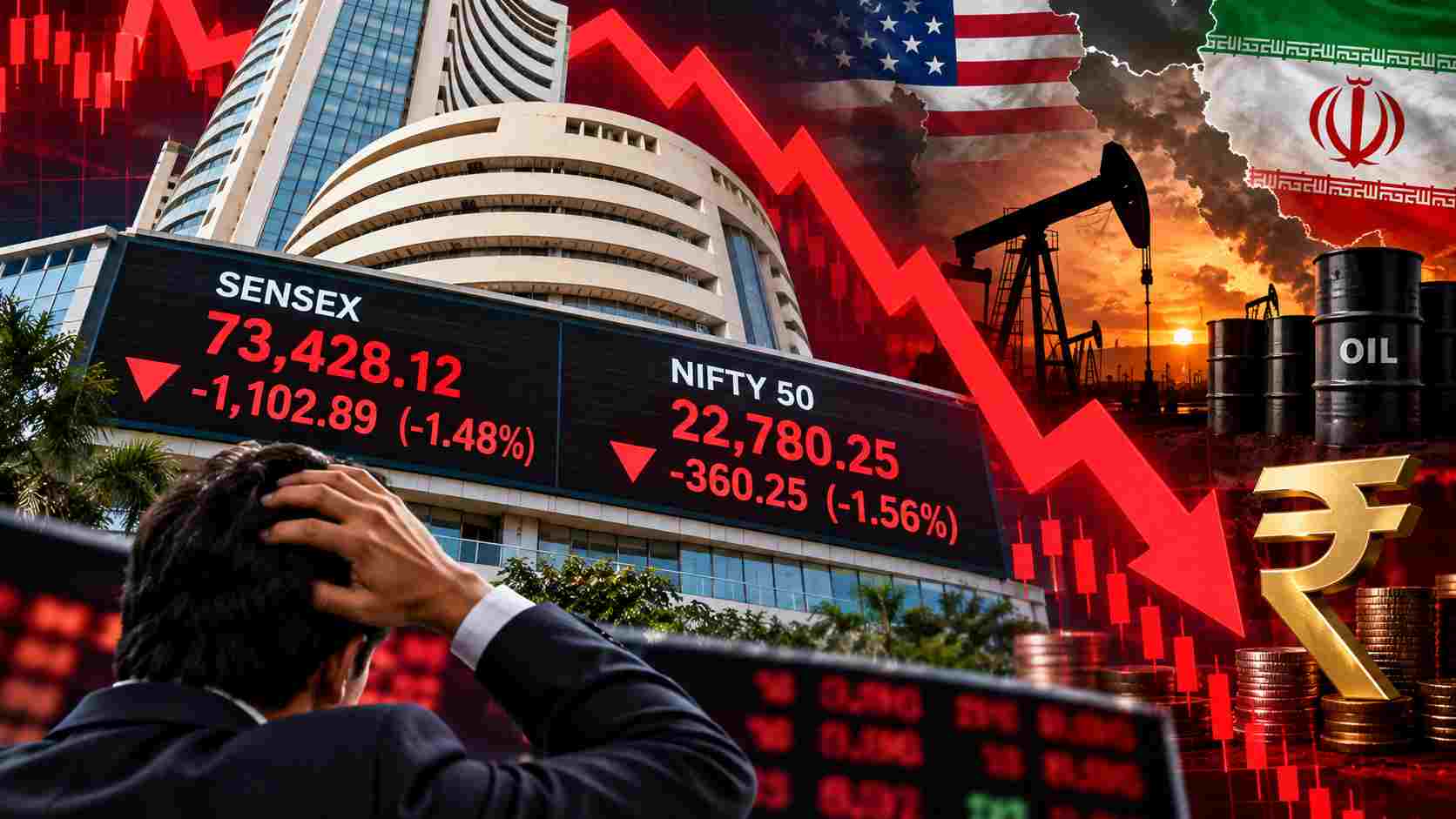
Indian stock markets suffered a sharp sell-off on Monday, September 28, 2026, as escalating geopolitical uncertainty, surging crude oil prices, rising global bond yields, foreign investor selling and pressure on the Indian rupee combined to weaken investor sentiment.
The benchmark BSE Sensex fell by more than 1,100 points during a volatile session, while the NSE Nifty 50 closed below the psychologically important 22,800 level.
The Nifty 50 ended the trading session at 22,780.25, down 360.25 points, or 1.56%, from its previous close.
The decline was broad rather than concentrated in a small number of companies. Banking, financial and other major sectors faced selling pressure, while mid-cap and small-cap shares also declined.
The sell-off erased approximately ₹7.41 lakh crore from the market capitalisation of BSE-listed companies, reducing their combined value to around ₹474.47 lakh crore.
The September 28 decline also came after Indian equities had already endured seven consecutive weeks of weakness, leaving investors increasingly sensitive to developments in crude oil, interest rates and the Middle East.
Why Did the Indian Stock Market Crash Today?
There was no single trigger behind Monday’s market decline.
Instead, investors were responding to a combination of domestic and international risks that have become increasingly connected.
The most important factors included:
- Renewed uncertainty surrounding the US-Iran conflict
- Brent crude oil trading above $106 per barrel
- Concerns about disruption around the Strait of Hormuz
- Rising US Treasury yields
- Weakness in the Indian rupee
- Continued foreign institutional investor selling
- Weak global market sentiment
- An already fragile domestic market after seven consecutive weekly declines
Together, these pressures triggered widespread selling across Indian equities.
1. US-Iran Tensions Put Global Markets on Edge
Geopolitical uncertainty remained one of the biggest factors influencing financial markets.
The latest pressure followed a deadlock surrounding efforts to ease the conflict involving Iran and the United States.
US President Donald Trump said he had rejected an Iranian proposal connected with ending hostilities and reopening the Strait of Hormuz.
Iran, meanwhile, continued to emphasize diplomacy while maintaining its position in the conflict.
For financial markets, the immediate concern is not only the military or diplomatic situation itself.
The bigger economic question is what happens to global energy supplies.
The Strait of Hormuz is one of the world’s most strategically important oil transportation routes. Any sustained disruption or uncertainty affecting the waterway can increase fears about global crude supply.
Those concerns pushed oil prices higher again on Monday.
2. Brent Crude Climbs Above $106 a Barrel
Oil was one of the most significant direct pressures on Indian markets.
Brent crude futures rose approximately 2.3% to around $106.7-$106.8 per barrel during Monday’s trading.
For India, high crude prices carry particular economic significance because the country is one of the world’s largest oil importers.
When international oil prices rise sharply, India may have to spend substantially more on energy imports.
That can create several problems simultaneously.
The country’s import bill can rise, inflationary pressure can increase, the current-account balance can face additional strain and businesses that rely heavily on fuel or petroleum-based inputs can experience higher costs.
Higher energy prices can also affect consumers through transportation, manufacturing and other costs.
That explains why Indian equity markets can be particularly sensitive to sustained increases in global crude prices.
3. Why the Strait of Hormuz Matters to India
The Strait of Hormuz has become central to the current market story because of its importance to international energy trade.
The narrow waterway connects the Persian Gulf with the Gulf of Oman and the Arabian Sea.
A significant amount of the world’s seaborne oil passes through the route.
India also depends heavily on energy supplies originating in the Middle East.
Consequently, investors closely watch any development that could restrict shipping or increase the cost of transporting energy through the region.
Even without a complete shutdown, uncertainty surrounding the route can introduce a geopolitical risk premium into crude prices.
That risk is currently being reflected in oil markets.
4. Higher Oil Prices Are a Major Risk for India
India’s dependence on imported crude means a sustained oil rally can affect several parts of the economy.
First, the cost of importing crude increases.
Second, higher energy prices can contribute to inflation.
Third, a larger import bill can increase demand for US dollars, potentially putting additional pressure on the rupee.
Fourth, companies in fuel-intensive sectors may experience margin pressure if they cannot pass their higher costs on to customers.
These concerns explain why rising crude prices frequently create selling pressure in Indian equities.
The effect can be particularly significant when oil prices rise at the same time as global interest rates and bond yields.
That is largely what investors are dealing with now.
5. Indian Rupee Comes Under Pressure
Currency weakness added another layer of uncertainty.
The Indian rupee weakened to around 95.95 against the US dollar during early trading on Monday after opening near 95.89.
The currency had closed around 95.75 in the previous session.
A stronger US dollar, foreign investor outflows and elevated oil prices all contributed to the pressure.
For India, crude oil and the rupee can create a difficult feedback loop.
Because international oil is largely priced in US dollars, a weaker rupee can make imported crude even more expensive in local currency terms.
At the same time, higher oil imports increase demand for dollars.
That can place additional pressure on the currency.
The psychologically important ₹96-per-dollar level therefore remained in focus among currency traders.
6. US Treasury Yields Add to Investor Concerns
Another important international factor was the continued rise in US government bond yields.
The benchmark US 10-year Treasury yield moved above 5.2%, reaching levels not seen for many years, while longer-term yields also remained elevated.
Higher bond yields matter for global stock markets because they can change the relative attractiveness of different investments.
When government bonds offer higher yields, investors may become less willing to take additional risk in equities.
Higher US yields can also encourage international capital to move toward dollar-denominated assets.
Emerging markets such as India can consequently face foreign capital outflows.
The combination of high crude prices and elevated US yields is particularly challenging because one increases India’s inflation and import risks while the other can make global capital more expensive.
7. Foreign Investors Continue Selling Indian Stocks
Foreign institutional investor activity was another source of pressure.
Provisional exchange data showed that foreign portfolio investors sold approximately ₹3,693.93 crore worth of Indian shares on Friday, September 25.
Domestic institutional investors provided some support, purchasing around ₹2,838.17 crore worth of equities.
However, continued foreign selling has remained an important concern for the market.
Foreign investor flows can significantly affect large-cap Indian stocks because overseas institutions hold substantial positions in many of the country’s biggest listed companies.
When foreign investors sell aggressively, the resulting pressure can affect both stock prices and the rupee.
8. Seven Consecutive Weeks of Market Weakness
Monday’s decline did not occur in isolation.
Indian equities entered the session after a prolonged period of weakness.
The Nifty 50 and Sensex had already experienced seven consecutive weeks of losses.
Reuters reported that the benchmarks had fallen roughly 6% during that period, marking one of their longest weekly losing streaks in years.
The sustained weakness has been driven by several overlapping concerns, including elevated oil prices, higher bond yields, foreign investor outflows and uncertainty about global monetary policy.
That meant market sentiment was already fragile before Monday’s fresh oil-price increase.
Banking and Financial Stocks Face Heavy Selling
Financial stocks were among the areas facing significant pressure during the session.
Banking companies carry substantial weight in India’s benchmark indices, meaning sharp declines among major banks can quickly pull down the Sensex and Nifty.
During the morning sell-off, heavyweight financial stocks including HDFC Bank and ICICI Bank declined.
Reliance Industries also traded lower, adding further pressure to the indices because of its significant benchmark weighting.
The weakness subsequently remained widespread across sectors.
Mid-Cap and Small-Cap Stocks Also Fall
The decline was not limited to India’s biggest companies.
Mid-cap and small-cap indices also moved sharply lower.
This broad participation in the sell-off suggested that investors were reducing risk across different parts of the market rather than simply reacting to company-specific developments among index heavyweights.
During the morning session, all 16 major sectoral indices tracked by Reuters were in negative territory.
India’s volatility gauge also jumped, reflecting greater expectations for market swings.
India VIX Jumps as Market Fear Increases
The India VIX rose sharply during Monday’s sell-off.
The volatility index is commonly interpreted as an indication of the market’s expectations for volatility over the coming 30 days.
A rising VIX generally signals that traders expect larger market movements.
Business Standard reported that India VIX jumped roughly 14% during Monday’s session as concerns surrounding oil and geopolitical risk intensified.
That does not predict the direction of future market movements, but it demonstrates how significantly uncertainty has increased.
Investors Lose Around ₹7.4 Lakh Crore in Market Value
The scale of Monday’s sell-off was also visible in overall market capitalisation.
The combined value of companies listed on the BSE fell by approximately ₹7.41 lakh crore, according to Business Standard.
Market capitalisation dropped to around ₹474.47 lakh crore, compared with approximately ₹481.88 lakh crore previously.
It is important to understand that this figure represents a decline in the market value of listed shares.
It does not mean ₹7.4 lakh crore in physical cash literally disappeared from investor accounts.
Market capitalisation changes as share prices rise and fall.
Why Crude Oil Could Remain the Key Market Variable
Among all the factors affecting Indian markets, crude oil may remain one of the most closely watched.
If geopolitical tensions ease and oil prices retreat, some of the pressure affecting inflation expectations, the rupee and India’s import bill could moderate.
If oil remains above $100 per barrel or moves higher, those concerns could persist.
The uncertainty is unusually high because oil prices currently depend heavily on geopolitical developments rather than purely economic demand and supply fundamentals.
That makes short-term forecasting particularly difficult.
What Investors Will Watch Next
Several developments are likely to remain important for Indian markets.
The first is the diplomatic and military situation involving Iran and the United States, particularly any development affecting the Strait of Hormuz.
Crude oil prices will remain closely connected to those developments.
Investors will also monitor the rupee, US Treasury yields, foreign institutional investor flows and global equity markets.
Domestic institutional buying may provide some support during periods of foreign selling, but broader sentiment will likely remain sensitive to international developments.
What Does the Market Crash Mean for Retail Investors?
Sharp market declines can create anxiety, particularly when several negative factors occur simultaneously.
However, daily index movements alone do not determine the long-term performance of an investment.
Different investors have different time horizons, risk tolerances and financial objectives.
Short-term traders may respond differently to volatility than investors building diversified portfolios over many years.
It is also important to distinguish between a decline caused by deterioration in an individual company’s fundamentals and a broad market sell-off caused by macroeconomic or geopolitical concerns.
Investors should therefore evaluate their own financial circumstances and investment strategy rather than making decisions solely because benchmark indices experience a sharp one-day movement.
Is This a Stock Market Crash or a Correction?
The word “crash” is widely used in headlines to describe a sudden large decline, but there is no universally accepted percentage threshold that automatically defines every one-day sell-off as a crash.
Monday’s movement was certainly a significant market decline.
However, understanding the broader trend requires looking beyond one trading session.
Indian benchmarks have been declining for several weeks, meaning Monday’s fall is better understood in the context of sustained pressure from oil, global yields, foreign flows and geopolitical uncertainty.
Whether that develops into a deeper correction will depend on future market and economic developments.
Indian Markets Face a Difficult Global Combination
The September 28 sell-off demonstrates how interconnected India’s financial markets have become with global events.
A geopolitical dispute thousands of kilometres away can affect the Strait of Hormuz.
That can push crude oil prices higher.
Higher crude prices can worsen India’s import costs and inflation expectations.
Those pressures can weaken the rupee.
At the same time, rising US Treasury yields can encourage global investors to move capital toward dollar assets.
Foreign investors may then reduce exposure to emerging markets such as India.
Together, these developments can create simultaneous pressure on equities, bonds and currencies.
Bottom Line
Indian stock markets experienced a severe risk-off session on September 28, 2026, with the Sensex falling more than 1,100 points and the Nifty 50 closing at 22,780.25, down 1.56%.
Approximately ₹7.41 lakh crore was erased from the market capitalisation of BSE-listed companies during the session.
The decline reflected a combination of escalating geopolitical uncertainty, Brent crude trading above $106 per barrel, concerns surrounding the Strait of Hormuz, elevated US Treasury yields, rupee weakness and sustained foreign investor selling.
The sell-off also came after seven consecutive weeks of declines, meaning investor sentiment was already under considerable pressure.
The immediate direction of Indian equities will remain sensitive to crude oil prices, developments in the US-Iran conflict, global bond yields, the rupee and foreign capital flows.
For investors, the key is to distinguish short-term market volatility from changes in the fundamental prospects of individual investments while avoiding decisions driven solely by headline movements.