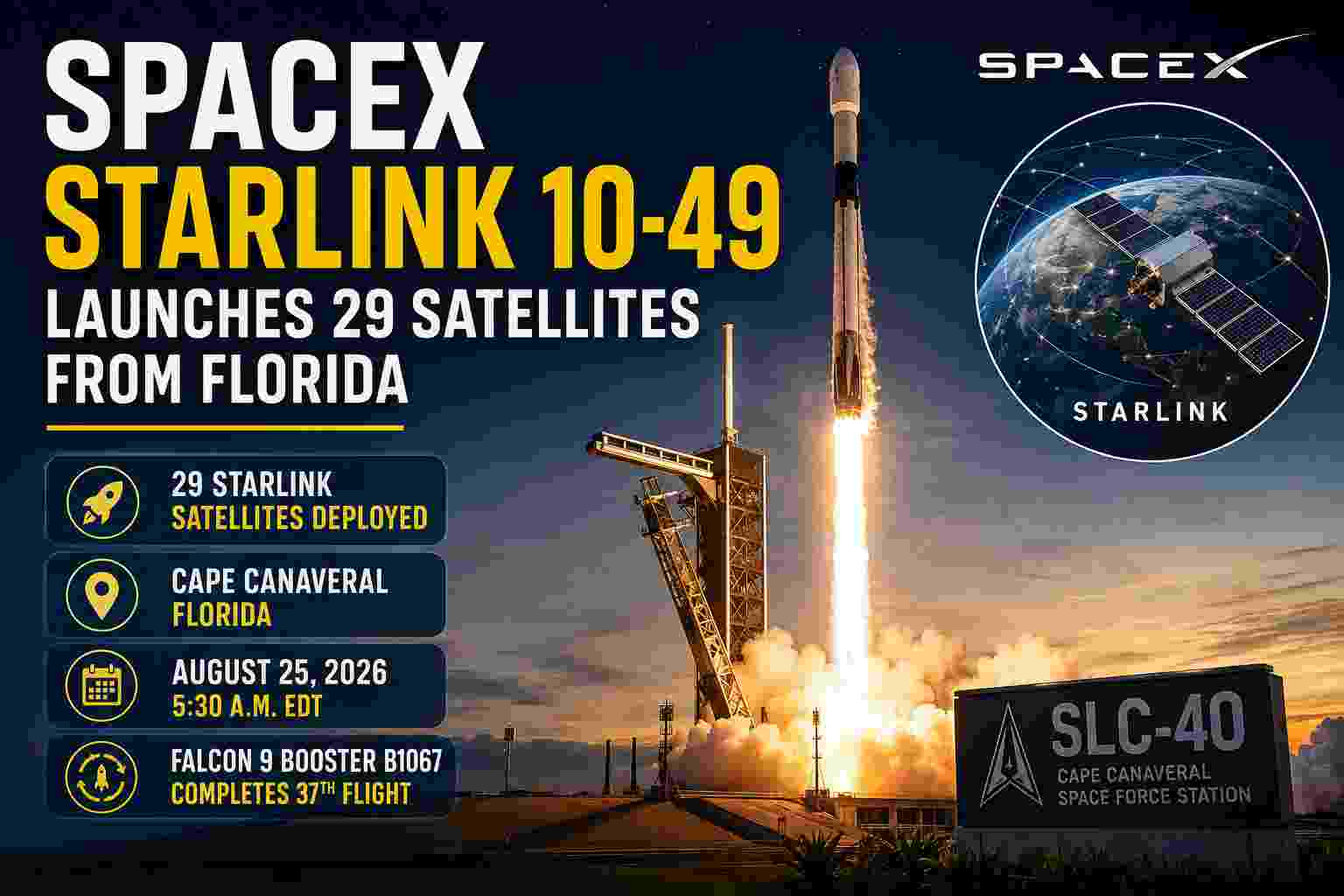
SpaceX successfully launched the Starlink 10-49 mission from Cape Canaveral Space Force Station in Florida early Tuesday, August 25, 2026, adding 29 more satellites to its growing Starlink internet constellation.
A Falcon 9 rocket lifted off from Space Launch Complex 40 (SLC-40) at approximately 5:30 a.m. EDT, marking another successful Starlink deployment for SpaceX. The mission also set an important reusability milestone: Falcon 9 first-stage booster B1067 completed its 37th flight, making it one of the most frequently flown orbital rocket boosters in history.
The pre-dawn launch also created the possibility of a striking visual effect in Florida’s sky, commonly described as a “space jellyfish.” The phenomenon can occur when sunlight illuminates the rocket’s exhaust plume at high altitude while the ground remains relatively dark.
SpaceX Starlink 10-49 Launch: What Happened?
The Starlink 10-49 mission launched from Cape Canaveral Space Force Station in Brevard County, Florida aboard a SpaceX Falcon 9.
The rocket carried 29 Starlink satellites, which were deployed toward low Earth orbit. Once operational, the satellites will become part of SpaceX’s large broadband network designed to provide internet connectivity across many parts of the world.
The mission was particularly notable because of the Falcon 9 booster assigned to it. Booster B1067, which first entered service in June 2021, flew for the 37th time on this mission. Its flight history includes Starlink missions as well as several major government, commercial and crewed missions.
After completing its role during ascent, the first stage was scheduled to return for a landing on SpaceX’s autonomous drone ship A Shortfall of Gravitas in the Atlantic Ocean. The recovery is part of SpaceX’s reusable-launch strategy, which allows the company to fly the same boosters multiple times.
When and Where Did Starlink 10-49 Launch?
The Starlink 10-49 mission launched from:
- Launch site: Space Launch Complex 40
- Location: Cape Canaveral Space Force Station, Florida
- Rocket: SpaceX Falcon 9
- Mission: Starlink 10-49
- Payload: 29 Starlink satellites
- Launch date: August 25, 2026
- Launch time: Approximately 5:30 a.m. EDT
- First-stage booster: B1067
- Booster flight number: 37th mission
- Recovery ship: A Shortfall of Gravitas
Spaceflight Now reported a targeted launch time of 5:33 a.m. EDT (0933 UTC), while local coverage reported liftoff shortly after 5:30 a.m. EDT.
Why Was the Launch Time Important?
The early-morning timing made this Starlink launch especially interesting for skywatchers.
Rocket launches around sunrise or before sunrise can produce unusual glowing patterns because the rocket’s exhaust reaches areas of the upper atmosphere that are already illuminated by sunlight. From locations where the ground is still dark, the illuminated exhaust can appear as a large, glowing cloud spreading across the sky.
This effect is often nicknamed the “space jellyfish” effect because of the way the expanding plume can resemble the shape of a jellyfish.
The phenomenon is not an indication of an unusual problem with the rocket. It is primarily a visual consequence of the interaction between the rocket’s exhaust, altitude and sunlight.
Why the Falcon 9 B1067 Booster Matters
One of the biggest highlights of Starlink 10-49 was the use of Falcon 9 booster B1067 for its 37th mission.
B1067 entered service in June 2021 and has supported a wide range of missions. According to local reporting, its previous flights included missions such as CRS-22, Crew-3, Turksat 5B, Crew-4, CRS-25, Eutelsat HOTBIRD 13G, SES O3b mPOWER-A, PSN SATRIA, Telkomsat Merah Putih 2 and Galileo L13, along with numerous Starlink launches.
The booster is an important example of SpaceX’s approach to rocket reusability.
Traditional expendable rockets are generally designed to be used once. Falcon 9’s first stage, by contrast, is engineered to return to Earth after launch, undergo refurbishment and fly again.
Repeated booster flights can help SpaceX reduce the amount of hardware required for each mission and support a high launch cadence.
What Are the 29 Starlink Satellites Going to Do?
The 29 satellites launched during Starlink 10-49 are designed to join SpaceX’s constellation in low Earth orbit (LEO).
Starlink satellites work together as part of a large network intended to deliver broadband internet connectivity to users on the ground. The system is particularly useful for locations where traditional wired or terrestrial broadband infrastructure can be difficult or expensive to deploy.
After reaching their intended orbit, newly launched satellites go through a series of procedures before becoming part of the operational network. These include orbital adjustments, system checks and positioning within the broader constellation.
The goal is to create a large network of satellites capable of maintaining internet coverage across wide geographic areas.
How Large Is the Starlink Constellation?
Starlink 10-49 is only one mission within a much larger deployment program.
Before this launch, astronomer Jonathan McDowell was tracking 11,028 Starlink satellites in orbit, with 9,733 listed in operational orbit. The 29 satellites launched on Starlink 10-49 add to the total number of spacecraft sent into orbit by the program.
The size of the constellation demonstrates how rapidly low-Earth-orbit satellite networks have expanded.
SpaceX has conducted a large number of Starlink missions because maintaining and expanding the network requires a continuing flow of new spacecraft. Satellites can also eventually need to be replaced as they reach the end of their operational lives.
What Is the Starlink Network Used For?
Starlink is SpaceX’s satellite internet service.
Unlike traditional broadband systems that depend heavily on cables, fiber networks or terrestrial infrastructure, Starlink uses satellites orbiting relatively close to Earth to connect users with internet services.
The network can be particularly valuable in areas where conventional broadband connections are limited.
Potential applications include:
- Residential internet access
- Rural broadband connectivity
- Internet access in remote locations
- Maritime connectivity
- Aviation connectivity
- Emergency and temporary communications
- Connectivity for locations with limited terrestrial infrastructure
The 29 satellites launched on Starlink 10-49 are intended to strengthen and expand that broader network.
What Weather Conditions Were Expected for the Launch?
Weather was closely monitored before the mission.
The 45th Weather Squadron forecast a 90% probability of favorable weather conditions for the launch window. The main weather concerns involved the rules governing cumulus clouds and anvil clouds.
Weather is an important factor in rocket launches because conditions can affect visibility, electrical activity, wind, clouds and other safety requirements.
A launch can be delayed or postponed when conditions violate established safety criteria, even when the rocket and payload are ready.
For Starlink 10-49, conditions ultimately allowed the Falcon 9 to launch successfully.
Falcon 9’s Reusable Design
The success of Starlink 10-49 also highlights why Falcon 9 remains central to SpaceX’s launch operations.
Falcon 9 is a two-stage rocket. The first stage provides most of the initial thrust needed to leave Earth and then separates from the second stage.
Instead of being discarded, the first stage can perform a controlled return to Earth.
For Starlink 10-49, booster B1067 was assigned to land on the drone ship A Shortfall of Gravitas in the Atlantic following stage separation.
This reusable approach is one of the defining features of SpaceX’s launch program and has enabled the company to operate Falcon 9 at a very high flight rate.
Could People See the Starlink Launch From Far Away?
Rocket launches from Florida can sometimes be visible from considerable distances, depending on weather, atmospheric conditions, darkness and the observer’s location.
The pre-dawn timing of Starlink 10-49 made the mission particularly favorable for dramatic visual effects.
The rocket itself is not necessarily visible from every location, but observers within suitable viewing areas may see the bright ascent and, under the right conditions, the illuminated exhaust plume.
The appearance can vary significantly depending on distance and atmospheric conditions.
What Is the “Space Jellyfish” Effect?
The so-called space jellyfish is not a separate space phenomenon or object.
It is a visual effect created when sunlight illuminates a rocket’s expanding exhaust plume at high altitude.
The effect is easiest to notice when:
- The launch occurs before sunrise or shortly after sunset.
- The rocket reaches an altitude where sunlight is still present.
- The observer remains in darkness or low light.
- Weather and visibility conditions are favorable.
Because the plume expands and spreads behind the rocket, it can take on unusual shapes that resemble a jellyfish or glowing cloud.
Similar effects have been observed during other early-morning and evening rocket launches.
Why Starlink 10-49 Is Significant for SpaceX
The Starlink 10-49 mission combines several important elements of SpaceX’s current launch strategy.
First, it adds 29 satellites to one of the world’s largest commercial satellite constellations.
Second, it demonstrates the continued operational use of reusable Falcon 9 hardware.
Third, the mission marks the 37th flight of booster B1067, highlighting how far reusable orbital launch systems have progressed.
Finally, the launch shows the continuing scale of SpaceX’s Starlink deployment campaign. Spaceflight Now reported that Starlink 10-49 would add another 29 satellites to a constellation already exceeding 11,000 spacecraft.
What Happens After a Starlink Launch?
A successful launch is only the beginning of the satellites’ journey.
After separation from Falcon 9’s upper stage, the Starlink spacecraft must reach their intended orbital configuration. The satellites then undergo checks and orbital adjustments before joining the operational constellation.
This process allows SpaceX to integrate newly launched satellites into the wider network rather than placing them immediately into their final operating positions.
Once operational, the satellites can contribute to Starlink’s ability to provide internet connectivity to customers around the world.
Frequently Asked Questions
What is Starlink 10-49?
Starlink 10-49 is a SpaceX satellite deployment mission that launched 29 Starlink broadband satellites into low Earth orbit from Cape Canaveral Space Force Station in Florida.
When did SpaceX launch Starlink 10-49?
SpaceX launched Starlink 10-49 early Tuesday, August 25, 2026, at approximately 5:30 a.m. EDT from Space Launch Complex 40.
How many satellites were launched?
The Falcon 9 carried 29 Starlink satellites on the Starlink 10-49 mission.
Which rocket launched Starlink 10-49?
The mission used a SpaceX Falcon 9 rocket.
Which Falcon 9 booster was used?
The first stage was B1067, completing its 37th mission.
Where did Starlink 10-49 launch from?
The mission launched from Space Launch Complex 40 at Cape Canaveral Space Force Station, Florida.
What is the Starlink “jellyfish” effect?
The “jellyfish” effect is a visual phenomenon that can occur when sunlight illuminates a rocket’s exhaust plume at high altitude while the observer is still in darkness.
What is Starlink used for?
Starlink is SpaceX’s satellite internet network, designed to provide broadband connectivity across many regions of the world.
How many Starlink satellites were in orbit before this launch?
Jonathan McDowell’s tracking data cited by Spectrum News listed 11,028 Starlink satellites in orbit before the Starlink 10-49 launch, including 9,733 in operational orbit.