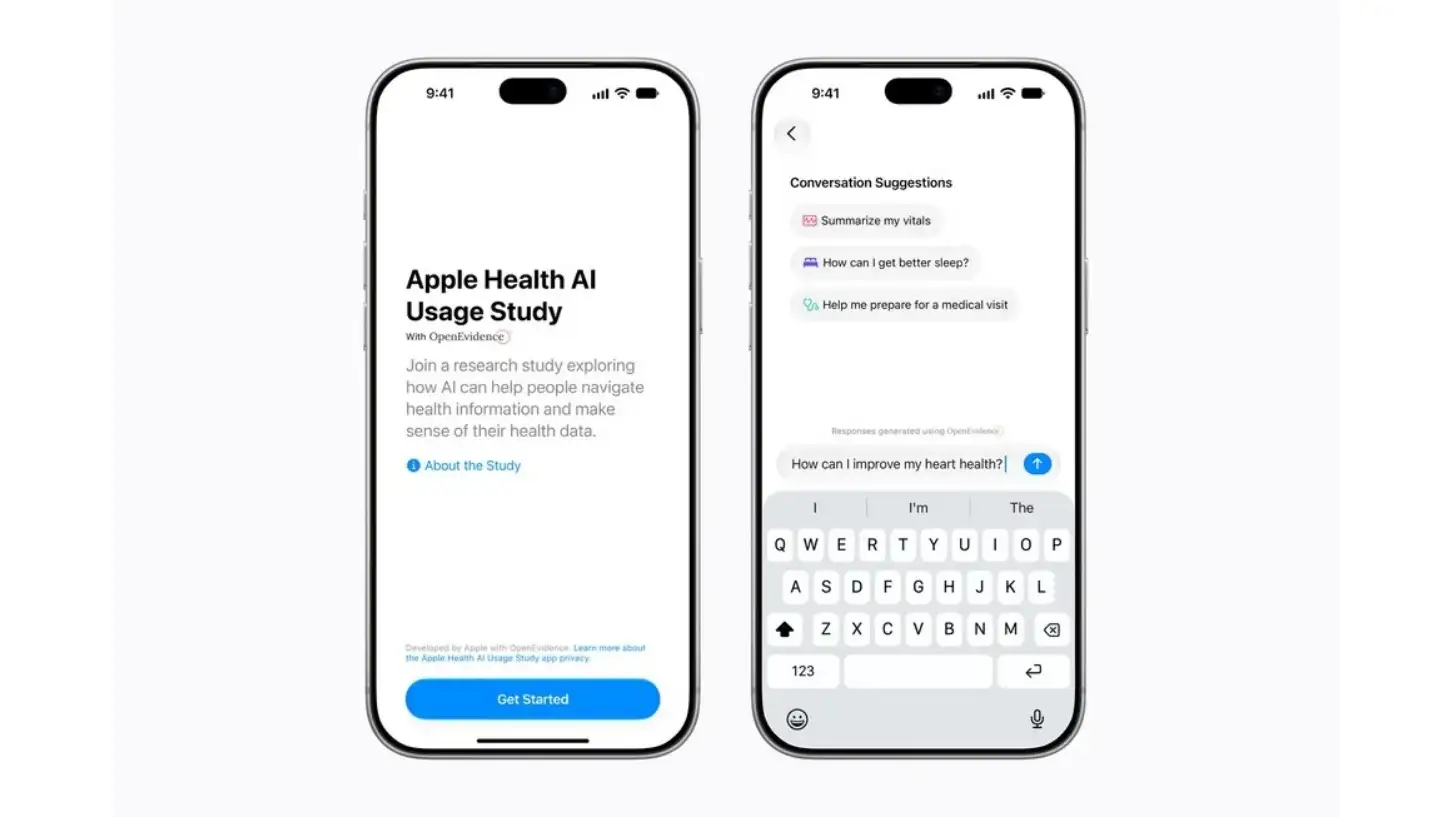
Apple has launched a new research initiative called the Apple Health AI Usage Study, designed to understand how people interact with artificial intelligence when asking health-related questions. Announced on November 15, 2026, the study will examine whether people trust AI-generated health information, understand its answers, and use the information in their everyday lives.
The initiative is being conducted in collaboration with OpenEvidence, a clinical AI platform used by healthcare professionals. Through a dedicated iPhone app, participants can ask health questions and receive responses supported by links to peer-reviewed medical research.
Apple plans to enroll up to 200,000 eligible participants in the United States. The research will also examine whether connecting personal health information makes AI responses more relevant and helps people prepare for conversations with their doctors.
The announcement comes as AI chatbots become increasingly popular for answering questions about symptoms, fitness, sleep, nutrition, and medical conditions. Apple wants to understand how these tools can provide information that is easier to understand and use responsibly.
What Is the Apple Health AI Usage Study?
The Apple Health AI Usage Study is a virtual research project that uses a dedicated app to examine how people interact with conversational AI for health information.
Rather than simply measuring how many questions users ask, Apple wants to understand several aspects of the experience. These include the quality of AI responses, user trust, comprehension, and whether the information influences everyday health-related actions.
Participants will be able to ask questions about common health topics and explore more complex medical information explained in accessible language. Responses will include links to peer-reviewed clinical sources so users can examine the research behind the information.
Apple says the study aims to support the responsible development of health AI experiences for both the company and the wider technology industry.
It is important to understand that this is a research initiative, not the launch of a new AI doctor or a replacement for Apple’s existing Health app. Apple has not announced that the study app will become a permanent feature of the Health app or Siri.
Apple Partners With OpenEvidence for Medical AI
A major part of the project is Apple’s collaboration with OpenEvidence, a clinical AI platform designed to help users access medical information.
OpenEvidence generates answers using established medical sources, including publications such as The New England Journal of Medicine, the Journal of the American Medical Association, and Nature.
Through this partnership, participants will receive health-related responses supported by links to clinical research. Apple’s research experience is designed to present complex information in language that everyday users can understand.
The collaboration brings together OpenEvidence’s medical AI technology and Apple’s experience in consumer health technology.
This approach is important because health questions can involve complicated information. A response may contain accurate medical details but still be difficult for someone without a medical background to understand.
Apple wants to study whether presenting medically grounded information in a simpler format can help people understand their health concerns and prepare better questions for healthcare professionals.
How Will the Apple Health AI Study App Work?
Participants will use a dedicated app to interact with the AI system and provide feedback about their experiences.
The app will allow users to ask everyday health questions, explore medical information, and review answers supported by clinical references.
For example, someone interested in improving their sleep or understanding their resting heart rate could ask a question and receive an explanation supported by medical sources.
Participants can also rate responses and share feedback about their quality. This will help researchers examine whether users find the information accurate, relevant, detailed, and understandable.
The study will also explore whether AI-generated information helps people prepare for appointments with their doctors.
Optional Health Data Integration
One of the study’s important features is the option to share personal health information through Apple’s HealthKit framework.
Participants can choose to share selected information, including:
- Resting heart rate
- Physical activity
- Sleep information
- Available laboratory results
This information may help the AI system provide responses that are more relevant to an individual’s health context.
For example, a participant asking about physical activity may receive an explanation that considers selected activity information they have chosen to share.
However, sharing HealthKit information is optional. Participants retain control over whether they provide these details.
Apple wants to understand whether personal health data improves the relevance and comprehension of AI-generated responses compared with general health information.
Apple Focuses on Trust, Accuracy, and Understanding
One of the main reasons behind the study is the growing use of AI chatbots for health-related questions.
People increasingly turn to conversational AI to understand symptoms, learn about medical conditions, explore fitness information, and prepare for healthcare appointments.
However, health-related AI tools can sometimes provide incomplete, unclear, or potentially misleading information. Even when a response includes useful details, users may misunderstand its meaning or place too much confidence in it.
Apple wants to study these issues rather than assume that providing medical references automatically makes an AI response useful.
The research will examine three important areas.
User trust: Researchers want to understand what makes people trust or question AI-generated health information and whether that trust is appropriate.
Comprehension: The study will examine whether participants understand the information presented to them, particularly when the topic involves complex medical details.
Everyday health actions: Apple also wants to learn whether people use the information to make decisions, change routines, or prepare for conversations with healthcare professionals.
These areas could help researchers understand what makes conversational AI more useful in healthcare settings.
Privacy and Safety Protections in the Study
Health information is highly personal, so privacy is an important part of Apple’s research initiative.
Apple says the study has been designed with privacy protections, transparency, and clinical safeguards. The company also confirms that study data will not be used to train AI models.
Participants can choose whether to share HealthKit information and survey responses. Apple says it has introduced security measures to protect the information it maintains and preserve participant confidentiality.
The app also includes safety guardrails intended to identify certain concerning questions and encourage participants to contact a healthcare provider or seek appropriate assistance.
These protections are important because AI-generated health information should not be treated as a substitute for professional medical care.
Apple clearly states that the study app is not designed to diagnose or treat medical conditions. Participants should consult qualified healthcare professionals about health concerns or verify medical information.
Who Can Participate in Apple’s Health AI Study?
Apple has opened the study to eligible adults in the United States who meet specific requirements.
The company plans to enroll up to 200,000 participants.
To join, users must:
- Be at least 21 years old.
- Live in the United States.
- Have an Apple Intelligence-enabled iPhone, specifically an iPhone 15 Pro or later.
- Run iOS 26 or a later version.
Interested users can download the dedicated Apple Health AI Study app to review the details and decide whether to enroll.
The study is currently limited to eligible participants in the United States. Apple has not announced availability in other countries.
What Does This Mean for Apple’s Future Health Technology?
The study could provide useful information about how AI fits into consumer healthcare technology.
Apple already offers several health-related features through its devices, including activity tracking, sleep information, heart-rate measurements, and access to health records in supported regions.
However, collecting health information and helping people understand it are two different things.
Conversational AI could potentially make health information easier to explore by allowing people to ask questions in everyday language. It could also help users organise questions before medical appointments and understand information from clinical sources.
The Apple Health AI Usage Study will help the company examine these possibilities through real-world user experiences.
However, Apple has not confirmed that the research will lead to a new AI health assistant or a major update to its Health app. Any connection to future Apple products remains a possibility rather than an announced product plan.
The findings may also contribute to broader discussions about how technology companies can develop responsible AI tools for healthcare.
Why Apple’s AI Health Research Matters
AI is becoming a more visible part of the healthcare technology industry. Companies are exploring ways to use conversational systems to explain medical information, support patient education, and improve communication between patients and healthcare professionals.
Apple’s new study focuses on an important question: Are AI health responses actually useful to the people receiving them?
A system may produce detailed answers, but that does not guarantee users understand the information or know when they should seek professional help.
By examining trust, comprehension, response quality, and everyday actions, Apple hopes to gather evidence about how people use these tools in real situations.
The collaboration with OpenEvidence also highlights the importance of connecting AI responses with established medical research.
The results could help inform future health AI experiences, although Apple has not announced a publication date or specific product changes based on the study.
Final Thoughts
Apple’s launch of the Health AI Usage Study marks a new research effort focused on understanding how people interact with AI-powered health information.
By working with OpenEvidence, Apple aims to examine whether clinically supported answers can help users understand health topics, build appropriate trust, and prepare for conversations with doctors.
The study will involve up to 200,000 eligible US participants and will explore the role of optional personal health data in making responses more relevant.
Rather than announcing a new consumer health AI product, Apple is first gathering evidence about how these tools work in everyday situations. The findings could help shape future conversations about responsible AI in healthcare.