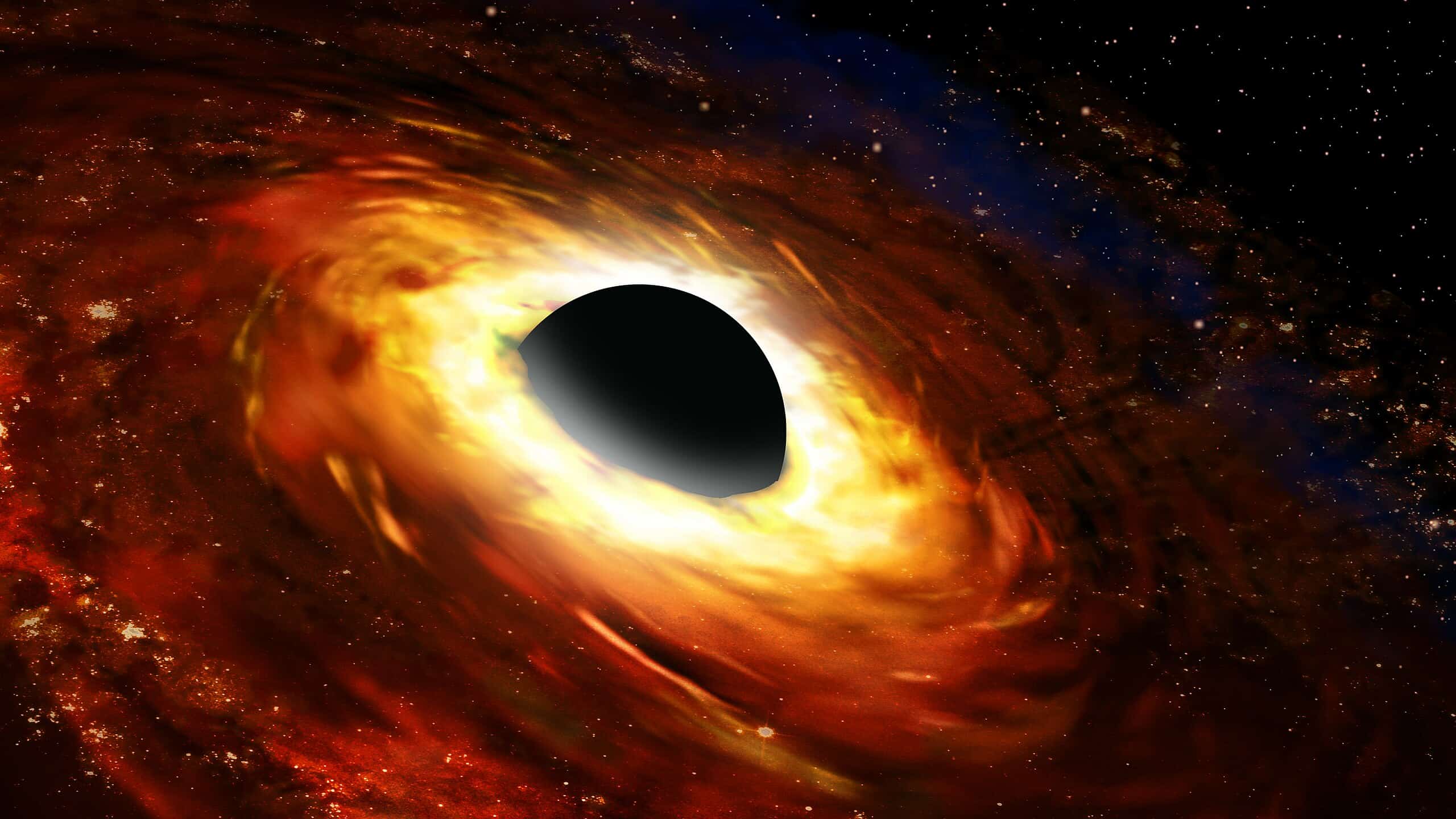
Astronomers have discovered new clues that could explain how some black holes are formed. A recent study suggests that certain black holes may originate from massive stars that collapse inward without producing the powerful explosion known as a supernova.
The research, led by scientists at the California Institute of Technology (Caltech), examined gravitational-wave observations collected by the LIGO, Virgo and KAGRA observatories. The findings suggest that a group of black holes may share a common origin: massive stars that quietly collapsed under their own gravity.
The discovery could help scientists understand why some stars explode at the end of their lives while others may disappear almost silently. However, researchers stress that direct evidence of a failed supernova has not yet been confirmed.
How Do Massive Stars Normally Become Black Holes?
Massive stars spend much of their lives producing energy through nuclear fusion. During this process, they convert lighter elements into heavier ones inside their cores.
Eventually, a massive star runs out of the fuel needed to support itself against gravity. Its core begins to collapse, creating extreme pressure and temperature conditions.
In many cases, this collapse triggers a supernova, an enormous explosion that releases a large amount of energy and sends stellar material into space. Depending on the mass and conditions inside the collapsing core, the remaining object may become a neutron star or a black hole.
However, scientists have long considered another possibility. Some massive stars may collapse directly into black holes without producing a bright supernova explosion. This process is called a failed supernova.
What Did the New Black Hole Study Discover?
The research team analysed data from 257 black hole mergers detected by the LIGO–Virgo–KAGRA network over approximately ten years.
Gravitational waves are ripples in spacetime produced by some of the universe’s most energetic events. When two black holes orbit each other and eventually merge, they generate these waves, which can be detected by specialised observatories on Earth.
The researchers studied the masses and spin rates of black holes involved in these mergers. They found that approximately three-quarters of the sample showed a peak around 10 times the mass of the Sun.
The study also identified a noticeable shortage of black holes with masses between 12 and 16 times the mass of the Sun.
According to the researchers, this unusual mass distribution could indicate that many black holes around 10 solar masses formed through a different process from other black holes.
The findings are consistent with theoretical predictions for failed supernovas, suggesting that some massive stars may collapse directly into black holes rather than exploding.
Why Are Failed Supernovas Important?
A failed supernova challenges the traditional understanding of how massive stars end their lives.
When astronomers observe a normal supernova, they can study the explosion, the material released and the remaining object. A failed supernova is much harder to detect because the star may simply become fainter and disappear from view.
Without a bright explosion, scientists have fewer opportunities to observe the process directly.
Studying these events could help researchers understand how black holes form, why certain black hole masses are more common and how massive stars behave during their final stages.
It may also help explain why astronomers observe fewer supernova explosions than some theoretical models predict.
How Gravitational Waves Help Scientists Study Black Holes
Gravitational-wave astronomy has created a new way to investigate objects that cannot be studied through ordinary visible light alone.
The LIGO observatory made history in 2015 when scientists announced the first direct detection of gravitational waves from a pair of merging black holes.
Since then, the international LIGO–Virgo–KAGRA network has detected more than 300 black hole collisions.
Each detection provides information about the objects involved, including their masses, spins and movements before merging.
In the latest research, scientists used these observations to identify patterns that may reveal how different groups of black holes formed.
This approach is particularly valuable for investigating failed supernovas because the original stars may disappear without leaving behind a bright explosion.
What Do Black Hole Spins Reveal?
Mass is not the only property that can help scientists understand a black hole’s origin. Its spin can also provide important clues.
Black holes can rotate, and their spin characteristics may be influenced by the conditions under which they formed.
The researchers found that black holes around 10 solar masses appeared to have a narrower range of spin rates compared with the broader population in the study.
This pattern, combined with the unusual mass distribution, supports the possibility that these black holes belong to a distinct population.
Scientists believe they may have formed through the quiet collapse of massive stars. However, more observations and research are needed to confirm this explanation.
Could Astronomers Observe a Failed Supernova Directly?
Finding direct evidence remains one of the biggest challenges.
Scientists have previously studied massive stars that appear to vanish without producing a typical supernova. One example is the object known as N6946-BH1.
Images from the Hubble Space Telescope showed the giant star before it disappeared from view. Researchers have considered the possibility that it collapsed into a black hole without a powerful supernova explosion.
Such observations provide useful clues, but they do not establish that every disappearing massive star follows the same process.
Future observations from advanced telescopes, combined with gravitational-wave detections, could help scientists identify more potential failed supernovas and understand their evolution.
What Happens Next in Black Hole Research?
The new findings provide another way to investigate the connection between massive stars, supernovas and black holes.
Researchers will need to study larger samples of gravitational-wave events and compare their observations with models of stellar evolution. More detailed measurements of black hole masses and spins may help determine whether the suspected population really formed through failed supernovas.
The research does not prove that most black holes form this way. Instead, it shows that existing gravitational-wave observations are consistent with the possibility that some massive stars collapse without exploding.
As gravitational-wave observatories continue collecting data, astronomers may uncover more evidence about the final stages of massive stars.
The discovery highlights how black holes can reveal the hidden lives of stars, even when those stars disappear without a spectacular cosmic explosion.