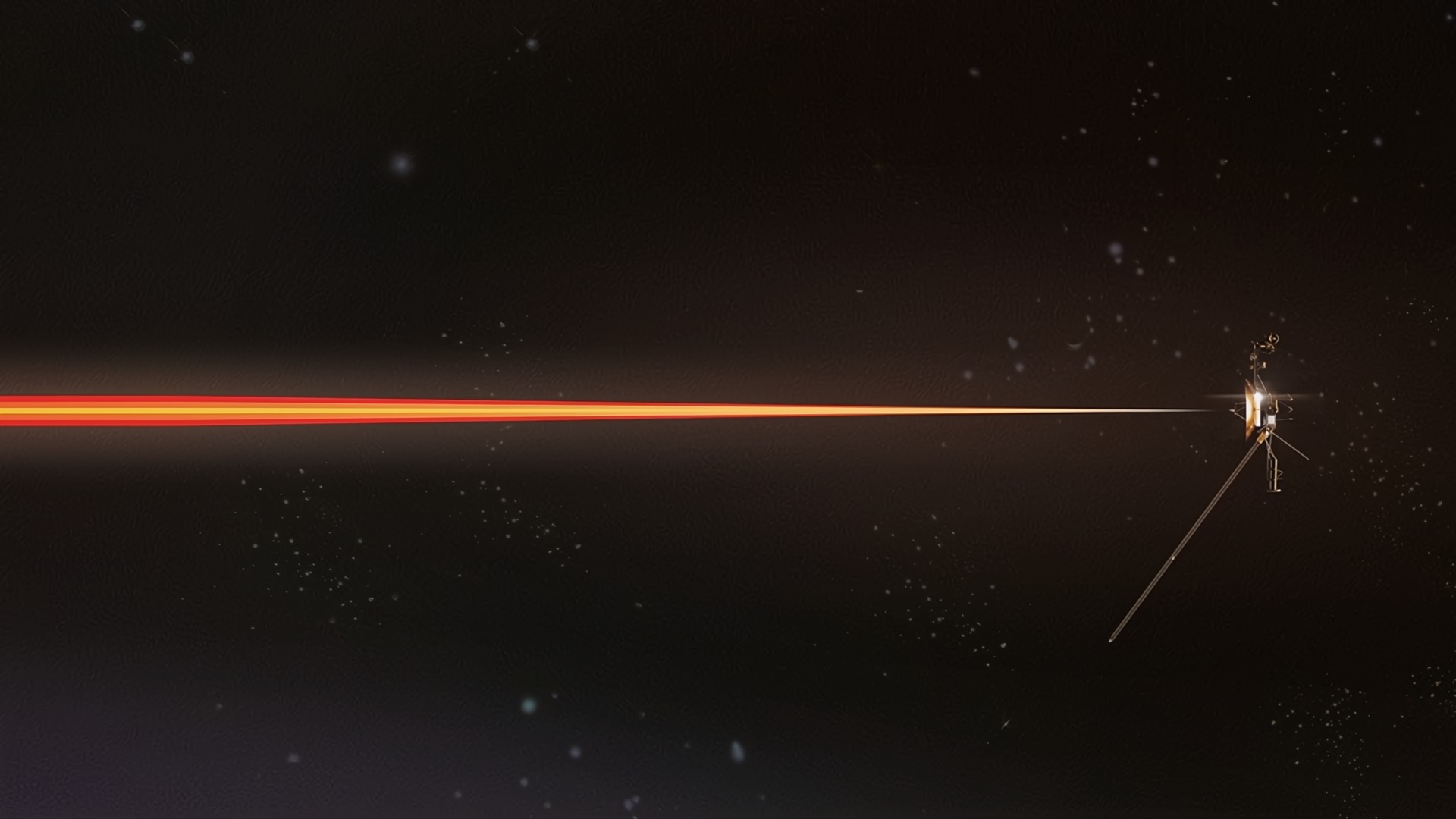
NASA’s Voyager 1 spacecraft is approaching a remarkable milestone in space exploration: travelling one light-day away from Earth. Launched in 1977, Voyager 1 has spent decades moving through interstellar space, becoming the most distant human-made object from our planet.
A light-day is the distance light travels in 24 hours, approximately 25.9 billion kilometres (16.1 billion miles). Reaching this distance means a radio signal travelling at the speed of light would take a full day to cover the distance between Earth and the spacecraft, with another day required for a round trip.
The milestone highlights the extraordinary journey of a spacecraft that was originally designed to study the outer planets of our solar system. More than four decades after its launch, Voyager 1 continues to send scientific information back to Earth.
What Is the One Light-Day Milestone?
A light-day is a unit of distance used in astronomy. It represents how far light travels in one day through space.
Because light travels at approximately 299,792 kilometres per second, one light-day equals roughly 25.9 billion kilometres.
For Voyager 1, reaching this distance is more than a symbolic achievement. It demonstrates how far the spacecraft has travelled since leaving Earth in 1977.
The distance also explains why communicating with Voyager 1 is becoming increasingly challenging. Radio signals need approximately 24 hours to travel one way when the spacecraft is one light-day away.
This means engineers must wait around two days to send a command and receive a response, excluding additional processing time.
Voyager 1’s Journey Began in 1977
NASA launched Voyager 1 on September 5, 1977, from Cape Canaveral, Florida. Its original mission was to explore Jupiter and Saturn and collect information about their atmospheres, moons, magnetic fields, and surrounding environments.
The spacecraft reached Jupiter in 1979 and Saturn in 1980. During these encounters, Voyager 1 captured important images and scientific measurements that helped researchers understand the two giant planets.
Its observations included detailed studies of Jupiter’s atmosphere, volcanic activity on its moon Io, and Saturn’s rings and moon Titan.
After completing its planetary exploration mission, Voyager 1 continued travelling outward from the Sun.
Unlike many spacecraft designed for shorter missions, Voyager 1 was able to continue operating long after its original planetary objectives were completed.
Voyager 1 Entered Interstellar Space in 2012
One of the most important moments in Voyager 1’s journey occurred in August 2012, when it crossed the heliopause and entered interstellar space.
The heliopause is the outer boundary of the heliosphere, the large region influenced by the solar wind and the Sun’s magnetic field.
Crossing this boundary marked the beginning of Voyager 1’s journey through the space between stars.
The spacecraft continues to study its surroundings using scientific instruments that measure particles, magnetic fields, and other conditions in interstellar space.
Its observations provide researchers with valuable information about the environment beyond the influence of the solar wind.
Why Communication With Voyager 1 Takes So Long
Voyager 1 communicates with Earth using radio signals. These signals travel at the speed of light, but the enormous distance between the spacecraft and our planet creates a significant delay.
As Voyager 1 moves farther away, the time needed for signals to reach it continues to increase.
At a distance of one light-day, a command sent from Earth would take approximately 24 hours to reach the spacecraft. Engineers would then need to wait another 24 hours for a response.
This makes communication very different from operating spacecraft closer to Earth.
NASA engineers must carefully plan commands and account for long communication delays. They cannot control Voyager 1 in real time.
The spacecraft also relies on its onboard systems to perform tasks independently while waiting for instructions from Earth.
Voyager 1 Continues to Send Scientific Data
Despite its age, Voyager 1 remains an important source of scientific information.
Its instruments have helped researchers study cosmic rays, magnetic fields, and charged particles in interstellar space.
These measurements are especially valuable because Voyager 1 is exploring a region that no other operating spacecraft has studied in the same way.
The spacecraft’s findings help scientists understand the boundary between the Sun’s influence and the wider interstellar environment.
However, Voyager 1’s power supply is gradually weakening. It uses radioisotope thermoelectric generators, which produce electricity from the heat released by radioactive material.
As the available power decreases, NASA engineers have had to turn off some instruments and non-essential systems to extend the mission.
The Golden Record Still Travels Through Space
Voyager 1 also carries one of the most recognisable messages ever sent into space: the Golden Record.
The record contains sounds, music, images, and greetings from Earth. It was created as a message for any possible extraterrestrial civilisation that might encounter the spacecraft in the distant future.
Its contents represent different aspects of human life, culture, science, and the natural world.
Although the record is not part of Voyager 1’s scientific operations, it remains an important symbol of humanity’s curiosity about the universe.
Voyager 1 and its sister spacecraft, Voyager 2, both carry Golden Records.
Why the Voyager 1 Milestone Matters
The one light-day milestone represents the scale of human exploration beyond Earth.
Voyager 1 has travelled farther than any other human-made spacecraft, and its continued operation demonstrates the durability of the engineering behind the mission.
Its journey has also changed scientific understanding of the outer solar system and interstellar space.
The spacecraft provides researchers with direct measurements from a region that cannot easily be studied using telescopes or simulations alone.
For future space missions, Voyager 1 also offers valuable lessons about long-duration spacecraft operations, energy management, communication systems, and autonomous engineering.
What Comes Next for Voyager 1?
Voyager 1 will continue moving away from Earth as it travels through interstellar space. Its available electrical power will keep declining, which means NASA will eventually have to switch off more instruments and systems.
The mission’s long-term scientific operations depend on how much power remains and whether essential spacecraft systems continue functioning.
Even after Voyager 1 can no longer communicate with Earth, it will continue travelling through space.
Its journey represents one of the longest-running achievements in space exploration. Approaching one light-day from Earth is another reminder of how far human technology has reached beyond our planet.
Key Takeaway
NASA’s Voyager 1 is approaching the one light-day distance from Earth, a milestone that illustrates the extraordinary scale of its journey since 1977. From exploring Jupiter and Saturn to entering interstellar space, the spacecraft has transformed our understanding of the outer solar system.
Its continued journey demonstrates the lasting value of long-term scientific exploration and the discoveries that can come from missions designed to travel far beyond their original objectives.