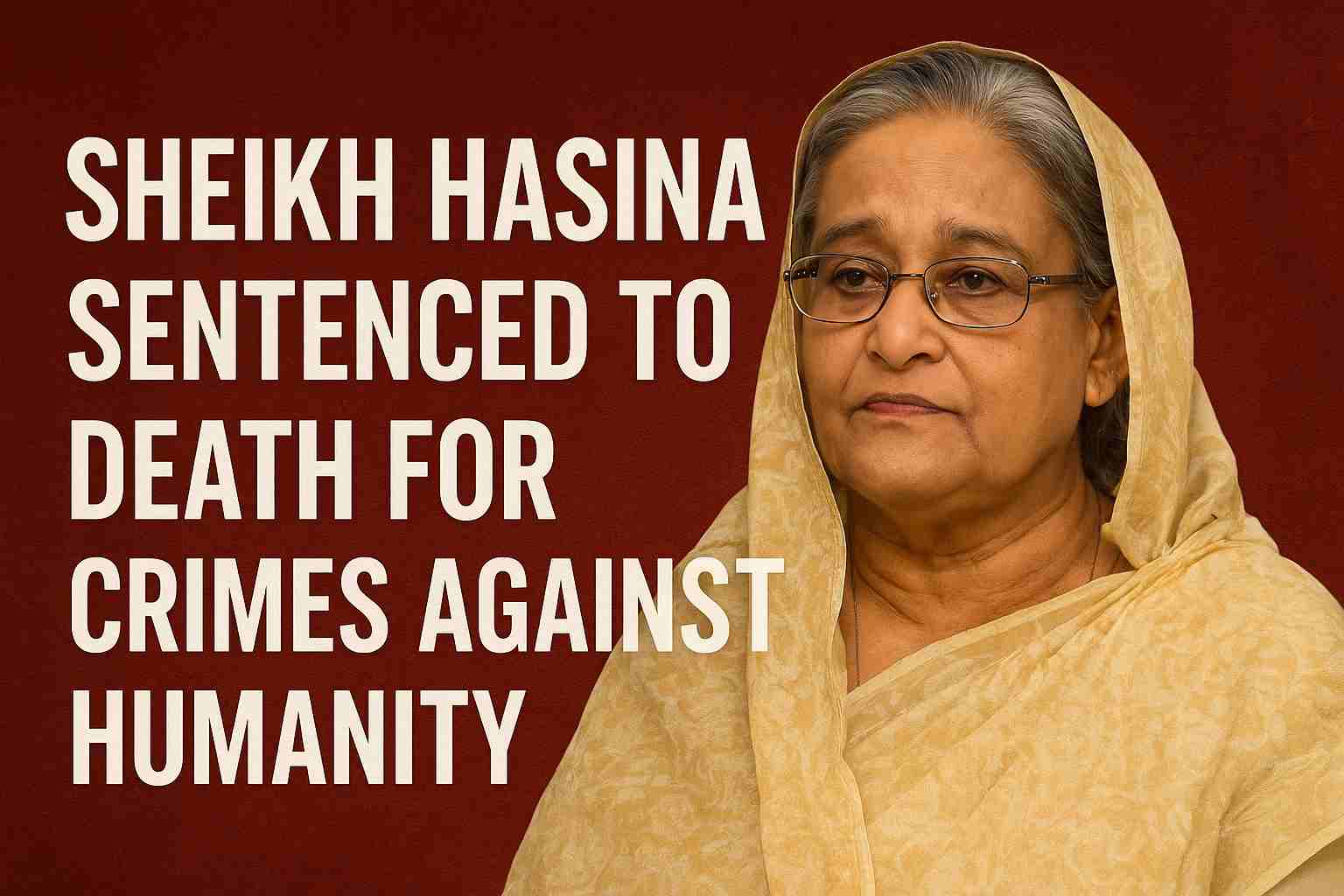
In a dramatic and historic ruling a special court in Bangladesh has sentenced former Prime Minister Sheikh Hasina to death in absentia. The sentence stems from charges of crimes against humanity related to a violent crackdown on a student-led uprising in 2024.
Background: The 2024 Student Uprising
The unrest that led to this landmark trial began in mid-July 2024 when students across Bangladesh mobilized against the government. According to the court, Hasina’s administration did not heed their demands. Evidence presented during the trial suggests that Hasina used inflammatory rhetoric, reportedly calling protesters Razakars a derogatory term and later allegedly ordered their elimination.
What followed was a brutal crackdown: the tribunal found that Hasina ordered law-enforcement agencies to deploy helicopters, drones and lethal weapons to suppress protests. The tribunal heard testimony and evidence suggesting that security forces, along with political cadres, carried out widespread violence, including murder, torture and other inhumane acts.
The Verdict and Legal Findings
The International Crimes Tribunal (ICT), presided over by Justice Md. Golam Mortuza Mozumder found Hasina guilty on three major counts: incitement, ordering to kill and failing to prevent atrocities.
Key legal observations by the court included:
-
Superior command responsibility: Hasina was held responsible for giving orders that were later executed by security forces.
-
Use of mechanized force: The tribunal cited orders for helicopters and drones to manage protesters.
-
Systematic violence: The court linked her and her aides to conspiracy, abetment,and facilitation of crimes.
In its final decision, the tribunal did not spare Hasina despite her absence. The court explicitly stated that only one sentence was appropriate — death.
Co-accused and Sentences
Along with Hasina, former Home Minister Asaduzzaman Khan Kamal was also sentenced to death on similar charges.
Chowdhury Abdullah Al-Mamun, the former police chief, initially faced trial but later turned approver and was spared the death sentence.
The Human Cost
According to a United Nations rights office report cited in court documents, up to 1,400 people died during the crackdown between July 15 and August 15, 2024. Families of the victims and many in Bangladesh see this ruling as a measure of justice, though it also risks further polarizing the country.
Hasina’s Position and Exile
Sheikh Hasina, aged 78, has denied all wrongdoing. She is currently in exile in India, having fled Bangladesh on August 4, 2024. The interim government in Dhaka, led by Nobel laureate Muhammad Yunus, has formally demanded her extradition — but so far, there has been no response from India.
Hasina’s supporters argue that the trial was politically motivated and question the tribunal’s independence.
Political and Regional Implications
The verdict has far-reaching implications:
-
Political stability: Bangladesh is already volatile and this ruling could trigger further unrest.
-
Justice vs politics debate: Critics warn that political motives may overshadow legal integrity, while proponents argue this is long-overdue accountability.
-
International dimension: Hasina’s presence in India adds a diplomatic layer and her extradition request may test bilateral ties.
-
Human rights concerns: Human rights groups may raise alarms about the use of the death penalty, especially in a politically charged trial.
What This Means Going Forward
-
The verdict is likely to shape Bangladesh upcoming elections, which are expected in 2026.
-
For the victims’ families this may be seen as a measure of justice, but the challenge will be implementation and reconciliation.
-
The ruling also sets a precedent for accountability in political conflict, though critics will closely watch whether the tribunal will remain free from political influence.
-
On the regional level Hasina’s case could strain India–Bangladesh relations, especially if extradition demands intensify.