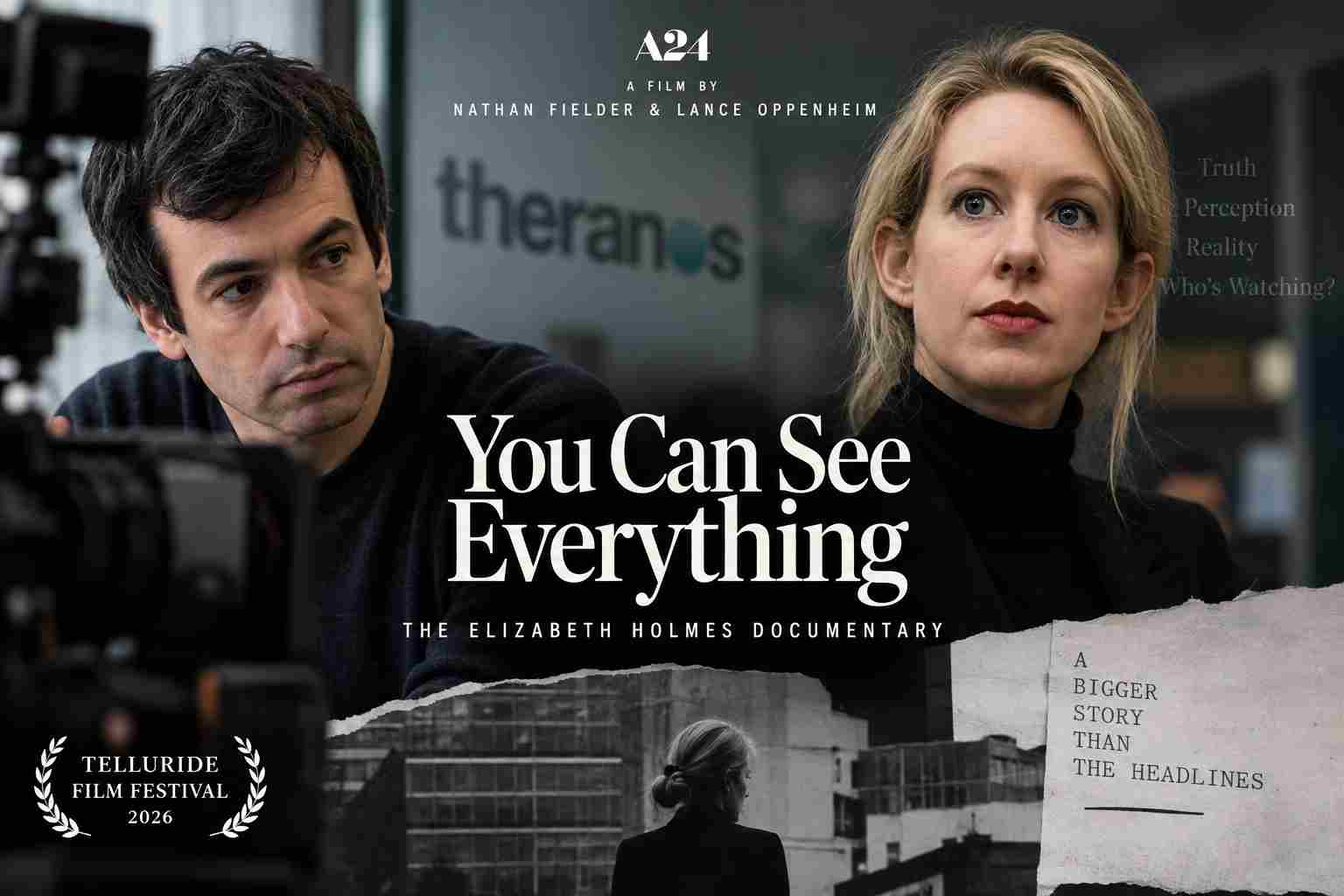
Nathan Fielder has finally revealed the secret documentary project that has been quietly generating rumors for years.
Titled You Can See Everything, the new documentary follows convicted Theranos founder Elizabeth Holmes and was secretly filmed over several years by Fielder and filmmaker Lance Oppenheim. The project made its surprise world premiere at the 2026 Telluride Film Festival, where it was kept so secret that audiences did not know the identity of the film before entering the screening.
Produced by A24, the documentary takes a very different approach to the Elizabeth Holmes story than the books, podcasts, documentaries and scripted productions that have already examined the collapse of Theranos.
Rather than simply revisiting the rise and fall of the biotech company, Fielder and Oppenheim gained unusually close access to Holmes during a crucial period of her life. The result is a documentary that reportedly becomes increasingly unconventional as it examines questions surrounding truth, perception, image and manipulation.
Here is everything you need to know about You Can See Everything, including its story, directors, Telluride premiere, release plans and why the project has attracted so much attention.
What Is ‘You Can See Everything’ About?
You Can See Everything is a documentary about Elizabeth Holmes, the former Theranos founder whose rise from Silicon Valley entrepreneur to convicted fraudster became one of the most widely discussed corporate scandals of the past decade.
The film begins shortly before Holmes was due to report to federal prison. According to the film’s premise, she invited a skeptical documentary crew to record her life and experiences during the final weeks before her incarceration.
That starting point gives the filmmakers access to a period that had received relatively little direct documentary attention.
Holmes had already become one of the most recognizable figures associated with the Theranos scandal. Her company had once promised to revolutionize blood testing, while Holmes herself became famous for her distinctive image, ambitious claims and rapid rise through Silicon Valley.
But after investigations exposed serious problems surrounding Theranos, the company’s story collapsed.
Holmes was eventually convicted of four counts related to defrauding investors and was sentenced to more than 11 years in federal prison.
Instead of simply retelling that familiar history, Fielder and Oppenheim focus on what happened around Holmes after her public downfall.
The filmmakers were interested in what Holmes would say and how she would present herself when given the opportunity to control her own narrative.
That becomes one of the central tensions of the documentary.
Nathan Fielder and Elizabeth Holmes: An Unusual Combination
The choice of Nathan Fielder as one of the filmmakers is one of the biggest reasons You Can See Everything has attracted so much attention.
Fielder is best known for projects such as Nathan for You and HBO’s The Rehearsal, both of which blur the boundaries between comedy, reality, performance and documentary filmmaking.
His work often places real people in situations where it becomes difficult to determine exactly where reality ends and constructed performance begins.
That approach is particularly interesting when applied to Elizabeth Holmes.
Holmes’ public story has always involved questions about presentation and perception. She built a carefully controlled public identity around Theranos, while the company’s technology and business claims eventually came under intense scrutiny.
Fielder therefore becomes more than a conventional documentary interviewer.
He is also a participant in the story.
The film reportedly captures his attempt to understand Holmes while simultaneously questioning whether the version of reality presented to him can be trusted.
That unusual dynamic gives the documentary a very different tone from a traditional investigative film.
Who Directed ‘You Can See Everything’?
You Can See Everything was co-directed by Nathan Fielder and Lance Oppenheim.
The collaboration brings together two filmmakers with very different but complementary backgrounds.
Fielder has developed a reputation for mixing comedy, documentary techniques and carefully constructed real-life situations.
Oppenheim, meanwhile, is an established documentary filmmaker whose work includes Some Kind of Heaven and Primetime.
Their combination is particularly well suited to a subject like Holmes because the film is not presented as a straightforward chronological account of the Theranos scandal.
Instead, the filmmakers use their access to examine the uncertainty surrounding Holmes herself.
How Did Nathan Fielder Get Involved With Elizabeth Holmes?
The documentary reportedly began with an unexpected connection.
Fielder and Oppenheim were at Los Angeles’ Magic Castle when a magician asked the audience to name a celebrity. Elizabeth Holmes’ name was suggested.
Afterward, Oppenheim told Fielder that he had heard Holmes and her partner were interested in having their lives documented.
The opportunity was unusual.
Holmes had largely disappeared from public view following the Theranos scandal and her criminal conviction. She was also preparing to begin her prison sentence.
Fielder initially had little reason to believe another project about Holmes was necessary. Her story had already been extensively covered through investigative journalism, books, documentaries and dramatized adaptations.
However, meeting Holmes changed his perspective.
The filmmakers became interested in the contrast between what they knew about Holmes from the public record and what they experienced while spending time with her.
That tension ultimately became an important part of You Can See Everything.
The Documentary Was Filmed in Secret
One of the most remarkable aspects of the project is how long it remained hidden.
Rumors about Nathan Fielder working on an Elizabeth Holmes documentary had circulated for years, but the project was not publicly revealed until its Telluride premiere.
The filmmakers worked on the project for approximately three years.
According to reporting surrounding the premiere, the original filming began before Holmes entered federal prison and continued after her incarceration changed the filmmakers’ access to her.
That extended production period allowed the documentary to evolve considerably beyond its original premise.
What initially appeared to be a portrait of Holmes before prison eventually became a much broader exploration of her life, relationships and the complicated process of documenting someone whose public identity has already been intensely scrutinized.
What Happens in ‘You Can See Everything’?
Without giving away the documentary’s biggest surprises, You Can See Everything reportedly moves far beyond the straightforward documentary setup suggested by its premise.
The film begins with the filmmakers observing Holmes and her family, including her partner Billy Evans and their children.
Holmes and Evans reportedly present the idea of allowing cameras into their lives as an exercise in openness.
The filmmakers, however, remain skeptical.
That creates an unusual relationship between subject and filmmaker.
Instead of simply asking questions from behind the camera, Fielder becomes increasingly involved in the situation. His attempts to understand Holmes’ intentions become part of the film itself.
As the documentary develops, it incorporates increasingly unconventional filmmaking techniques, including reenactments and sequences that challenge the viewer’s understanding of what is actually happening.
This is one reason critics have urged audiences to avoid learning too much about the film before watching it.
The documentary’s biggest impact reportedly comes from the way it repeatedly changes expectations.
How Long Is ‘You Can See Everything’?
You Can See Everything has a reported runtime of 174 minutes, making it approximately 2 hours and 54 minutes long.
That is a substantial running time for a documentary, but the length allows Fielder and Oppenheim to explore the Holmes story in considerably more depth than a conventional feature-length profile.
The extended runtime also reflects the unusual production history of the film, which developed over multiple years rather than following a traditional documentary schedule.
What Makes the Documentary Different From Other Elizabeth Holmes Films?
Elizabeth Holmes has already been the subject of enormous media attention.
Her story has appeared in investigative books, podcasts, documentaries and fictionalized productions, including the Hulu series The Dropout, starring Amanda Seyfried.
So the biggest question surrounding Fielder’s documentary is simple:
What can another Elizabeth Holmes film reveal that audiences have not already seen?
The answer appears to be access.
Instead of reconstructing the Theranos scandal entirely through interviews and archival material, Fielder and Oppenheim were able to observe Holmes directly during an extraordinary period in her life.
That access changes the documentary’s focus.
The film is less concerned with simply explaining how Theranos collapsed and more interested in understanding Holmes as a person — and, perhaps more importantly, understanding how difficult it can be to determine whether the person in front of the camera is presenting an authentic version of herself.
The Question of Truth Is Central to the Film
The title You Can See Everything itself points toward one of the documentary’s major ideas.
A camera can record what happens in front of it.
But that does not necessarily mean the viewer understands the truth.
Every documentary involves choices about what to film, what to include and how to arrange events. That becomes especially complicated when the person being filmed understands the power of the camera.
Holmes is a particularly fascinating subject in this respect because her entire public history revolves around credibility.
The Theranos controversy was not simply about a failed business.
It was about claims, promises, trust and the ability to convince powerful people that an ambitious idea was real.
Fielder’s presence introduces another layer to that question.
Can a filmmaker objectively observe someone who is actively aware of being observed?
And can a viewer determine where genuine behavior ends and performance begins?
Those questions appear to drive much of the documentary.
What Happened at the Telluride Film Festival?
The film’s premiere was deliberately designed as a surprise.
The 2026 Telluride Film Festival had reserved a secret screening slot, creating considerable speculation about which major project would appear.
Audiences reportedly entered the screening without knowing that they were about to watch a Nathan Fielder documentary about Elizabeth Holmes.
Electronic devices were also restricted during the screening to help preserve the secrecy surrounding the film.
When the movie was revealed as You Can See Everything, Fielder and Oppenheim appeared at the event.
The unusual premiere strategy generated significant attention because Telluride is one of the most closely watched festivals of the fall movie season.
The secrecy also fit the film itself.
A documentary built around uncertainty and surprise was introduced to audiences through one of the most secretive premieres of the festival.
What Are Critics Saying About ‘You Can See Everything’?
Early reactions from Telluride have been strongly focused on the film’s unconventional structure and its ability to surprise viewers.
Several critics have described the documentary as difficult to categorize because it moves between traditional nonfiction filmmaking, reality television, comedy, reenactment and something closer to performance.
Variety described it as a reality-TV-style portrait that uses Holmes as a way to explore what makes someone like her possible.
Other early reviews have emphasized the film’s unusual combination of investigative curiosity and surreal filmmaking. Awards Radar called it an extraordinary documentary experience while noting that explaining too much would undermine its impact.
The Hollywood Reporter and Los Angeles Times coverage also highlighted the film’s unusual structure and the way Fielder’s involvement gradually becomes part of the story.
The early consensus is therefore less about whether the movie is a conventional biography of Holmes and more about how dramatically it expands the possibilities of the documentary format.
Is There a Trailer for ‘You Can See Everything’?
Yes.
A24 released a teaser around the film’s Telluride premiere.
The short preview immediately establishes the unusual relationship between Fielder and Holmes.
In the footage, Fielder directly questions Holmes about whether she is being truthful with him. Holmes insists that she has no reason to deceive him and describes herself as genuine.
The exchange captures the central tension of the film without revealing its later developments.
The teaser also gives audiences a glimpse of the documentary’s distinctive tone: uncomfortable, restrained and occasionally darkly funny.
When Will ‘You Can See Everything’ Be Released?
A24 is scheduled to release You Can See Everything in theaters in October 2026.
The film’s Telluride premiere serves as its world premiere, with the theatrical release following later in the month.
TheWrap has reported an October 16, 2026 theatrical release date, although availability can vary depending on the market and rollout strategy.
At present, the film’s theatrical release is the key confirmed route for audiences wanting to see the documentary.
Who Is Elizabeth Holmes?
Elizabeth Holmes founded Theranos, a Silicon Valley healthcare technology company that claimed it could conduct numerous medical tests using very small quantities of blood.
The company attracted enormous attention and investment before serious questions emerged about whether its technology worked as advertised.
Investigations into Theranos ultimately contributed to the company’s collapse and Holmes’ prosecution.
In 2022, Holmes was convicted on four counts connected to defrauding investors. She was subsequently sentenced to more than 11 years in federal prison.
Her story became one of the most famous examples of the risks associated with startup hype, charismatic leadership and inadequate scrutiny.
Because the Theranos story has already been extensively documented, You Can See Everything is not primarily valuable because it introduces audiences to Holmes for the first time.
Its significance comes from the filmmakers’ unprecedented access to her after her public downfall.
Why Nathan Fielder Is the Perfect Filmmaker for This Story
Fielder’s filmmaking style makes You Can See Everything particularly intriguing.
His previous projects have repeatedly explored the relationship between reality and performance.
In Nathan for You, he placed himself in elaborate real-world situations that often became stranger than expected.
In The Rehearsal, he pushed that concept even further, using elaborate simulations to examine human behavior and uncertainty.
That background makes Holmes an unusually fitting subject.
Her story already raises questions about performance, persuasion and constructed identities.
Fielder does not approach those issues from a completely detached position.
Instead, he appears willing to acknowledge his own uncertainty and allow the audience to watch him struggle to understand what he is seeing.
That self-awareness is one of the documentary’s most interesting qualities.
Does the Documentary Reveal New Information About Elizabeth Holmes?
The film does not simply repeat the standard Theranos timeline.
Instead, it reportedly offers new access to Holmes during the period surrounding her imprisonment and follows the consequences of that access over several years.
The filmmakers’ observations provide a perspective that differs from traditional retrospective documentaries.
However, audiences should not approach the film expecting a straightforward investigative exposé that simply presents a new set of facts.
Its larger purpose appears to be examining the complicated relationship between a person, the story they tell about themselves and the people attempting to document that story.
Should You Watch ‘You Can See Everything’?
If you are interested in Elizabeth Holmes, the Theranos scandal, unconventional documentaries or Nathan Fielder’s work, You Can See Everything is one of the more unusual documentary releases to watch in 2026.
Its biggest advantage is that it does not simply retell information audiences already know.
Instead, Fielder and Oppenheim use direct access to Holmes to explore uncertainty, credibility and the strange relationship between filmmaker and subject.
The film’s nearly three-hour runtime may seem intimidating, but early reviews suggest that its unusual structure and unexpected developments make the experience substantially different from a conventional documentary.
Most importantly, viewers may want to avoid reading detailed spoiler-filled reviews before watching it.
The filmmakers themselves have encouraged audiences to experience the film with as little prior information as possible.