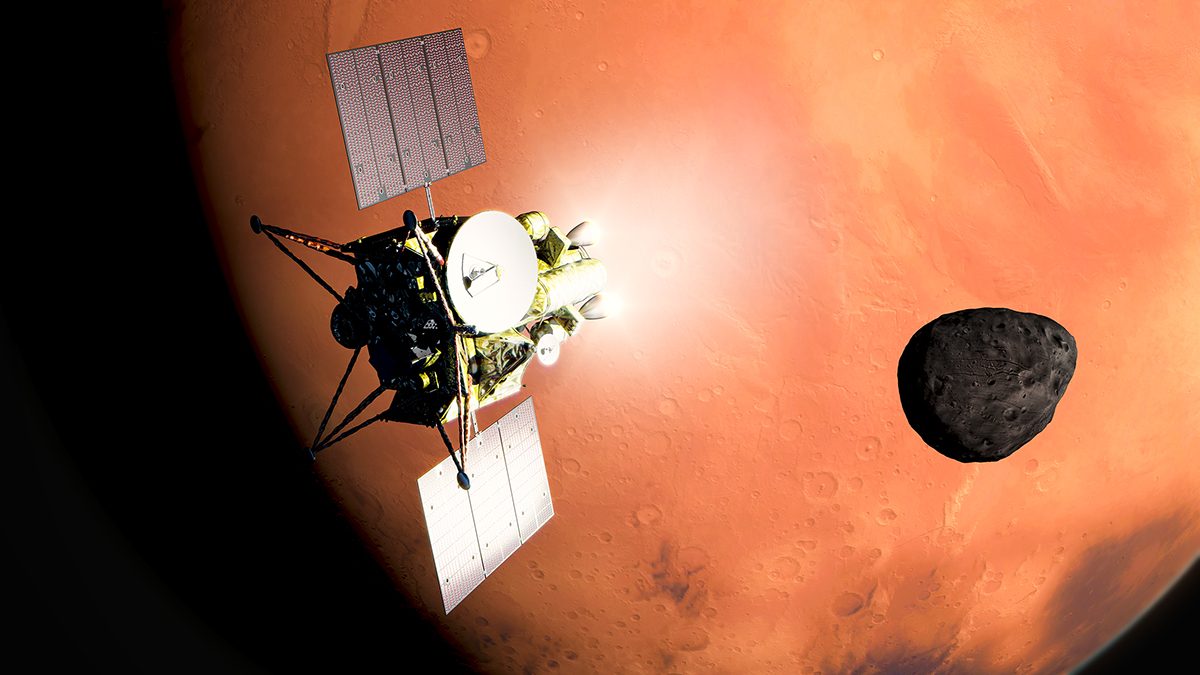
Japan has taken an important step in planetary exploration with the launch of its Martian Moons eXploration (MMX) mission. Led by the Japan Aerospace Exploration Agency (JAXA), the mission will study the two moons of Mars, Phobos and Deimos, and attempt to bring samples from Phobos back to Earth for scientific research.
The spacecraft launched aboard Japan’s H3 rocket from the Tanegashima Space Center on October 20, 2026, Japan Standard Time. On October 21, JAXA confirmed that the spacecraft had completed its initial critical operations successfully and that its health had been confirmed. The mission is now preparing for the long journey toward the Martian system.
The goal is ambitious. MMX plans to collect at least 10 grams of material from Phobos and return it to Earth in 2031. Scientists hope these samples will help explain how Mars’ moons formed, how the Martian system developed, and how materials important to planetary habitability moved through the early Solar System.
The mission also includes international partners, including NASA, the European Space Agency (ESA), the German Aerospace Center (DLR), and France’s space agency, CNES.
What Is Japan’s MMX Mission?
MMX stands for Martian Moons eXploration. It is a robotic space mission designed to investigate Phobos and Deimos, the two natural satellites of Mars.
Although spacecraft have explored Mars for decades, scientists still have important questions about its moons. Researchers do not yet know exactly how Phobos and Deimos formed or whether they are made from material created near Mars or from objects captured by the planet’s gravity.
MMX aims to address these questions by studying the moons up close and returning a sample from Phobos for laboratory analysis.
The spacecraft will use scientific instruments to examine the moons’ surfaces, shapes, composition, gravity, and other physical properties. These measurements will help researchers compare Phobos and Deimos with Mars and other bodies in the Solar System.
The mission is also designed to test technologies needed for future exploration. Landing on a small moon, collecting surface material, and returning it to Earth require careful navigation, precise control, reliable communication, and a safe return system.
According to JAXA, the mission is planned to last approximately five years, with the return capsule expected to reach Earth in 2031.
Why Is Phobos Important to Scientists?
Phobos is the larger of Mars’ two moons, although it is still small compared with Earth’s Moon. It has an irregular shape and a heavily marked surface containing craters.
Its unusual appearance and uncertain origin make it an important target for planetary scientists.
There are two leading explanations for the origin of Mars’ moons.
Theory 1: The moons formed after a major impact
One theory suggests that a large object collided with Mars early in the planet’s history. The impact may have thrown material into orbit around Mars, where some of that material later came together to form the moons.
If this theory is correct, Phobos could contain material connected to Mars itself. Studying its composition could help scientists understand the impact and the conditions that existed during the planet’s early development.
Theory 2: The moons are captured asteroids
Another possibility is that Phobos and Deimos were once independent objects in space. Mars may have captured them through its gravitational pull.
If this explanation is correct, the moons could preserve clues about the population of small bodies that existed in the early Solar System.
Scientists have not fully resolved the debate. Observations from spacecraft can provide useful information, but bringing material back to Earth could allow researchers to conduct much more detailed tests.
The MMX mission is designed to help determine which explanation better fits the evidence.
How Will MMX Collect Samples From Phobos?
Collecting material from a small moon is a difficult engineering challenge. Phobos has very low gravity, so a spacecraft must control its movement carefully when approaching and touching the surface.
MMX will first travel to the Martian system and conduct detailed observations of Phobos. Scientists will use these observations to identify suitable landing areas and understand the surface conditions.
The mission plan includes two soft-landing operations: one for the IDEFIX rover and another for the main spacecraft.
The rover is designed to examine the surface and help scientists understand the terrain. This information can support the selection of a safe sampling location.
The main spacecraft will then attempt to land on Phobos and collect surface material using its sampling system. JAXA aims to bring back at least 10 grams of material.
Although this amount may appear small, even a few grams can provide valuable scientific information when analyzed with advanced laboratory equipment.
Scientists on Earth can use instruments that are too large, complex, or sensitive to carry on a spacecraft traveling millions of kilometers.
The samples could reveal details about the minerals, chemical elements, and physical structure of Phobos. Researchers may also search for material that originated from Mars and was transported to the moon by ancient impacts.
What Is the IDEFIX Rover?
IDEFIX is a small rover developed jointly by the German Aerospace Center and France’s space agency, CNES.
The rover will travel with the MMX spacecraft and is expected to explore the surface of Phobos before the main spacecraft attempts its sample collection.
Its task is to examine the moon’s surface and provide information about the environment where the sampling operation will take place.
Operating a rover on Phobos is challenging because the moon’s gravity is extremely weak. A rover designed for Earth or Mars cannot simply operate in the same way on such a small body.
The IDEFIX project therefore supports the development of technology for moving across small celestial objects.
According to the German Aerospace Center, the rover is expected to reach Phobos around the turn of 2028 and 2029 and explore the surface for approximately 100 days. Its observations will help improve understanding of the moon’s terrain and support the wider MMX mission.
The rover also demonstrates the international nature of the project. Japan is leading the mission, while European partners are contributing important hardware and scientific expertise.
What Will MMX Discover About Mars?
The mission is not limited to studying Phobos. It will also observe Deimos and investigate the wider Martian system.
These observations may help scientists understand how the moons interact with Mars and how the planet’s environment has changed over time.
Studying the composition of Phobos
Scientific instruments will measure the chemical and physical properties of Phobos. Researchers can compare these observations with data from asteroids, Mars, and other planetary bodies.
The results could help identify the materials that formed the moon and provide clues about its history.
Searching for traces of ancient Mars
If Phobos contains material ejected from Mars by ancient impacts, the returned sample could offer an indirect way to study parts of the Red Planet.
Such material might preserve information about Mars’ early surface and geological history. However, finding Martian material in the samples is a scientific possibility, not a guaranteed result.
Understanding the history of the Solar System
The moons may also preserve clues about the movement of material during the early stages of Solar System formation.
Water-bearing minerals and organic compounds are important subjects in planetary science because they can help researchers understand the conditions that support habitability.
The MMX mission will not prove that life existed on Phobos or Mars. Instead, it aims to investigate the origin and evolution of the moons and improve our understanding of the processes that shape planetary environments.
What Is NASA’s Role in the MMX Mission?
Although JAXA leads MMX, NASA is contributing scientific equipment and expertise.
One important instrument is MEGANE, developed by the Johns Hopkins Applied Physics Laboratory in collaboration with Lawrence Livermore National Laboratory.
MEGANE will measure gamma rays and neutrons coming from Phobos’ surface. These measurements can help scientists determine the elements present in the moon’s surface material.
The instrument will provide information about Phobos’ chemical composition and help researchers evaluate theories about its origin.
NASA’s participation also connects the mission to wider efforts to explore Mars and prepare for future human missions to the planet.
ESA, CNES, and DLR are also contributing to the international project. Their work includes scientific support, mission collaboration, and the development of the IDEFIX rover.
This cooperation allows space agencies to share expertise and scientific resources on a mission that would be difficult for one agency to undertake alone.
MMX Mission Timeline: From Launch to Earth Return
The mission will take several years to complete because the spacecraft must travel to Mars, study its moons, collect samples, and return safely to Earth.
The following timeline reflects the mission plan published by JAXA and its partners.
| Year | Planned milestone |
|---|---|
| 2026 | MMX launches aboard Japan’s H3 rocket |
| 2027 | Spacecraft reaches the Martian system and begins its approach to Phobos |
| 2027–2030 | Detailed observations of Phobos, rover operations, sample collection, and observations of Deimos |
| 2030 | Spacecraft departs the Martian system and begins its return journey |
| 2031 | Return capsule reaches Earth with the collected sample |
The exact dates of individual operations may change as the mission progresses. Deep-space missions require careful adjustments based on spacecraft performance, navigation, and operational conditions.
The return capsule is planned to land in Australia, where it will be recovered before the sample is transferred for scientific analysis.
The returned material will be studied by researchers using laboratory techniques that can examine its composition in far greater detail than remote instruments can achieve.
Why Is Returning Samples to Earth So Important?
Spacecraft can collect images and measurements, but their onboard instruments have limits. Weight, energy, size, and reliability requirements restrict the equipment that can be sent into space.
A sample-return mission overcomes some of these limitations by bringing physical material to Earth.
Scientists can use multiple laboratory instruments to examine the same grains and compare results from different techniques. They can also preserve some of the material for future research as scientific methods improve.
This is especially important for planetary science, where a small amount of material may contain clues about events that happened billions of years ago.
JAXA has previous experience with sample-return missions through its Hayabusa and Hayabusa2 projects, which returned material from asteroids. MMX builds on that experience but introduces new challenges because it must operate in the Martian system and collect material from a moon with very low gravity.
Success would be a major achievement for Japan and the wider international space science community.
What Happens After the MMX Samples Reach Earth?
If the mission completes its return journey as planned, the sample capsule will enter Earth’s atmosphere and be recovered in Australia.
The material will then be transferred for controlled handling, cataloguing, and scientific analysis.
Researchers will study its minerals, chemical elements, and other properties to learn more about Phobos. They will compare the results with observations collected by MMX and data from other planetary missions.
The findings could help scientists determine whether Phobos formed from material around Mars or originated elsewhere in the Solar System.
The samples may also be studied by researchers beyond the mission’s original team, allowing new questions to be investigated as analytical tools improve.
However, the scientific results will depend on the material actually collected and the evidence found during analysis. The mission is designed to answer important questions, but its discoveries cannot be predicted with certainty.
Final Takeaway
Japan’s MMX mission is an ambitious effort to bring material from Phobos back to Earth for the first time. Following its successful launch and initial spacecraft operations, the mission is beginning a journey that will take it to the Martian system and back over several years.
By studying Phobos, observing Deimos, and collecting samples, MMX aims to answer major questions about the origin of Mars’ moons and the evolution of the Solar System.
If the mission succeeds, the returned material could provide scientists with new evidence that cannot be obtained through distant observations alone. It will also demonstrate technologies that may support future robotic and human exploration of Mars and its surroundings.