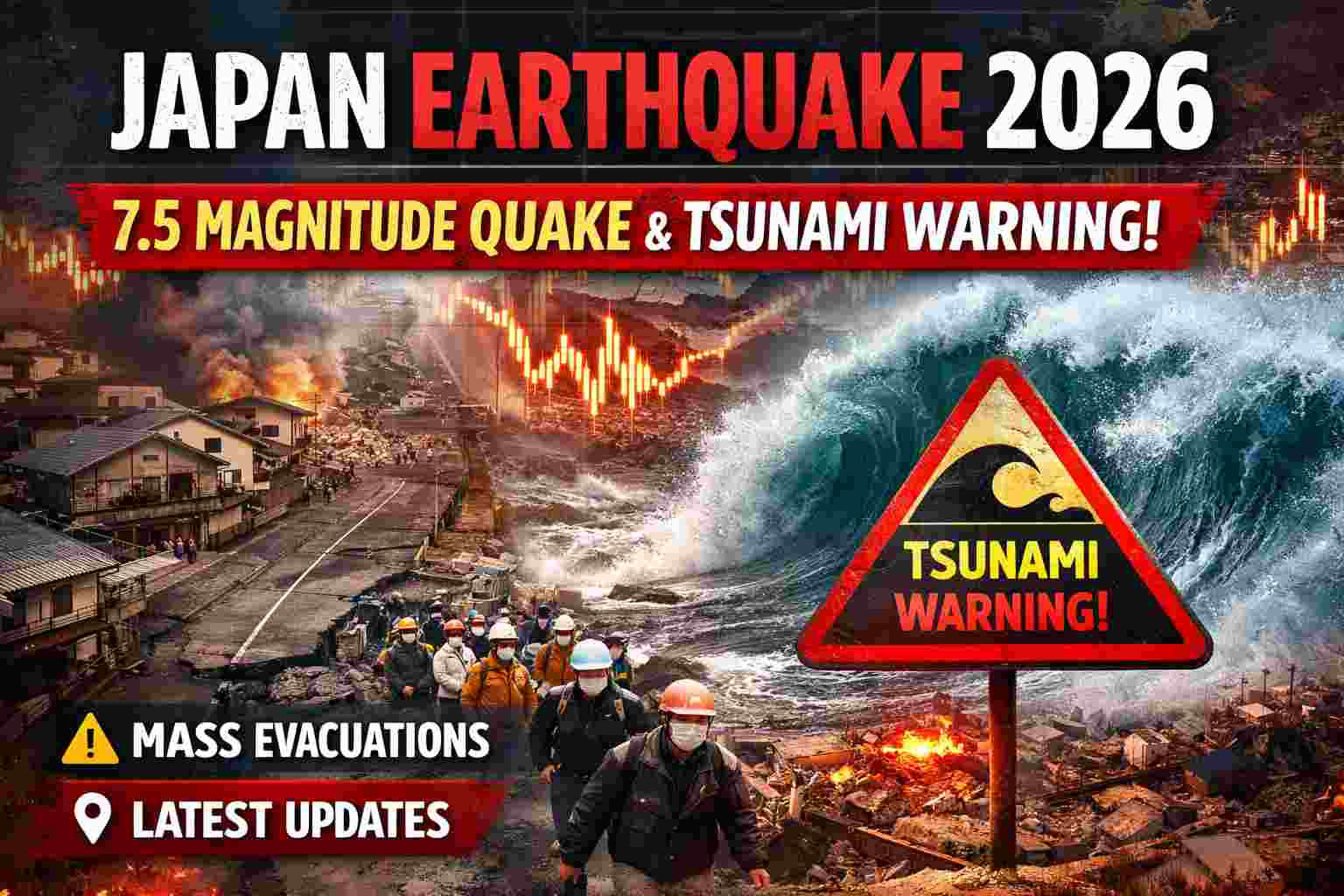
A powerful 7.5 magnitude earthquake struck off the northeastern coast of Japan on April 20, 2026, triggering widespread concern, tsunami warnings, and emergency evacuations across multiple regions. The seismic event highlights Japan’s ongoing vulnerability due to its location along the Pacific “Ring of Fire.”
Where Did the Earthquake Occur?
The earthquake hit offshore near the Sanriku region in northern Japan, with its epicenter located deep in the Pacific Ocean at approximately 10 kilometers below the surface.
The tremors were strongly felt across several regions, including:
- Iwate Prefecture
- Aomori Prefecture
- Hokkaido
Authorities reported the quake occurred around late afternoon local time, causing intense shaking categorized as “upper 5” on Japan’s seismic intensity scale—strong enough to damage buildings and disrupt infrastructure.
Tsunami Warning Issued After the Quake
Immediately after the earthquake, the Japan Meteorological Agency issued a tsunami warning, forecasting waves of up to 3 meters (nearly 10 feet).
Key tsunami updates:
- Initial waves of 40–80 cm were recorded along the coast.
- Coastal towns were placed on high alert.
- Authorities warned that multiple waves could follow, each potentially stronger than the first.
Although later assessments suggested the tsunami threat reduced, authorities urged people to stay away from coastal areas until it was completely safe.
Mass Evacuations & Emergency Response
Following the quake, large-scale evacuations were carried out:
- Over 128,000 residents were advised to evacuate across multiple regions.
- Emergency task forces were activated by the government.
- Coastal towns like Otsuchi and Kamaishi issued immediate evacuation orders.
Japanese Prime Minister Sanae Takaichi urged citizens to move to higher ground and prioritize safety.
Transport & Infrastructure Impact
The earthquake caused disruptions across Japan’s infrastructure:
- Bullet train services were suspended in affected areas as a precaution.
- Ports and coastal operations were temporarily halted.
- Ships were seen leaving harbors to avoid tsunami damage.
Despite the strong shaking, early reports indicated limited structural damage.
Nuclear Plant Safety Checks
Given Japan’s history with nuclear disasters, authorities quickly inspected nearby facilities:
- No abnormalities were reported at nuclear power plants.
- Shut-down facilities, including those in affected regions, were checked as a precaution.
This provided some reassurance amid fears of a repeat of past disasters.
Risk of Aftershocks
Experts warned that the danger may not be over:
- Aftershocks could continue for several days or even a week.
- Residents were advised to remain cautious, especially near coastal and river areas.
Japan frequently experiences aftershocks following major earthquakes due to ongoing tectonic activity.
Why Japan Faces Frequent Earthquakes
Japan lies on the Pacific Ring of Fire, one of the most seismically active zones in the world. This region is where multiple tectonic plates collide, making earthquakes a regular occurrence.
Key facts:
- Japan experiences thousands of earthquakes each year.
- It accounts for a significant portion of the world’s major seismic activity.
- Advanced building codes and early warning systems help reduce damage and save lives.
Comparison to Past Disasters
This earthquake revived memories of the devastating 2011 Japan earthquake and tsunami, which caused massive destruction and loss of life.
While the current quake is powerful, early reports suggest:
- No major casualties
- Limited damage compared to past disasters
- Faster emergency response due to improved systems
What to Do During an Earthquake & Tsunami Warning
For safety awareness, here are key steps:
During an earthquake:
- Drop, cover, and hold on
- Stay away from windows and heavy objects
- Avoid elevators
During a tsunami warning:
- Move immediately to higher ground
- Stay away from beaches and rivers
- Follow official alerts and instructions