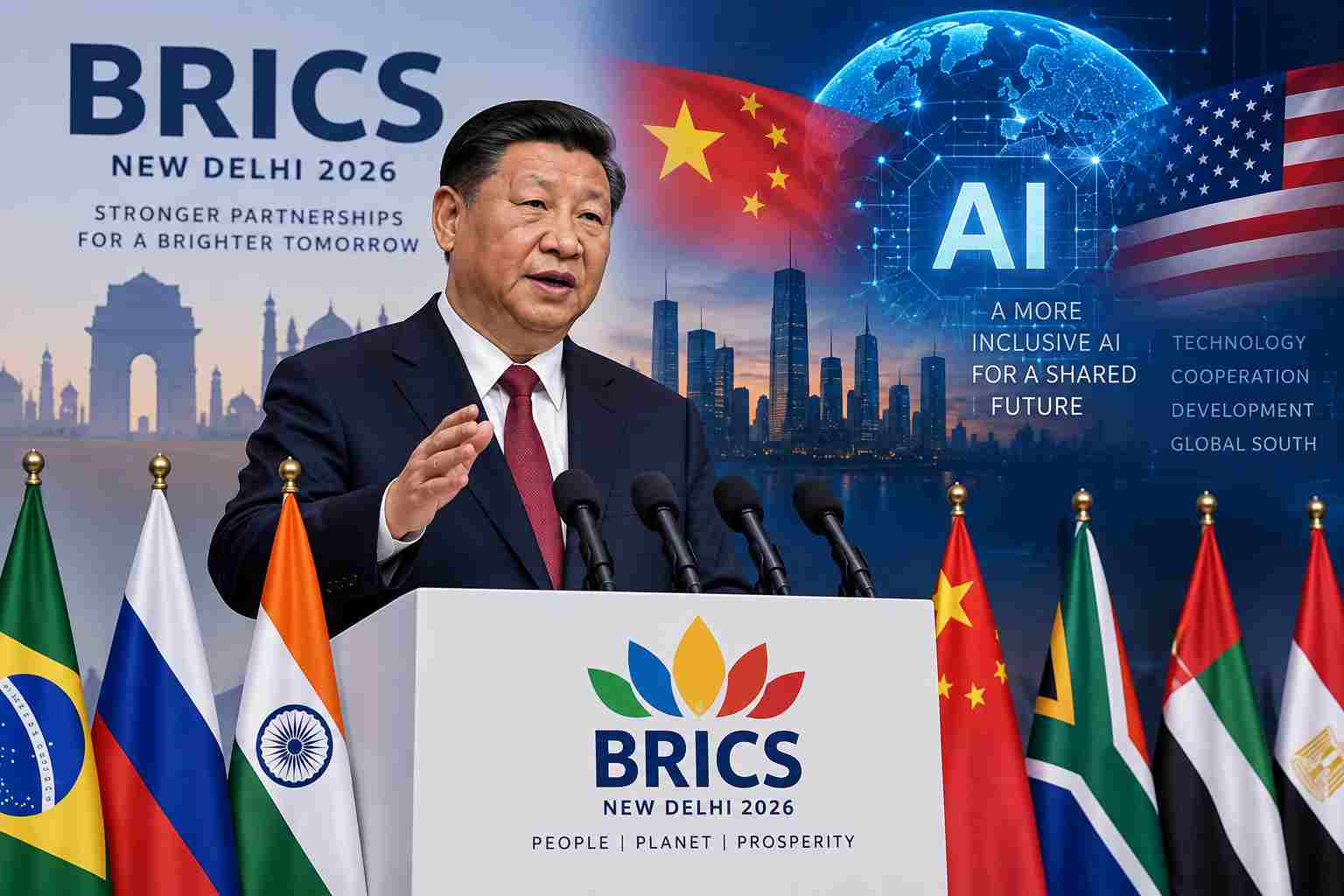
Chinese President Xi Jinping has placed artificial intelligence at the center of China’s agenda for deeper BRICS cooperation, proposing a China-led open-source AI community as Beijing seeks to strengthen technological ties with emerging economies.
Speaking at the 18th BRICS Summit in New Delhi, Xi outlined a broader plan covering artificial intelligence, trade and investment, digital industries, smart manufacturing and talent development. The proposals reflect an effort to turn the expanded BRICS grouping into a more practical platform for technological and economic cooperation among emerging markets and developing countries.
The AI proposal is particularly significant because it comes as competition over advanced technology continues to shape relations between China and the United States. Rather than focusing only on domestic AI development, Beijing is increasingly presenting its approach as an international alternative centered on open-source collaboration, training and wider access for developing economies.
China Proposes a BRICS AI Open-Source Community
One of Xi’s most prominent proposals was the creation of a BRICS AI open-source community.
Under the initiative, China plans to support cooperation among BRICS members in developing and applying large language models, while also organizing specialized AI seminars and training programs.
The broader objective is to establish an open AI ecosystem that gives participating countries more opportunities to develop and deploy artificial intelligence technologies.
Xi’s proposal could be especially relevant to developing economies that want to expand their AI capabilities but face barriers such as limited computing resources, shortages of specialized talent and dependence on technology supplied by a relatively small number of global companies.
China’s plan therefore extends beyond simply exporting AI products. It seeks to create a framework through which BRICS countries can cooperate on models, applications, skills and potentially technical standards.
AI Becomes a Bigger Part of the BRICS Agenda
Artificial intelligence is increasingly becoming an economic and geopolitical issue rather than simply a technology-sector concern.
Countries around the world are examining how AI could transform manufacturing, healthcare, education, finance, transportation, government services and scientific research.
For BRICS economies, access to AI technology could influence productivity and long-term competitiveness.
Xi argued that cooperation should include the development and application of large language models as well as specialized education and training.
China has also encouraged BRICS members to participate in broader international mechanisms promoted by Beijing for AI cooperation.
The approach fits into China’s wider argument that developing countries should have a greater voice in deciding how emerging technologies are developed, governed and distributed.
Xi Calls for a Global AI Governance Framework
China’s proposal is not limited to AI development.
Xi also called for faster progress toward a global artificial intelligence governance framework based on broad international consensus.
AI governance has become one of the most difficult issues facing governments as increasingly capable models spread across industries and national borders.
Policymakers are trying to balance innovation with concerns involving safety, security, privacy, misinformation, intellectual property and economic disruption.
There is also disagreement over who should establish global AI rules and how much influence major technology powers should have.
China’s BRICS strategy attempts to position emerging economies as participants in that debate rather than simply consumers of technologies and regulations developed elsewhere.
If BRICS members deepen coordination on AI governance, the grouping could eventually become another influential forum for discussing international technology standards.
China’s AI Strategy Extends Beyond BRICS
The BRICS proposal is part of a broader Chinese effort to expand international cooperation around artificial intelligence.
At the summit, Xi highlighted platforms intended to increase AI collaboration with countries across the Global South and encouraged BRICS members to participate.
China has increasingly linked its technology diplomacy with developing economies in Asia, Africa, Latin America and the Middle East.
That strategy could help Chinese AI companies and technologies gain broader international adoption while allowing Beijing to strengthen relationships with countries looking for alternatives to Western technology ecosystems.
However, the long-term impact will depend on implementation.
Creating an AI cooperation framework is different from building the computing infrastructure, research networks, skilled workforce and sustainable financing required to make advanced AI widely accessible.
US-China AI Competition Forms the Wider Backdrop
Xi’s announcement comes against the backdrop of intense technological competition between China and the United States.
AI has become one of the most strategically important areas of that rivalry.
The competition includes advanced semiconductors, computing infrastructure, data centers, AI models, cloud services, research talent and the international standards that could eventually govern the technology.
The United States remains home to many of the world’s most prominent AI developers and semiconductor technology companies, while China has invested heavily in domestic AI models, computing infrastructure and semiconductor capabilities.
The rivalry has also been shaped by US restrictions on China’s access to certain advanced chips and semiconductor technologies.
Against that backdrop, Beijing’s push for open-source AI cooperation with BRICS countries carries strategic significance.
A larger international ecosystem built around Chinese models, research institutions, platforms or standards could increase China’s influence in the global AI industry even when access to some US technologies is restricted.
At the same time, BRICS countries have their own national interests and technology strategies. Participation in greater AI cooperation with China does not necessarily mean aligning exclusively with Beijing.
Many emerging economies maintain economic and technological relationships with both China and the United States.
Five Initiatives for Greater BRICS Cooperation
Artificial intelligence was only one part of Xi’s wider BRICS agenda.
He presented five areas for expanding practical cooperation among members.
1. Open and Inclusive Artificial Intelligence
China proposed taking a leading role in establishing a BRICS AI open-source community.
The initiative would encourage cooperation involving large language models, AI applications, professional training and knowledge sharing.
2. Trade and Investment Facilitation
Xi proposed establishing a BRICS special economic zone partnership.
The plan is intended to strengthen policy coordination and improve trade and investment cooperation between participating economies.
China also plans to host a BRICS Forum on Trade in Services during its chairmanship in 2027.
3. Digital Industry Cooperation
China wants BRICS countries to deepen collaboration across the digital economy.
Greater digital connectivity could help businesses in member countries participate more easily in cross-border commerce while creating opportunities for cooperation in emerging technology industries.
4. Smart Manufacturing
Another priority is expanding cooperation in intelligent manufacturing.
AI, robotics, industrial software and automation are rapidly changing manufacturing, and China has significant experience building large-scale industrial supply chains.
Greater cooperation could allow BRICS members to explore smart factories, industrial modernization and new manufacturing technologies.
5. Talent Development
Xi also emphasized the importance of developing skilled workers.
AI and advanced manufacturing require engineers, researchers, software developers and other technical professionals. Training programs and educational exchanges could therefore become an important component of future BRICS technology cooperation.
BRICS Is Expanding Its Global Economic Role
The proposals come as BRICS continues to evolve beyond its original five members: Brazil, Russia, India, China and South Africa.
The grouping has expanded to include additional major emerging economies, increasing its reach across Asia, Africa, the Middle East and Latin America.
This expansion has strengthened debate over whether BRICS could become a more influential platform for the Global South.
For China, a larger BRICS provides an opportunity to promote greater economic integration among developing economies while increasing cooperation in technology, trade, finance and industrial development.
Xi called for stronger industrial and supply-chain cooperation and the development of a larger integrated market among BRICS economies.
Such ambitions are substantial because the member countries have very different economic structures, political systems and strategic interests.
BRICS therefore does not function as a unified political or economic bloc in the same way as some formal alliances.
Its influence will depend heavily on whether members can convert summit declarations and initiatives into practical projects.
India Emphasizes Inclusive Technology Development
India, which hosted the 2026 summit, also placed technology and development high on the agenda.
Prime Minister Narendra Modi argued that technological solutions developed within BRICS should not remain limited to the grouping itself. Instead, they should be adaptable and accessible to countries across the wider Global South.
India has simultaneously emphasized the importance of inclusivity and resilient supply chains.
This creates an important dynamic inside BRICS.
China has enormous manufacturing capabilities and is increasingly influential in AI, renewable energy, telecommunications and other advanced industries. India, meanwhile, has its own rapidly growing digital economy, technology sector and strategic ambitions.
The ability of the two countries and other BRICS members to identify areas of genuine cooperation will play an important role in determining how effective the group’s technology initiatives become.
Why Open-Source AI Matters
Open-source AI has become increasingly important because it can allow developers, businesses and researchers to work with models without depending entirely on closed commercial platforms.
For emerging economies, broader access could reduce some barriers to experimenting with artificial intelligence.
Local developers could potentially adapt models for domestic languages, industries and public services.
This is particularly important in countries where local languages and regional needs may receive less attention from globally dominant AI platforms.
An open ecosystem could encourage the development of AI applications designed specifically for local markets.
However, open-source access alone does not solve every challenge.
Training and operating sophisticated AI systems requires computing infrastructure, electricity, skilled workers, data and investment.
BRICS cooperation would therefore need to address the infrastructure surrounding AI as well as access to models themselves.
Could BRICS Become an Important AI Bloc?
The idea remains at an early stage.
BRICS includes countries with large populations, rapidly expanding digital economies and significant pools of engineering and scientific talent.
If members establish sustained cooperation in AI research, model development, infrastructure, education and governance, the grouping could become an increasingly important part of the global AI landscape.
China’s proposal could also encourage more AI development outside the traditional technology centers of the United States and Europe.
But several challenges remain.
BRICS members have different regulatory environments, economic priorities, technological capabilities and geopolitical relationships. Reaching common positions on data governance, AI safety, cybersecurity and technical standards could therefore be difficult.
Implementation will ultimately determine whether the initiative becomes a meaningful technology ecosystem or remains primarily a diplomatic framework.
China Prepares for the 2027 BRICS Chairmanship
The New Delhi summit also carries importance because China is expected to take over the BRICS chairmanship in 2027.
That gives Beijing an opportunity to advance the initiatives introduced by Xi and potentially convert them into more concrete programs.
AI cooperation, smart manufacturing, digital industries, trade facilitation and skills development are likely to remain important themes.
China has said it wants to work with other members to deepen cooperation as BRICS enters what Beijing describes as another phase of its development.
The next year could therefore provide an early indication of how quickly the proposed AI community moves from political commitment toward actual research, training and technology projects.
What Xi’s BRICS AI Proposal Means for the Global Technology Race
Xi Jinping’s BRICS initiative demonstrates how artificial intelligence is becoming intertwined with diplomacy and international economic strategy.
The global AI competition is no longer only about which company produces the most capable model.
It increasingly involves access to semiconductors, computing power, infrastructure, technical standards, talent, international partnerships and regulatory influence.
China is attempting to strengthen its position by presenting AI cooperation as part of a wider development agenda for emerging economies.
The United States, China, Europe and other major technology powers are simultaneously developing their own approaches to AI innovation and governance.
For countries across the Global South, this competition could create opportunities to gain investment, infrastructure, training and access to advanced technologies.
It could also create difficult decisions over technology standards, supply chains and strategic dependencies.