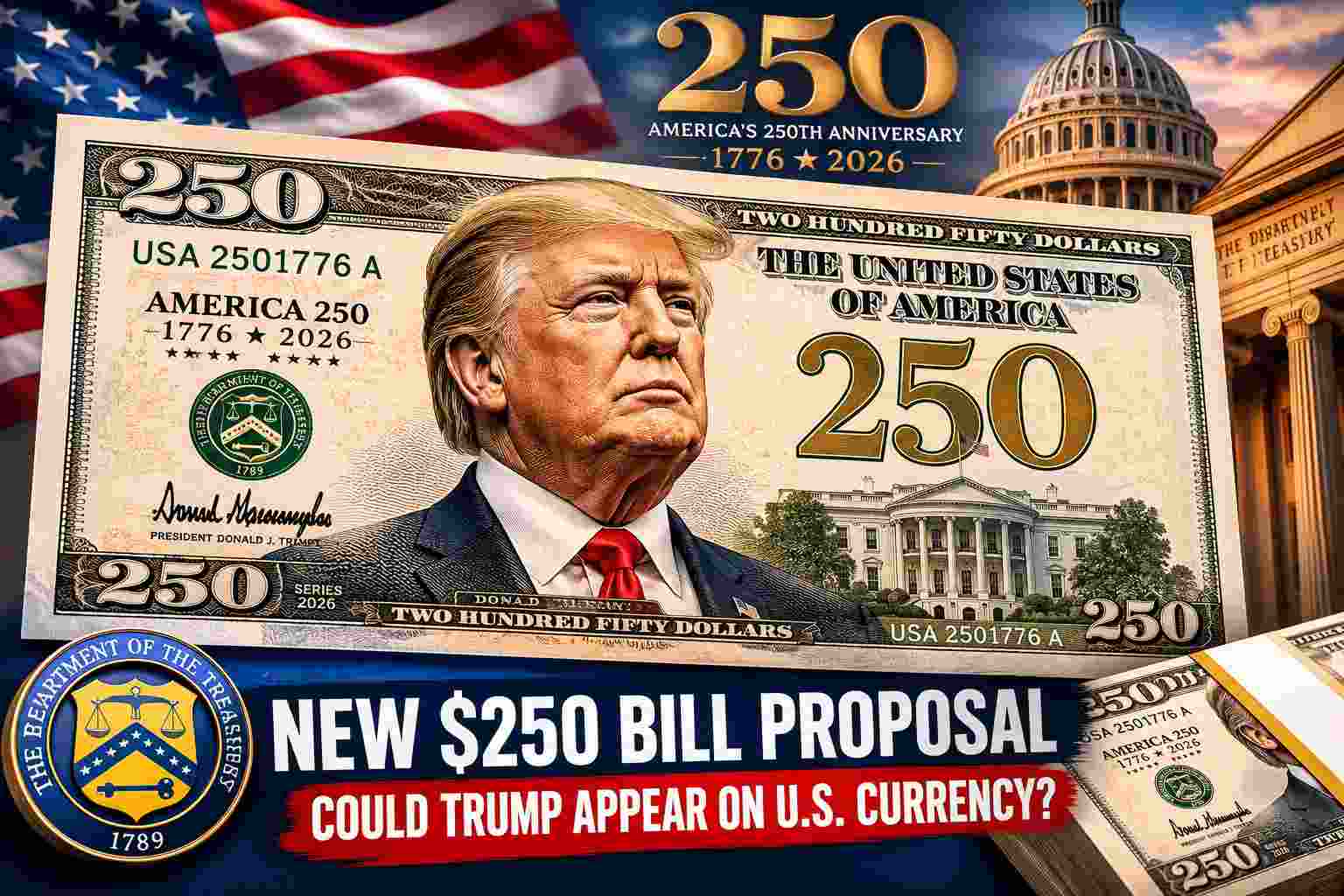
Could Donald Trump Appear on a New $250 Bill?
A proposal to place President Donald Trump’s image on a newly created $250 bill is generating significant discussion across the United States. The idea, tied to the nation’s upcoming 250th Independence Anniversary celebrations in 2026, would mark one of the most dramatic changes to American currency in modern history. However, before such a bill could become reality, Congress would need to approve legislation that overturns a long-standing federal restriction preventing living individuals from appearing on U.S. paper money.
The proposal has quickly become one of the most talked-about political and financial developments of the year, attracting both strong support and intense criticism from lawmakers, historians, and currency experts.
Why Is a $250 Bill Being Proposed?
The proposed denomination is intended to commemorate the United States’ 250th anniversary, often referred to as the Semiquincentennial, which will be celebrated on July 4, 2026. Supporters argue that the milestone deserves unique commemorative initiatives, and some lawmakers believe a special $250 note could serve as a symbolic tribute to the occasion.
Republican Representative Joe Wilson introduced legislation that would authorize the Treasury Department to print a $250 Federal Reserve note featuring Donald Trump’s portrait. According to supporters of the measure, the bill would honor both the nation’s historic anniversary and Trump’s role during the celebration period.
Current Law Prevents Living People From Appearing on U.S. Currency
One of the biggest obstacles facing the proposal is federal law.
Since 1866, U.S. law has prohibited living individuals from being depicted on American paper currency. The rule was introduced after controversy surrounding the appearance of a government official on currency issued during the 19th century. As a result, portraits on modern U.S. banknotes have traditionally featured deceased presidents and historical figures.
For the proposed Trump $250 bill to move forward, Congress would need to pass legislation creating an exception or modifying the existing restriction. Treasury officials have emphasized that any action would require full legal authorization before implementation.
Treasury Department Says It Is Preparing for Possibility
Treasury Secretary Scott Bessent confirmed that the department has conducted preliminary planning related to the proposal. According to reports, officials have examined design concepts and potential production requirements should Congress ultimately approve the legislation.
Bessent stated that the Treasury remains committed to following existing laws while also preparing for potential future scenarios. He indicated that any final decision rests with lawmakers rather than the Treasury Department itself.
Reports suggest that prototype concepts have already been discussed internally, featuring Trump’s portrait alongside references to America’s 250th anniversary celebration.
What Would the Proposed Design Look Like?
Although no official design has been approved, reports indicate that early concept artwork includes:
- A portrait of Donald Trump on the front of the note.
- References to the “America 250” celebration.
- Commemorative elements highlighting the nation’s 250 years of independence.
- Additional patriotic imagery associated with the anniversary.
Any final design would require approval through the federal currency design and production process.
Political Reactions Remain Divided
The proposal has quickly become a political flashpoint.
Supporters argue that commemorative currency is an appropriate way to recognize major national milestones and believe Trump’s image reflects a significant period in modern American politics. They contend that creating a special anniversary note could generate public interest and serve as a collectible historical item.
Critics, however, argue that placing a living president on U.S. currency would break with more than 150 years of tradition. Opponents have raised concerns about politicizing national symbols and changing long-established practices that were designed to keep American currency nonpartisan.
Several Democratic lawmakers have publicly criticized the idea, describing it as unnecessary and controversial during a period when many Americans are focused on economic challenges.
Would a $250 Bill Actually Be Used?
Another major question involves practical usage.
Currently, the highest denomination in active circulation is the $100 bill. The U.S. Treasury and Federal Reserve have repeatedly indicated that existing denominations adequately meet public needs. Historically, larger denominations such as $500, $1,000, $5,000, and $10,000 bills were discontinued decades ago.
Because of modern electronic payments, critics question whether a $250 note would have significant real-world utility. Supporters counter that the bill’s primary purpose would be commemorative rather than transactional.
Historical Significance if Approved
If Congress authorizes the measure and the bill enters circulation, it would represent a historic first in modern American currency.
Trump would become the first living individual to appear on U.S. paper money since the federal restriction was established in the 19th century. The move would also create an entirely new denomination not currently used in the American monetary system.
Financial historians note that such a change would rank among the most significant redesigns of U.S. currency in generations.