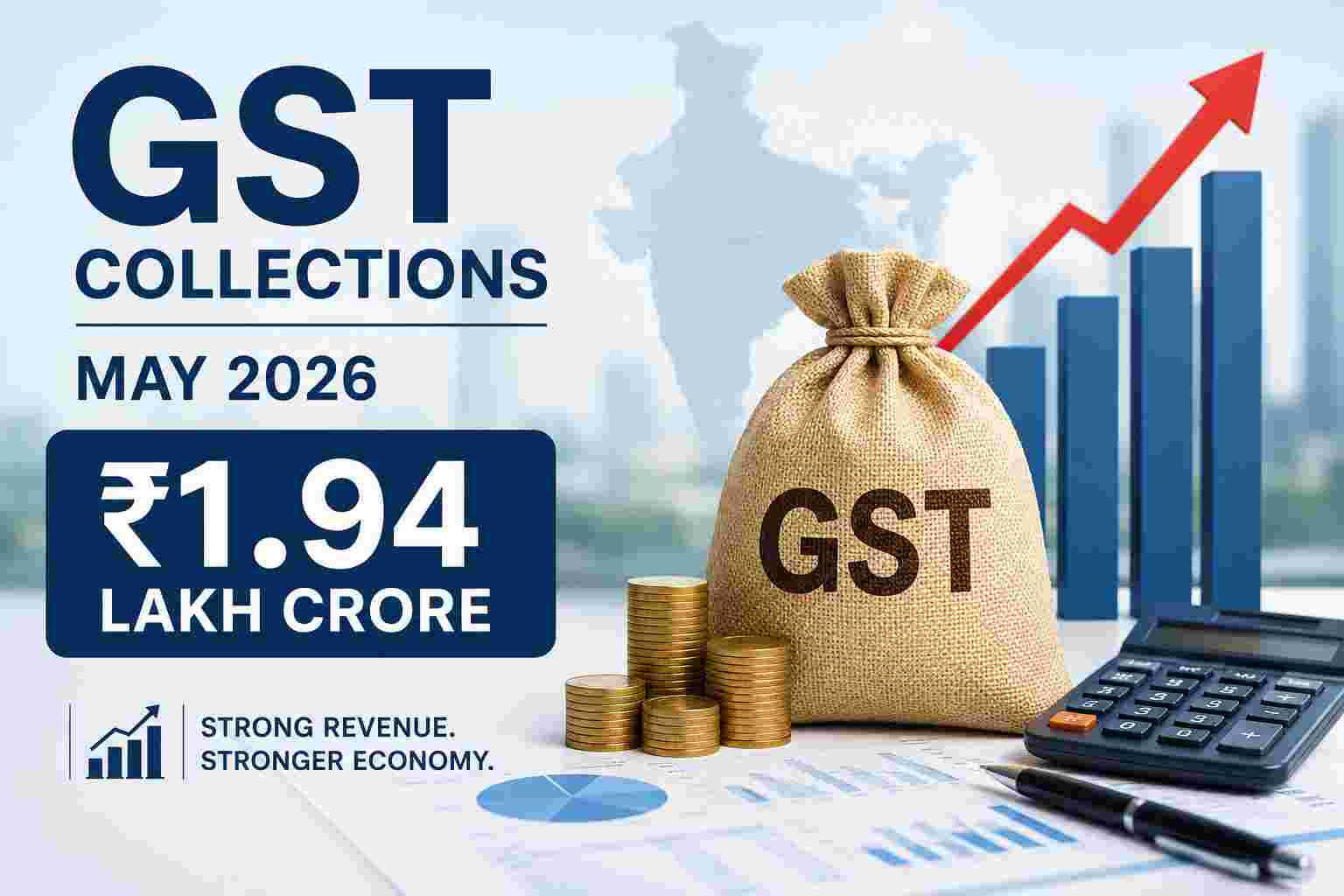
India’s Goods and Services Tax (GST) collections remained strong in May 2026, showing the continued strength of the country’s tax system and economic activity. According to official government data, gross GST collections reached approximately ₹1.94 lakh crore during May 2026. Although this was lower than the record-breaking collections seen in April 2026, it still represented a year-on-year growth of 3.2% compared to May 2025.
The latest figures indicate that businesses are continuing to comply with tax regulations, while consumer spending, trade activities, and imports remain healthy despite global economic uncertainties.
GST Collections in May 2026
The total gross GST revenue collected in May 2026 stood at more than ₹1.94 lakh crore. This includes revenue from Central GST (CGST), State GST (SGST), Integrated GST (IGST), and compensation cess.
Key highlights include:
- Gross GST collections crossed ₹1.94 lakh crore.
- Collections increased by 3.2% compared to May 2025.
- Domestic economic activity continued to support tax revenues.
- Import-related GST collections remained an important contributor to overall growth.
- Tax compliance levels remained stable across sectors.
While the growth rate was lower than some previous months, the collections remained among the highest monthly GST revenues recorded in India.
Why GST Collections Matter
GST is one of the most important sources of revenue for the Indian government. It is collected on the sale of goods and services throughout the country.
Strong GST collections are often considered a sign of:
- Healthy business activity
- Strong consumer demand
- Better tax compliance
- Growth in formal economic transactions
- Increased government revenue for development projects
Economists and policymakers closely monitor GST collections because they provide valuable insights into the overall health of the economy.
Comparison with April 2026
April 2026 had recorded a historic GST collection of approximately ₹2.43 lakh crore, the highest monthly GST collection ever recorded in India. The May figure of ₹1.94 lakh crore appears lower when compared with April, but this decline is not unusual.
Several factors contribute to exceptionally high GST collections in April:
1. Financial Year-End Adjustments
Businesses complete annual account reconciliations and clear pending tax liabilities at the end of the financial year. These adjustments often boost April collections significantly.
2. Strong Tax Compliance
Digital monitoring, e-invoicing systems, and improved reporting mechanisms have helped increase compliance among businesses.
3. Import Activity
Higher import values generate additional GST revenue because imported goods are subject to GST at the time of entry into India. Import-related collections contributed significantly to recent GST growth.
Therefore, while May collections were lower than April’s record figure, they still demonstrate a stable and resilient tax base.
Domestic Demand Continues to Support Revenue
One of the positive signals from the May GST data is the continued contribution of domestic transactions.
Consumer spending, manufacturing activity, logistics, retail trade, and service-sector growth continue to generate tax revenue. As businesses expand and more transactions move into the formal economy, GST collections benefit from a broader tax base.
Experts believe that stable domestic demand remains one of the key drivers behind India’s consistent GST performance over the past few years.
Role of Imports in GST Growth
Import-related GST collections have become increasingly important in recent months.
When the value of imported goods rises due to higher commodity prices, currency fluctuations, or increased demand, GST collections from imports also increase. Recent government data has shown stronger growth in import-related GST revenue compared to some domestic segments.
This trend highlights India’s active participation in global trade while also contributing additional revenue to government finances.
Benefits of Strong GST Collections
Higher GST collections provide several advantages for the economy:
Increased Government Revenue
Higher tax collections allow the government to invest more in infrastructure, healthcare, education, transportation, and public welfare programs.
Better Fiscal Stability
Strong revenue collections help reduce fiscal pressure and improve budget management.
Improved Business Formalization
As more businesses register under GST and follow compliance requirements, the formal economy continues to expand.
Greater Economic Transparency
Digital GST systems have improved transparency in transactions and reduced tax leakage.
Challenges That Could Affect Future Collections
Despite the positive numbers, several factors could influence future GST performance:
- Global economic slowdowns
- Rising crude oil prices
- Inflationary pressures
- Changes in consumer spending patterns
- International trade disruptions
- Currency fluctuations
These factors can impact both domestic demand and import activity, which ultimately affect GST revenue growth.
Outlook for the Coming Months
Experts expect GST collections to remain strong during the 2026 financial year. The government’s continued focus on digital compliance, e-invoicing, data analytics, and tax monitoring is expected to support revenue growth.
India’s expanding economy, growing digital payments ecosystem, and increasing formalization of businesses could help maintain collections above historical averages.
While monthly fluctuations are normal, the long-term trend suggests that India’s GST system has become more efficient and capable of generating stable revenue for economic development.
Conclusion
India’s GST collections of ₹1.94 lakh crore in May 2026 reflect the continued strength of the country’s tax framework and economic activity. Although the figure was lower than April’s record-breaking collection, it still showed positive annual growth and demonstrated strong tax compliance across sectors.
The combination of healthy domestic demand, steady business activity, improved compliance systems, and robust import revenues continues to support GST collections. As India moves forward with economic reforms and digital tax administration, GST is expected to remain a critical pillar of government revenue and economic growth.