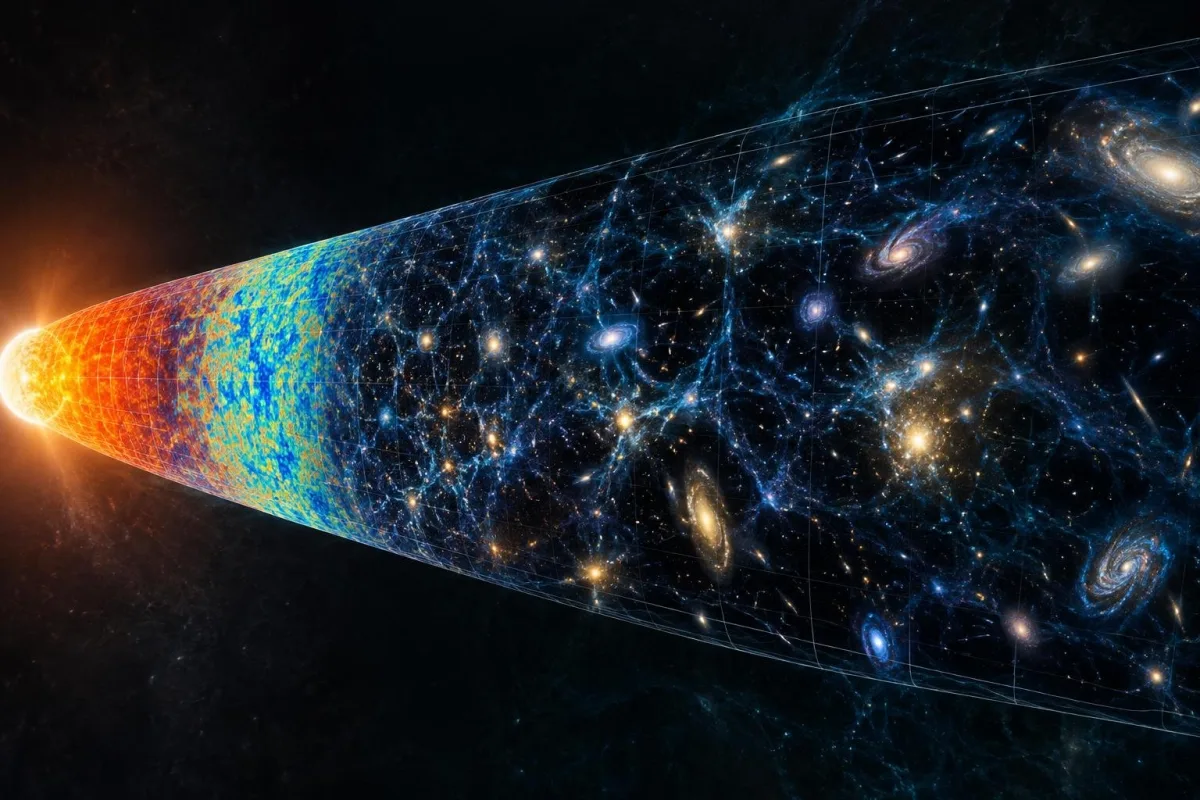
Scientists have developed a powerful computer simulation called Lumina to explore how the early universe evolved after the Big Bang. The model follows the growth of galaxies, stars, gas clouds, and other cosmic structures over the universe’s first two billion years.
Researchers from the Center for Astrophysics | Harvard & Smithsonian, MIT, and other institutions helped develop the simulation. Their work could help astronomers understand new observations from the James Webb Space Telescope (JWST) and future space missions. The research appeared in Monthly Notices of the Royal Astronomical Society in October 2026.
What Is the Lumina Simulation?
Lumina is a large-scale computer model that recreates important stages of the early universe. It tracks how ordinary matter, dark matter, and radiation interact across space.
These interactions helped shape the first stars and galaxies. They also changed the gas between galaxies over time. By modeling these processes, scientists can explore how the universe developed from a much simpler early state into the complex cosmos we observe today.
The simulation covers a region about 1.6 billion light-years across. It also captures small details within individual developing galaxies. This combination of large-scale coverage and fine detail makes Lumina a major step forward in cosmological simulations.
How Does Lumina Work?
Lumina uses advanced physics models and immense computing power to simulate the changing universe. It follows dark matter, gas, stars, galaxies, and radiation as they evolve and affect one another.
The model builds on an earlier galaxy-formation framework called IllustrisTNG. Researchers improved its computing methods and added a system that tracks how radiation moves through space and interacts with gas.
The simulation contains around half a trillion resolution elements. These represent components such as dark matter particles and gas cells. The calculations ran on Frontier, a powerful supercomputer at Oak Ridge National Laboratory in the United States.
At its largest scale, the project used around 15,000 graphics processing units (GPUs). This computing power allowed the team to model a much larger volume of space without losing important details.
Lumina Explores Two Major Changes in Cosmic History
One of Lumina’s key achievements is its ability to model two important changes in the early universe: hydrogen reionization and helium reionization.
1. Hydrogen Reionization
After the Big Bang, the universe cooled enough for neutral hydrogen to form. This gas absorbed much of the light moving through space. As a result, the early universe entered a period often called the cosmic dark ages.
Later, the first stars and galaxies produced ultraviolet radiation. This radiation stripped electrons from hydrogen atoms, allowing light to travel more freely through space. Scientists call this process hydrogen reionization.
Lumina models how this process spread across vast regions of the universe. It helps researchers investigate how early galaxies changed their surroundings and gradually cleared the cosmic fog.
2. Helium Reionization
Helium also went through a major transformation as the universe evolved. Lumina models how energetic radiation removed electrons from helium atoms.
The simulation indicates that early galaxies and stars played a leading role in hydrogen reionization. In contrast, powerful radiation from active supermassive black holes helped drive helium reionization.
Modeling both processes in the same simulation gives scientists a more complete picture of how the early universe changed.
Why Is Lumina Important for Astronomy?
Astronomers use telescopes to observe distant objects and study the universe’s past. However, observations alone cannot explain every process that shaped the first galaxies.
Computer simulations help fill this gap. They allow scientists to test theories and compare predicted results with real observations.
The James Webb Space Telescope has revealed galaxies from the universe’s early history. Lumina can help researchers test how such galaxies formed and how they affected the gas around them.
Scientists can also compare its predictions with future observations from the Nancy Grace Roman Space Telescope. These comparisons may reveal where current theories work well and where they need improvement.
What Could Scientists Discover Next?
Lumina provides a foundation for further research into galaxy formation, black holes, and the large-scale structure of the universe.
Researchers can use it to study how gas moves between galaxies and how radiation changes the space around them. The model may also help scientists investigate the growth of active black holes and improve predictions for upcoming astronomical surveys.
The simulation does not directly photograph the early universe. Instead, it uses established physical models and theoretical starting conditions to calculate how cosmic structures may have developed. Scientists must compare its results with telescope observations to test how accurately it represents the real universe.
The research team plans to make Lumina useful to the wider scientific community. This could help astronomers study large populations of simulated galaxies and compare them with data from current and future telescopes.
A New Tool for Understanding the Universe
Lumina gives scientists a detailed way to explore the first two billion years of cosmic history. Its large coverage, high resolution, and ability to model hydrogen and helium reionization make it a valuable research tool.
As telescopes reveal more distant galaxies, simulations like Lumina can help scientists interpret those discoveries. Together, observations and computer models may bring researchers closer to understanding how the first stars and galaxies formed and how the universe became what it is today.