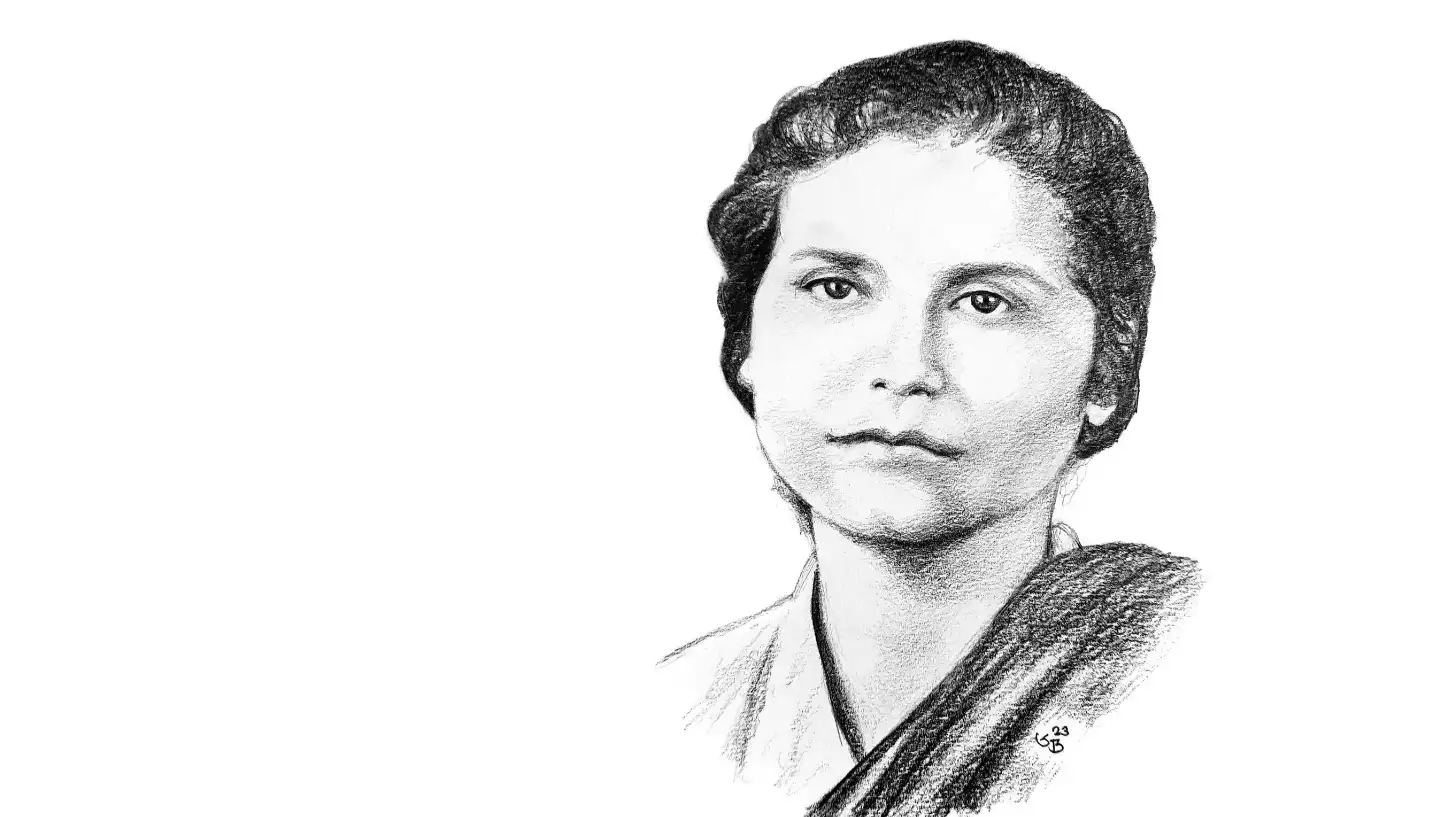
Bibha Chowdhuri was a pioneering Indian physicist who studied cosmic rays and tiny particles from space. She made important contributions to particle physics at a time when women faced many barriers in scientific research.
Born in 1913, she worked with leading scientists in India and abroad. Her research helped scientists understand mesons, a type of subatomic particle. However, her achievements received limited public recognition during her lifetime.
In 2019, the International Astronomical Union (IAU) honoured her by naming a star “Bibha.” This recognition brought renewed attention to her remarkable scientific journey.
Who Was Bibha Chowdhuri?
Bibha Chowdhuri was an Indian experimental physicist who specialised in cosmic rays and particle physics. She was born on July 3, 1913, in Calcutta, now known as Kolkata, West Bengal.
She developed an interest in physics during her education. Later, she studied the particles that cosmic rays produce when they enter Earth’s atmosphere.
At that time, few women worked in advanced physics research. Despite these challenges, Chowdhuri built a career across several leading scientific institutions.
She worked at the Bose Institute in Kolkata and later joined the University of Manchester in the United Kingdom. She also contributed to research at the Tata Institute of Fundamental Research (TIFR) and the Physical Research Laboratory (PRL) in India.
Her work helped establish an important place for women in Indian experimental physics. Today, scientists recognise her as one of India’s pioneering women particle physicists.
How Did Bibha Chowdhuri Study Cosmic Rays?
Cosmic rays are high-energy particles that travel through space. When they enter Earth’s atmosphere, they collide with atoms and create showers of smaller particles.
Scientists study these particles to understand how matter behaves at very high energies. However, researchers in the 1930s had limited tools for detecting them.
Chowdhuri worked with physicist Debendra Mohan Bose at the Bose Institute. Together, they used special photographic plates to record the tracks left by particles.
They exposed these plates to cosmic rays at high altitudes. The resulting tracks helped them investigate the properties of particles known as mesons.
Their research appeared in the scientific journal Nature during the early 1940s. These studies contributed to the early understanding of mesons and their properties.
This work was particularly important because researchers had few instruments available for studying such tiny particles. Photographic techniques offered a practical way to observe their behaviour.
Bibha Chowdhuri’s Contribution to Particle Physics
Chowdhuri’s research with D. M. Bose helped advance the study of mesons. These particles play a role in understanding the structure and interactions of matter.
Their experiments used photographic emulsions to study particle tracks. The researchers examined how particles behaved as they passed through different materials.
Later, physicist Cecil Powell made important advances in the study of mesons using photographic-emulsion techniques. He received the Nobel Prize in Physics in 1950 for developing the photographic method and making discoveries involving nuclear processes.
Scientific accounts have acknowledged the pioneering work of Bose and Chowdhuri. However, Chowdhuri herself received little recognition outside scientific circles during her lifetime.
Her story highlights how scientific progress often depends on the work of many researchers. It also shows why historians need to recognise contributions that received limited attention in the past.
Her Research Career in India and Abroad
Chowdhuri continued her scientific journey beyond her early work in Kolkata. In 1945, she moved to the University of Manchester to pursue doctoral research under physicist Patrick Maynard Stuart Blackett.
Blackett had received the Nobel Prize in Physics in 1948. Under his guidance, Chowdhuri studied extensive air showers produced by cosmic rays. She earned her PhD in 1952.
In 1949, she joined the Tata Institute of Fundamental Research in Mumbai. She became its first woman researcher and later led work involving the cloud chamber group.
She also worked at research institutions in France and the United States. These experiences allowed her to explore new methods for detecting and studying high-energy particles.
Later, Chowdhuri joined the Physical Research Laboratory in Ahmedabad. There, she contributed to cosmic-ray research and investigations involving high-energy muons at the Kolar Gold Fields.
She continued scientific work after returning to Kolkata. Her research career lasted for decades, and she remained active in physics until the later years of her life.
Why Did Bibha Chowdhuri Receive Limited Recognition?
Although Chowdhuri made important scientific contributions, she remained largely unknown to the public during her lifetime.
Women faced significant barriers in science during the early and mid-20th century. Research opportunities were limited, and institutions often gave women less visibility than their male colleagues.
Chowdhuri published research and worked alongside prominent physicists. Yet she did not receive major national scientific awards during her lifetime.
Her story gained wider attention years after her death. Books, scientific articles and public outreach projects helped bring her work to a broader audience.
Her experience also highlights the importance of recognising women in science. Their contributions can shape entire fields, even when public recognition comes much later.
Why Was a Star Named After Bibha Chowdhuri?
In 2019, the International Astronomical Union named the star HD 86081 “Bibha” to honour the Indian physicist.
The name came from a nationwide Indian campaign called NameExoWorlds India. The Astronomical Society of India coordinated the campaign and invited people to suggest names for a star and its planet.
Ananyo Bhattacharya, a student from Surat, proposed the name Bibha. The name honours Chowdhuri and also connects with the Bengali pronunciation of a Sanskrit word meaning a beam of light.
The star lies in the constellation Sextans. Its planet received the name “Santamasa,” a Sanskrit word associated with darkness or cloudiness.
The naming recognised Chowdhuri’s contributions to particle physics and cosmic-ray research. It also helped introduce her achievements to people who might not have known her story.
The tribute carries a special meaning. Chowdhuri spent her career studying particles from space, and now a star bears her name.
Bibha Chowdhuri’s Legacy in Indian Science
Bibha Chowdhuri died on June 2, 1991, in Kolkata. She left behind decades of research on cosmic rays and high-energy particles.
Her career helped expand opportunities for women in physics. She worked at major research institutions and contributed to experiments that improved scientific understanding of particles.
Today, her story also encourages students to explore science and question the barriers that limit opportunity. Her recognition shows that important contributions can receive wider appreciation even many years later.
The star named Bibha serves as a lasting tribute to her work. It also reminds us to recognise scientists whose achievements history may have overlooked.
Bibha Chowdhuri’s journey remains an important part of India’s scientific history. Her research helped advance particle physics, while her legacy continues to inspire future generations of scientists.