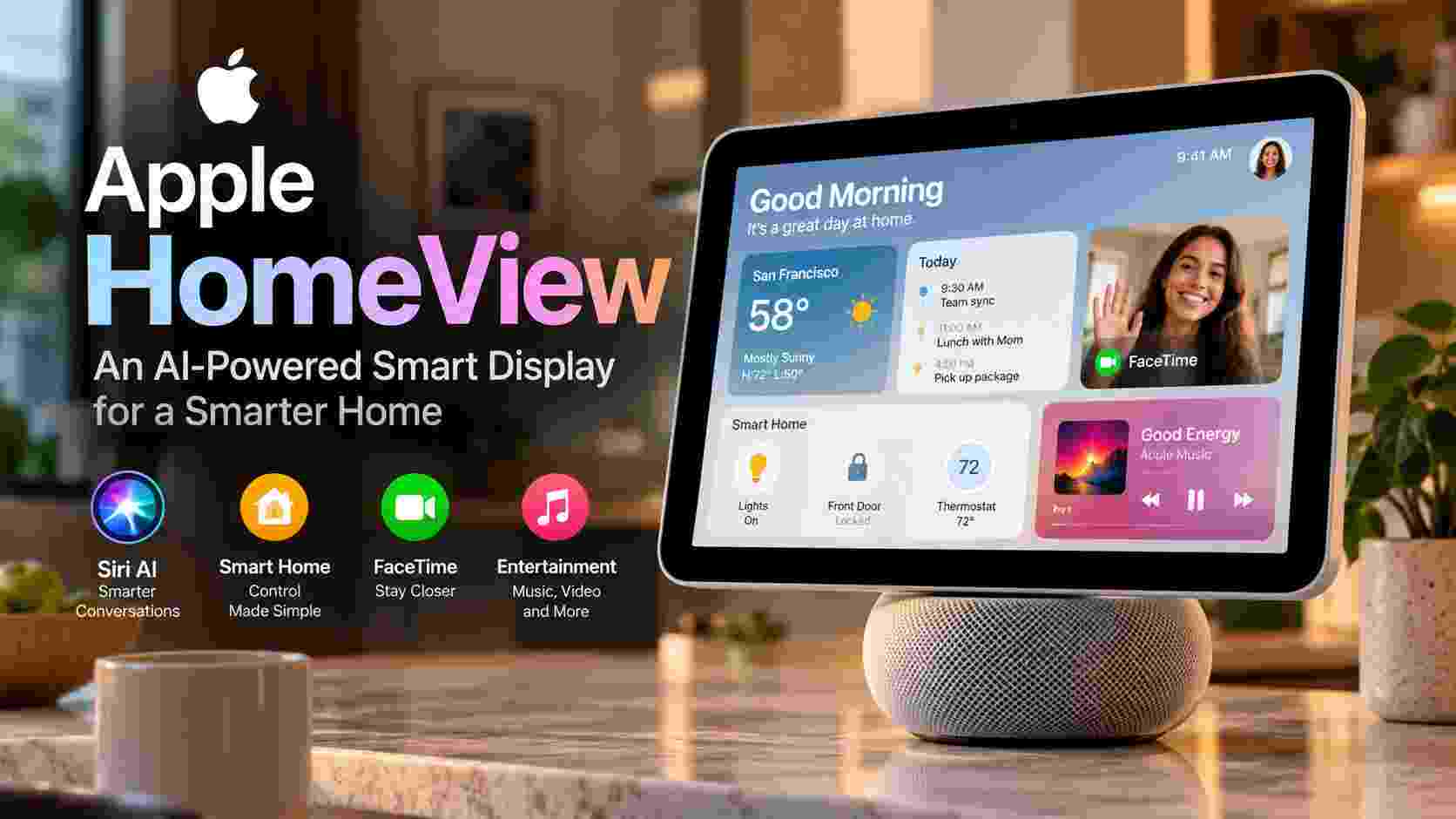
Apple has introduced HomeView, a new AI-powered smart display designed to make connected homes easier to manage. The device combines an upgraded Siri assistant, personalized household experiences, entertainment, and smart home controls in one screen.
Apple officially announced HomeView on October 13, 2026, alongside a broader expansion of its smart home ecosystem. The company is betting that advances in artificial intelligence can make everyday household technology more useful and accessible.
The new device features a 7-inch Liquid Retina display and a redesigned Siri AI assistant powered by Apple Intelligence. It can help users manage connected devices, make FaceTime calls, check household information, and access personal content.
HomeView starts at $299 in the United States. Both tabletop and wall-mounted versions are scheduled to become available on November 13, 2026.
The launch represents an important development in Apple’s strategy. Rather than limiting AI improvements to smartphones and computers, Apple is bringing its technology into shared household spaces.
However, the company faces an important challenge: convincing consumers that a dedicated smart home display offers enough value when smartphones already perform many similar tasks.
What Is Apple HomeView?
Apple HomeView is a smart display that combines several household functions into a single device.
Unlike a conventional tablet, HomeView is designed to remain in a fixed location, such as a kitchen counter, living room, bedside table, or hallway.
Its primary purpose is to provide convenient access to information, entertainment, communication, and compatible smart home accessories.
The display can show calendars, reminders, music controls, camera feeds, and other household information. Users can interact through the touchscreen or issue spoken instructions using Siri AI.
Apple offers two versions of HomeView.
The tabletop model features an adjustable screen attached to a rounded speaker base. The wall-mounted model is designed for permanent installation and provides a similar interface with a different speaker configuration.
The device is powered by Apple’s A18 chip, which supports its processing and AI capabilities.
HomeView also recognizes different household members, allowing a shared device to provide personalized experiences without requiring everyone to use the same account or home screen.
Siri AI Brings More Natural Conversations to the Home
One of HomeView’s biggest features is its integration with the new Siri AI assistant.
Apple says the updated assistant can understand more complex requests, use information displayed on the screen, and respond to follow-up questions in a more conversational way.
The system can also access relevant personal information when connected to a compatible Apple Intelligence-enabled iPhone or iPad.
For example, a user could ask Siri to find information about an upcoming appointment. The assistant could use relevant calendar details to provide an answer, rather than requiring the user to open the Calendar app manually.
Siri AI can also help with music discovery, reminders, household tasks, and questions about general topics.
An important distinction is that HomeView can provide general Siri AI features without an Apple Intelligence-enabled iPhone. However, more advanced personal-context features depend on a compatible paired device.
This approach allows Apple to offer basic AI functionality to a wider audience while reserving more personalized capabilities for users with supported hardware.
Personalized Experiences for Up to Six Household Members
A major challenge for smart home technology is supporting multiple people on one device.
A smartphone generally belongs to one person. A smart display in the kitchen may be used by an entire family.
Apple has addressed this problem by designing HomeView to recognize up to six household members.
When an enrolled user approaches the display, HomeView can switch to that person’s personalized interface.
This includes access to individual widgets, reminders, calendars, and supported communication features.
Shared household content, such as family photographs and music, can remain accessible to other members.
Apple also uses additional security checks before showing sensitive personal information.
According to Reuters, the company demonstrated how HomeView could respond differently when different family members approached the device. The system considers factors such as who last interacted with it when managing shared requests.
This personalization could make HomeView more useful in busy households, although its reliability in everyday environments will need to be assessed after release.
Apple HomeView Features: Smart Controls, Security and Entertainment
HomeView is designed to function as a central dashboard for compatible connected devices.
Through Apple’s Home app and Siri AI, users can manage several household systems without switching between different applications.
Smart home controls and automation
HomeView supports compatible smart lights, thermostats, door locks, cameras, and window blinds.
For example, users could create a morning routine that adjusts the temperature, switches on selected lights, and starts playing music.
These actions depend on having compatible accessories and properly configured automations.
The device also supports Apple Home and compatible Matter accessories, helping it work with products from participating manufacturers.
Home security and camera monitoring
HomeView can display live feeds from supported security cameras.
Apple says its camera dashboard can show up to nine video feeds simultaneously.
With compatible cameras and an eligible iCloud+ subscription, the system can identify activity involving people, pets, vehicles, and delivered packages.
AI-generated video descriptions can also help users understand recorded events without watching an entire clip.
The display includes sound recognition technology designed to detect smoke and carbon monoxide alarm sounds and send notifications to supported Apple devices.
These functions supplement existing home security equipment rather than replace dedicated safety alarms.
FaceTime and everyday communication
HomeView includes a 12-megapixel camera with Center Stage support.
The feature automatically adjusts video framing to keep participants visible as they move.
This could be particularly useful during video calls from a kitchen or shared living space.
Users can also access Messages, communicate through Apple’s Intercom feature, and view household reminders.
Music, video and recipes
HomeView supports entertainment through services including Apple Music, Apple Podcasts, and Apple TV.
It can display song lyrics, photographs, and other visual content.
In the kitchen, the device can present recipes as step-by-step instructions while allowing users to manage timers using voice commands.
Its audio capabilities include Spatial Audio and computational sound processing, although the tabletop and wall-mounted models have different speaker configurations.
Apple Expands Its Smart Home Ecosystem Beyond HomeView
Apple’s announcement was not limited to a single smart display.
The company also introduced an updated HomePod mini, a new Apple TV 4K, and a collection of smart home accessories developed with partners.
The broader product strategy suggests that Apple wants its devices to operate as parts of one connected household system.
HomePod mini 2
The second-generation HomePod mini introduces updated hardware, additional colors, and enhanced entertainment capabilities.
Apple has confirmed that Siri AI support will arrive through a future software update rather than being available at launch.
The speaker will also support a four-speaker surround sound arrangement when paired with the new Apple TV 4K.
New Apple TV 4K
The latest Apple TV 4K includes built-in microphones that allow hands-free interaction with Siri AI.
Users can search for entertainment, control compatible smart home accessories, and access household camera notifications from their television.
Apple has also introduced additional home theater capabilities and improvements to its Siri Remote.
Apple Home Collection
Apple worked with LG Electronics and Schneider Electric to develop a new collection of connected home accessories.
The lineup includes smart cameras, video doorbells, locks, thermostats, and temperature sensors.
Apple says the accessories are designed for simplified setup through an iPhone and centralized management using the Home app.
The collection is expected to become available in stages beginning in December 2026, with some products arriving in early 2027.
The accessories will be sold separately, meaning consumers may need to spend considerably more than HomeView’s starting price to build a complete smart home system.
Privacy Is Central to Apple’s AI Smart Home Strategy
Privacy is particularly important for devices that contain cameras and microphones and remain inside private homes.
Apple says HomeView uses dedicated security features built into its A18 chip to isolate sensitive camera and microphone processing.
The company calls these protected processing environments Secure Exclaves.
For personalized information, HomeView relies on security checks involving facial recognition and a compatible paired device.
Apple says private content from apps such as Messages and Calendar is only displayed when the appropriate user is recognized and other authentication requirements are satisfied.
Siri AI can process certain requests directly on the device. Other requests may use Apple’s Private Cloud Compute infrastructure.
According to Apple, this system is designed to process requests without retaining the data or making it accessible to the company.
Reuters also reported that Apple does not intend to use HomeView’s personal information to build advertising profiles.
These are significant privacy commitments. However, consumers will still need to consider device settings, camera permissions, connected accessories, and the privacy practices of third-party services.
Apple HomeView Price and Release Date
Apple has confirmed pricing and initial availability for its new smart display.
| Detail | Confirmed information |
|---|---|
| Product | Apple HomeView |
| Starting price in the US | $299 |
| Price in India | ₹39,900 |
| Display | 7-inch Liquid Retina |
| Processor | Apple A18 |
| Camera | 12MP Center Stage |
| Models | Tabletop and wall-mounted |
| Pre-orders | Began October 13, 2026, in initial markets |
| Release date | November 13, 2026 |
Both HomeView versions have the same starting price in the United States and India.
However, compatible accessories, wall-mounting hardware, and eligible subscription services may add to the total cost.
Apple has confirmed initial availability in markets including the United States, United Kingdom, Canada, Australia, India, and New Zealand.
Siri AI will initially support English in the announced markets.
HomeView is not currently being offered for sale in the European Union because Siri AI is not yet available there under Apple’s announced rollout arrangements.
Why Apple Believes AI Could Revive the Smart Home Market
The smart home industry has promised greater convenience for more than a decade.
Connected speakers, security cameras, smart lighting, and automated thermostats are already available from several major technology companies.
However, setting up these systems can be complicated.
Consumers may encounter incompatible devices, unreliable connections, multiple mobile applications, or confusing voice commands.
Apple is attempting to address these problems through deeper hardware integration and a more capable AI assistant.
The company’s approach centers on making everyday tasks easier rather than requiring users to learn complicated automation systems.
Industry figures also show why the opportunity remains uncertain.
According to Circana data cited by Axios, US smart speaker sales measured in dollars declined by 9% in 2024 and a further 7% in 2025.
The figures suggest that interest in connected home technology has not consistently translated into stronger hardware sales.
Apple may be able to attract customers who already own iPhones and other Apple products. Nevertheless, the company must demonstrate that HomeView delivers benefits beyond those available on existing devices.
Apple Faces Competition From Amazon and Google
Apple enters a market where Amazon and Google already have established smart home ecosystems.
Amazon’s Echo devices and Google’s Nest products have helped popularize voice-controlled home technology.
Both companies have also been investing in more advanced AI assistants.
Apple’s potential advantage lies in the integration of its hardware, software, personal data controls, and existing customer ecosystem.
HomeView’s ability to recognize household members and connect securely with compatible iPhones could provide a differentiated experience.
However, there are also limitations.
Households using devices from several manufacturers may need to check compatibility carefully. Some of HomeView’s most advanced capabilities also depend on other Apple products.
Price is another consideration, particularly for consumers who only need basic voice controls, music playback, or a digital photo display.
For Apple, the challenge is not simply developing a more intelligent assistant. It is making the experience useful enough for consumers to justify purchasing additional hardware.
What HomeView Could Mean for the Future of AI Devices
HomeView reflects a broader shift in the consumer technology industry.
Companies are exploring how artificial intelligence can become part of everyday products rather than remain limited to smartphone apps or web-based chatbots.
In the home, this could mean assistants that understand household routines, coordinate connected appliances, and provide more relevant information with fewer instructions.
Apple’s approach emphasizes a familiar form factor: a screen combined with speakers, microphones, and a camera.
Rather than introducing an entirely unfamiliar AI gadget, the company is attempting to improve an existing product category.
The strategy also raises questions about long-term consumer demand.
A more conversational assistant may improve convenience, but it does not automatically make a separate smart display essential.
The success of HomeView will depend on how consistently its AI features work, how easily accessories connect, and whether users find its personalized capabilities valuable over time.
With availability scheduled for November, real-world testing will provide a clearer picture of whether Apple’s latest smart home investment can meet those expectations.
Frequently Asked Questions
What is Apple HomeView?
Apple HomeView is an AI-powered smart display featuring Siri AI, a 7-inch touchscreen, FaceTime, and controls for compatible smart home devices.
How much does Apple HomeView cost?
The starting price is $299 in the United States and ₹39,900 in India.
When will Apple HomeView be released?
Apple has announced November 13, 2026, as the initial availability date in supported markets.
Does HomeView require an iPhone?
HomeView can provide general Siri AI functionality without an Apple Intelligence-enabled iPhone. However, advanced personalized features require a compatible paired iPhone or iPad.