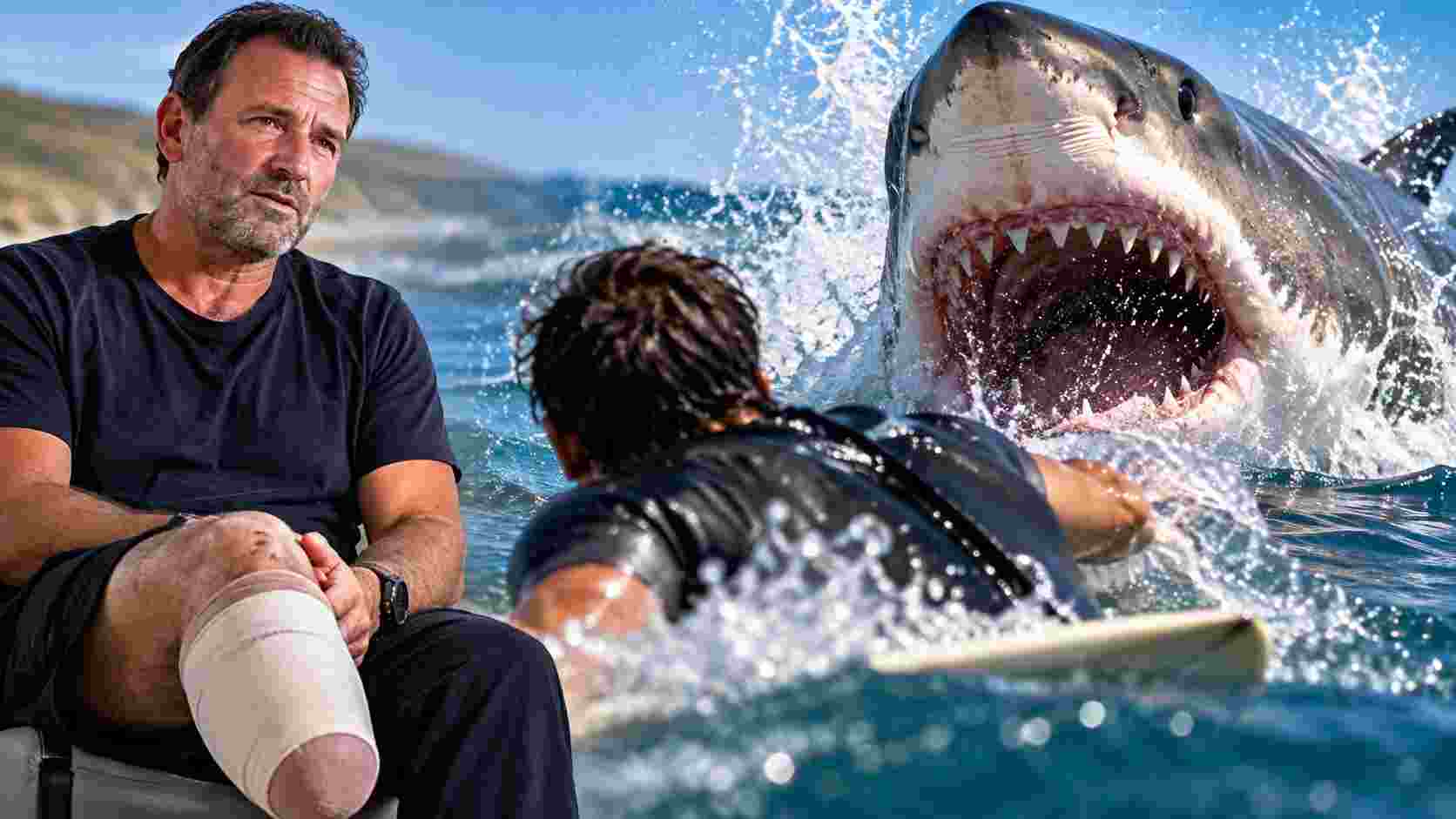
An Australian surfer who lost part of his right leg in a shark attack has described the frightening moments he spent fighting for his life off the coast of Western Australia.
Mel Ismail, a 56-year-old professional firefighter, was attacked while surfing at Glenfield Beach near Geraldton on September 14, 2026.
In his first public interview since the incident, Ismail described being pulled underwater, coming face-to-face with the shark and attempting to defend himself by targeting its eye.
He also recalled the extraordinary moment when the animal appeared to wink at him.
The interview, published by the Australian Broadcasting Corporation (ABC) on October 8, provides new details about his escape, the people who helped save him and his plans to return to the ocean.
A Peaceful Surfing Session Turned Into a Life-Threatening Attack
Ismail was surfing at Glenfield Beach, approximately 400 kilometres north of Perth, when the encounter occurred.
Before the attack, he had noticed a group of roughly 20 dolphins swimming nearby.
When something suddenly struck him, he initially believed one of the dolphins had collided with him.
That assumption quickly changed.
The animal grabbed him and pulled him beneath the surface. Ismail realised he was dealing with a shark and faced an immediate struggle to survive.
The force of the encounter brought him directly in front of the predator. With limited time to react, he attempted to fight back.
Survivor Describes Looking Directly Into the Shark’s Eye
One of the most unusual details of Ismail’s account involves his close encounter with the shark’s eye.
As the animal held him underwater, he attempted to push his fingers toward its eye in an effort to make it release him.
He later described seeing a large, dark eye that appeared to close or move during the struggle.
Ismail interpreted the movement as the shark winking at him.
His description attracted international attention because of how closely he had encountered the animal during the attack.
However, the apparent wink was his personal observation. It does not establish that the shark intentionally made such a gesture.
The attack resulted in the loss of his right leg below the knee. Despite the devastating injury, Ismail managed to reach the surface after the shark moved away.
Fighting to Reach Shore After Losing His Leg
After escaping the shark, Ismail faced another serious danger.
He was still in the ocean, far from the safety of the beach, with a severe injury and significant blood loss.
His surfboard had drifted away. When he attempted to retrieve it using the attached leg rope, he could no longer pull it toward him as expected.
He realised the extent of his injury while looking at the water around him.
Despite his condition, Ismail managed to use an incoming wave to move approximately 20 metres closer to shore.
He tried to remain calm and conserve his remaining strength.
According to his ABC interview, thoughts of seeing his family again helped him remain focused on surviving.
However, he was still too far from the beach to reach safety without assistance.
Fellow Surfer Shannan Dunn Rushed Into the Water
The situation changed when another surfer, Shannan Dunn, arrived at the beach.
Dunn noticed Ismail struggling in the water and immediately recognised that something was wrong.
He entered the ocean with his surfboard and paddled toward the injured man, despite the possibility that the shark was still nearby.
Once he reached Ismail, Dunn helped him onto the board.
The two eventually made it back to shore, where other beachgoers joined the rescue effort.
A couple identified as Chrissy and Rick provided immediate assistance.
Chrissy contacted emergency services, while Rick used a surfboard leg rope to create an improvised tourniquet to help control the bleeding.
Two teenagers also helped move Ismail into Dunn’s four-wheel-drive vehicle.
Dunn then drove along the beach to meet an approaching ambulance.
The combined actions of the rescuers helped Ismail reach medical professionals following an injury that could have been fatal.
Family Faced an Emotional Wait at Geraldton Hospital
Ismail’s partner, Kylie Fleay, was working at Geraldton Hospital when she learned that a shark attack had occurred at Glenfield Beach.
She was on her first independent shift operating the hospital switchboard.
Initially, she did not know that her partner was the person involved.
After receiving confirmation, she rushed to the emergency department.
Fleay later described the shock of seeing Ismail following the attack.
She was particularly distressed when medical staff explained the severity of his injuries and the loss of his lower leg.
Despite the circumstances, Ismail maintained a positive outlook.
According to Fleay, he even joked about becoming a bodyboarder in the future.
The couple has since expressed appreciation for the emergency workers, rescuers and members of the Geraldton community who supported them.
Why Did the Shark Appear to Wink?
Ismail’s description of the shark’s eye has raised questions about how these animals protect themselves during an attack.
The movement he observed may have a biological explanation.
According to Associated Press reporting, several shark species, including great white sharks and mako sharks, lack conventional eyelids.
Some of these sharks protect their eyes by rotating them backward into their sockets when feeding or attacking.
This movement can expose protective tissue and may appear unusual to someone observing the animal at close range.
However, there is no confirmation that this specific behaviour caused the movement Ismail described.
The species responsible for the Glenfield Beach attack had not been identified in the latest detailed reports reviewed.
Western Australian fisheries authorities were investigating the incident, and Ismail’s surfboard had been collected for examination.
Until the investigation establishes the species, identifying the animal as a great white shark or another particular type would be speculative.
Western Australia Responded With Beach Safety Measures
The September attack also brought renewed attention to shark safety along Western Australia’s coastline.
Following the incident, local authorities restricted access to beaches around Glenfield.
A September 16 advisory published by the Western Australian Government confirmed that the City of Greater Geraldton had reopened beaches in the area.
However, authorities continued to recommend additional caution.
The government also maintains the SharkSmart WA system, which provides information about reported shark sightings, detections and beach safety warnings.
On October 6, Western Australia announced an additional A$5 million investment in shark hazard mitigation.
The announced measures included expanded aerial and beach patrols, more shark tagging, additional monitoring receivers and trials of new surveillance technology.
These measures form part of broader shark safety efforts. The announcement did not establish a direct connection between the funding decision and Ismail’s individual case.
Shark Attacks in Australia During 2026
Ismail’s experience occurred during a year in which several serious shark incidents were reported around Australia.
According to Associated Press reporting published in October, five fatal shark attacks had been recorded in Australia during 2026 at that point.
Among the reported incidents was the death of 63-year-old swimmer Greg O’Neill, who was attacked at Sorrento Beach in Perth’s northern suburbs on September 18.
That attack happened just four days after Ismail’s encounter near Geraldton.
The incidents occurred at different locations, and there is no established evidence connecting the animals involved.
Australia’s long-term shark incident records indicate an average of approximately two to three fatal attacks annually since 2000.
While individual incidents can be devastating, researchers emphasise that shark bites remain relatively uncommon compared with the large number of people who enter the ocean.
What Experts Recommend During a Shark Encounter
Ismail’s attempt to defend himself by targeting the shark’s eye is consistent with emergency guidance from the International Shark Attack File, maintained by the Florida Museum of Natural History.
Researchers identify the eyes and gills as sensitive areas that a person may target if a shark is actively biting them.
However, experts distinguish between avoiding a confrontation and defending against an attack that is already underway.
For people swimming, surfing or diving in areas where sharks may be present, safety recommendations include:
-
Enter the water with another person rather than alone.
-
Stay relatively close to shore and avoid areas with limited visibility.
-
Avoid swimming near active fishing operations or large schools of fish.
-
Check official beach warnings and shark activity alerts.
-
If a shark approaches, maintain visual contact and move away calmly when possible.
-
If a shark bites, defend yourself by targeting sensitive areas and leave the water as soon as an opportunity arises.
These recommendations can reduce risk but cannot guarantee protection.
The presence of dolphins also does not mean sharks are absent. Both animals may occupy the same waters while pursuing food.
This detail is particularly relevant to Ismail’s experience because he had been watching dolphins shortly before the attack.
Mel Ismail Plans to Return to the Ocean
Although the attack permanently changed his life, Ismail has expressed a desire to return to the water.
He has spoken about taking up bodyboarding as he adapts to living without the lower part of his right leg.
His recovery will involve physical rehabilitation and adjustment to the long-term effects of the injury.
No confirmed date has been announced for his return to surfing or bodyboarding.
For now, his account has drawn attention not only to the dangers of shark encounters but also to the importance of rapid assistance during emergencies.
The actions of Shannan Dunn, other beachgoers and emergency personnel played a crucial role in helping him survive.
Ismail’s experience also highlights the challenges facing coastal communities as they balance public safety with recreational access to the ocean.