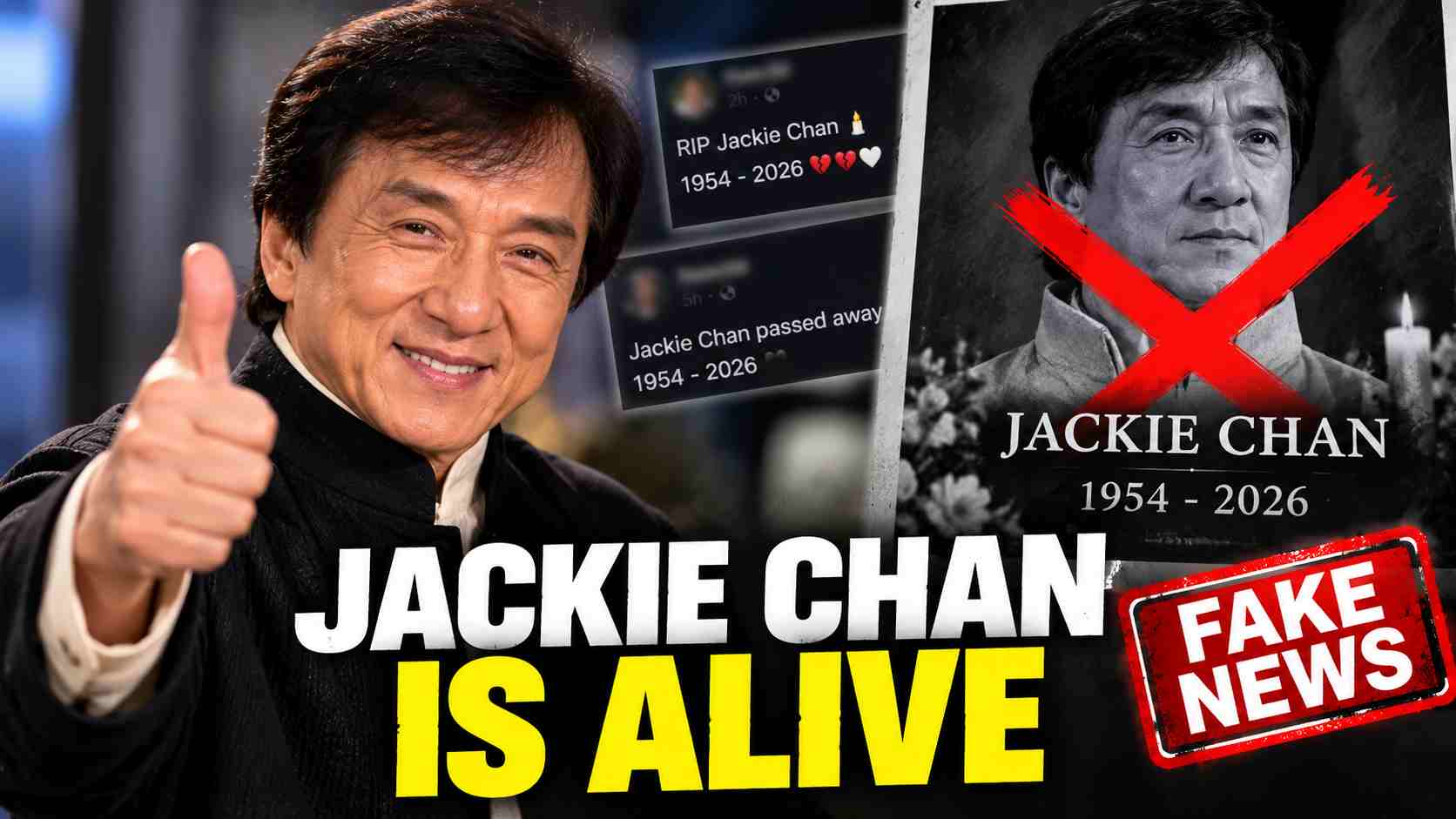
Jackie Chan is alive.
False social media posts claiming that the legendary actor and martial artist died in 2026 have spread rapidly online, causing confusion and concern among fans around the world.
The latest rumor centers on memorial-style posts showing a black-and-white image of Chan alongside the dates “1954–2026.” The format made the posts appear like genuine death announcements, leading some social media users to believe that the 72-year-old action star had died.
However, there is no credible evidence supporting the claim.
Multiple reports published on September 29 have identified the story as a death hoax, while available information about Chan shows that he remains active.
The viral episode is also not the first time the Rush Hour and Police Story star has been falsely declared dead online.
Is Jackie Chan Dead or Alive?
Jackie Chan is alive as of September 29, 2026.
No credible announcement of his death has been issued by his representatives or official channels, and established news reports investigating the viral claim have identified it as false.
Gulf News reported on September 29 that the “1954–2026” posts circulating online were part of a social media hoax.
Hindustan Times separately investigated the viral claims and also reported that Chan was alive.
The absence of any credible confirmation is especially significant given Chan’s international prominence. The death of a globally recognized actor of his stature would be expected to generate confirmation from his representatives, family or multiple established international news organizations.
Instead, the current rumor appears to have originated and spread through social media posts.
What Is the Viral ‘1954–2026’ Jackie Chan Post?
The latest wave of misinformation appears to have been driven largely by a black-and-white memorial image.
It features Jackie Chan’s photograph together with his name and the years:
1954–2026
The presentation resembles the type of tribute graphic commonly published after a celebrity’s death.
That visual format appears to have convinced some viewers that the information was genuine even though the posts did not provide reliable evidence confirming Chan’s death.
The images then spread quickly through social platforms.
Some users reposted them while asking whether Chan had died. Others apparently accepted the claim as genuine and began posting tributes.
As engagement increased, the false story reached millions of people.
Viral Jackie Chan Death Claim Reaches Millions
The speed at which the rumor spread demonstrates how quickly celebrity misinformation can travel online.
Gulf News reported that one widely circulated post accumulated more than 3.8 million views within approximately five hours.
Other versions of the claim also generated substantial engagement.
The rapid spread illustrates an important problem with social media information: popularity does not establish authenticity.
A post can receive millions of views, shares and comments while still containing completely false information.
In fact, emotionally powerful claims involving the supposed death of a globally famous celebrity can generate particularly strong engagement because users may share them before checking the original source.
Jackie Chan’s Recent Public Appearance Contradicts the Rumor
There is also recent documented evidence of Chan appearing publicly.
On July 7, 2026, Chan made a surprise appearance at Pei Chun Public School in Singapore during an event organized by the Lim Family Foundation.
Reports from Singapore said he interacted with more than 900 students during the visit.
He also performed his song Hard to Say Goodbye and spoke with students and staff.
Photos and videos documented the appearance.
The July event provides a recent confirmed public record of the actor well before the latest September death hoax began circulating.
There is currently no credible subsequent report establishing that Chan died after that appearance.
Why Did People Believe the Jackie Chan Death Rumor?
Several characteristics of the viral posts helped them appear convincing.
The first was their visual presentation.
Black-and-white photographs are frequently associated with memorial announcements, while displaying a person’s birth year followed by an alleged death year creates an immediate impression that the individual has died.
The second factor was repetition.
Once multiple accounts began reposting similar images, users could encounter the same claim repeatedly.
Seeing a claim from several accounts can create the impression that multiple independent sources have confirmed it, even when those accounts are simply copying the same unverified rumor.
The third factor is Jackie Chan’s age.
Chan was born on April 7, 1954, meaning he is 72 years old in 2026.
A memorial image containing his correct birth year alongside a fabricated death year can therefore look superficially credible to someone scrolling quickly through a social media feed.
None of those factors constitutes evidence that the claim is true.
Jackie Chan Has Faced Death Hoaxes Before
The September 2026 rumor is not the first false report of Jackie Chan’s death.
Similar claims have circulated online for years.
In 2022, PolitiFact investigated another viral Facebook post falsely claiming that Chan had died.
The fact-check found no credible evidence supporting the claim and noted that Chan had previously been the subject of similar death rumors.
Even earlier, Chan’s official Facebook account addressed a death rumor in 2011 after false claims circulated suggesting that he had suffered a heart attack.
The message assured fans that the actor was alive and preparing for another film.
This history makes the current “1954–2026” rumor part of a recurring pattern rather than an unprecedented event.
Previous False Rumors Have Used Different Stories
Celebrity death hoaxes frequently change their details.
Rather than repeating exactly the same story, new versions may invent different causes of death or use altered photographs.
For example, a separate false claim involving Jackie Chan circulated in 2025 alleging that he had died during flooding in Beijing.
Fact-checkers found that claim to be false as well.
Other misleading posts have used manipulated or misleading images to make fabricated stories appear authentic.
The changing narratives demonstrate why readers should verify the underlying source rather than relying on the appearance of a viral image.
Jackie Chan Previously Addressed Concerns About His Appearance
Chan has also faced online speculation about his health after photographs showed him with white hair and a white beard.
Those images generated concern among fans in 2024.
Chan addressed the situation himself on his official website around his 70th birthday.
He explained that the appearance was connected to a character he was playing for a film.
He reassured fans and reflected positively on reaching 70, particularly after spending decades performing demanding action sequences.
Chan said at the time that he remained grateful to continue making films.
That episode is another example of how photographs without proper context can generate inaccurate assumptions about a celebrity’s health.
Jackie Chan Remains One of Cinema’s Most Recognizable Action Stars
The intense reaction to the latest rumor reflects Chan’s extraordinary global popularity.
Born in Hong Kong on April 7, 1954, Chan built a career combining martial arts, physical comedy, stunt work and filmmaking.
His career spans more than six decades.
Unlike many traditional action stars, Chan became famous for performing elaborate stunt sequences himself, often combining dangerous physical action with comedy.
That distinctive style helped him become a major star in Asian cinema before achieving enormous international recognition.
Jackie Chan’s Most Famous Movies
Chan’s filmography includes numerous influential action movies and franchises.
Among his best-known works are Police Story, Drunken Master, Project A, Armour of God and the Rush Hour series.
The Rush Hour movies, in which Chan starred alongside Chris Tucker, significantly expanded his popularity with mainstream Western audiences.
His international work also includes Shanghai Noon, The Karate Kid and numerous other action and comedy productions.
His career has made him recognizable to multiple generations of moviegoers, helping explain why a false report about his death can attract worldwide attention almost immediately.
Jackie Chan’s Career Has Spanned More Than Six Decades
Chan began working in entertainment as a child.
Over time, he developed from a stunt performer into an actor, director, producer and internationally recognized martial arts star.
His action sequences became particularly famous because of his willingness to perform dangerous stunts.
Behind-the-scenes footage and end-credit sequences from many of his movies have shown failed stunt attempts and injuries sustained during production.
That commitment became part of his public image.
It also helped create a style of filmmaking that influenced action cinema internationally.
Why Celebrity Death Hoaxes Spread So Quickly
Jackie Chan is far from the only celebrity to become the subject of a false death announcement.
Similar rumors regularly target actors, musicians, athletes and other internationally recognized public figures.
Several factors make these stories particularly effective at attracting attention.
Death announcements generate immediate emotional reactions.
People may feel sadness, surprise or nostalgia and share the information before verifying it.
Social platforms can then amplify posts receiving unusually high engagement.
Once a false claim becomes viral, screenshots can spread beyond the account that originally posted it.
At that point, deleting or correcting the original post may not stop the misinformation because copies are already circulating elsewhere.
AI Can Make Celebrity Hoaxes More Convincing
The growing availability of artificial intelligence tools creates an additional challenge.
Realistic images can now be generated or altered rapidly.
A fabricated photograph can appear to show a celebrity in a hospital, at an event that never occurred or in another fictional situation.
Professional-looking memorial graphics can also be produced within minutes.
As image-generation technology improves, visual appearance alone becomes less useful as evidence.
Readers increasingly need to check where a claim originated and whether credible independent sources have confirmed it.
How to Check Whether a Celebrity Death Report Is Real
A few basic verification steps can prevent the spread of false celebrity death stories.
First, check the person’s official website or verified social media accounts.
Second, look for reporting from multiple established news organizations.
Third, examine the original source of the viral claim rather than relying on screenshots.
Fourth, be cautious when a post provides dramatic claims without naming a credible source.
Finally, avoid assuming that millions of views or thousands of comments make a claim reliable.
Virality measures attention — not truth.
Jackie Chan’s Official Accounts Are Important for Verification
Chan’s official website previously published guidance identifying his authentic online accounts.
The site listed his official website and verified profiles across major social platforms and warned fans about impersonation.
That advice remains particularly relevant when false claims involving the actor begin circulating.
Fake accounts can imitate celebrities or use their photographs to create misleading content.
Checking verified channels can therefore provide an important first step when evaluating a suspicious claim.
Why the ‘1954–2026’ Image Should Not Be Treated as Evidence
The viral memorial image does not provide evidence of Jackie Chan’s death.
It is simply an image containing a claim.
There is an important difference.
A credible death report involving an internationally famous public figure would normally be supported by identifiable reporting, statements from representatives or family members, or confirmation from authoritative sources.
The viral Jackie Chan image does not provide that documentation.
Adding dates to a photograph does not transform an unsupported claim into verified information.
Fans Should Avoid Sharing the False Death Claim
Users who encounter the “Jackie Chan 1954–2026” image should avoid reposting it as factual information.
Even sharing misinformation with good intentions can help increase its reach.
Instead, users can check reliable sources and, where appropriate, clarify that the viral claim has been debunked.
The current evidence is clear:
Jackie Chan is alive, and the viral reports claiming otherwise are false.
As of September 29, 2026, there is no credible announcement confirming his death.
The latest incident is another reminder that social media posts — even those attracting millions of views — should not automatically be treated as verified news.