Todd Blanche Scraps Proposed Compensation Fund as Senate Confirmation Moves Forward
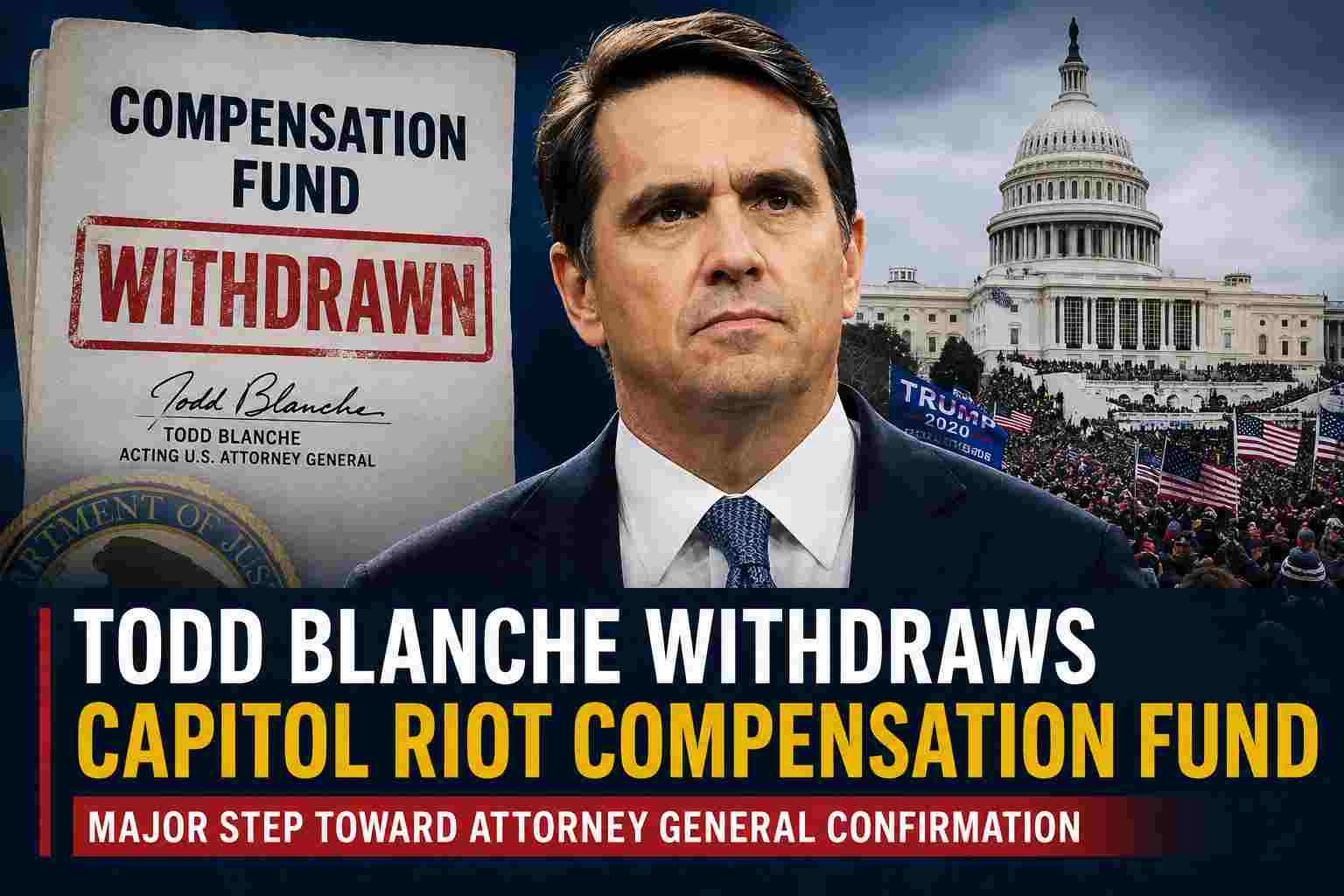
Acting U.S. Attorney General Todd Blanche has officially withdrawn a controversial proposal to establish a compensation fund that could have benefited individuals prosecuted in connection with the January 6, 2021, attack on the U.S. Capitol. The decision removes one of the biggest obstacles to Blanche’s confirmation as the permanent U.S. Attorney General and signals an effort by Republican leaders to resolve internal disagreements before an important Senate vote.
The proposal had generated widespread political debate because critics argued it could allow financial compensation for people convicted of crimes related to the Capitol riot, including those found guilty of assaulting law enforcement officers. By formally canceling the plan, Blanche has attempted to reassure lawmakers who previously opposed his nomination.
Why Todd Blanche Withdrew the Compensation Fund
Todd Blanche announced the decision in a public statement posted on X (formerly Twitter), explaining that he had spent several weeks meeting with senators and members of the Senate Judiciary Committee to address concerns surrounding the proposal.
To eliminate any uncertainty, Blanche released a signed legal order declaring:
“This Order establishes, beyond any doubt, that there is no Fund.”
The written order formally ends the proposed compensation program and confirms that no federal fund will be created under the previous agreement.
The move is widely viewed as an effort to secure enough Republican support for Blanche’s confirmation as the nation’s top law enforcement official.
Background: What Was the Proposed “Anti-Weaponisation” Fund?
Earlier this year, the Trump administration announced plans for a proposed $1.8 billion “anti-weaponisation” fund as part of a settlement involving a lawsuit against the Internal Revenue Service (IRS).
The lawsuit stemmed from the disclosure of former President Donald Trump’s tax returns, which Trump argued had been unlawfully leaked.
Under the proposed settlement, the fund could have allowed certain individuals to seek financial compensation if they believed they had been unfairly prosecuted for political reasons during previous administrations.
Supporters argued that the program would compensate victims of politically motivated legal actions.
Opponents, however, warned that the broad wording of the proposal could potentially include people prosecuted for their actions during the January 6 Capitol riot.
Why the Fund Faced Strong Opposition
The proposal quickly became one of the most controversial legal issues surrounding Blanche’s nomination.
Democrats strongly criticized the plan, arguing that taxpayer money should never be used to compensate individuals convicted of crimes connected to the Capitol attack.
Several Republican senators also raised concerns, saying the proposal lacked clear legal limits and could create serious political and ethical problems.
One of the biggest objections was that individuals convicted of violent offenses—including assaults against police officers—might become eligible for compensation if the program moved forward.
The criticism ultimately placed Blanche’s Senate confirmation at risk.
IRS Audit Provision Also Raised Concerns
In addition to the compensation fund, lawmakers questioned another section of the proposed settlement involving IRS audits.
According to senators reviewing the agreement, the language appeared to protect former President Trump, members of his family, and their businesses from certain IRS audits related to previous tax returns.
Some Republican senators requested that the wording be clarified or narrowed before they would support Blanche’s confirmation.
Blanche later stated that he had clarified the language regarding IRS audit protections in discussions with lawmakers.
Federal Judge Previously Blocked the Proposal
The controversy extended beyond Congress.
A federal judge had already blocked implementation of the proposed fund after raising concerns that parts of the agreement could conflict with ethical standards governing government settlements.
The court’s intervention increased pressure on the Department of Justice to reconsider the proposal.
Blanche’s latest order formally removes the issue by ending the compensation fund altogether.
Trump’s Mixed Messages Added to the Political Uncertainty
Former President Donald Trump delivered conflicting public statements about the future of the compensation fund in recent days.
At one point, Trump said the proposal was “dead,” suggesting it would not move forward.
However, shortly afterward, he warned that he might revive the idea if Republican senators continued delaying Blanche’s confirmation.
Trump also indicated he had considered withdrawing Blanche’s nomination altogether because of the prolonged confirmation process.
Those comments created uncertainty among lawmakers who wanted written guarantees that the compensation fund had been permanently abandoned.
Blanche’s signed order appears to provide that assurance.
Which Senators Delayed Blanche’s Confirmation?
Two Republican senators—John Cornyn of Texas and Thom Tillis of North Carolina—played a key role in delaying Blanche’s confirmation.
Both senators sought legally binding assurances that:
- The proposed compensation fund would be permanently canceled.
- The IRS audit language would be clarified.
- The Justice Department would formally address their concerns in writing.
Following Blanche’s announcement, a spokesperson for Senator Cornyn confirmed that an agreement had been reached with the Department of Justice.
Senator Tillis had not issued an updated statement immediately after Blanche’s announcement, although he had previously criticized the proposal and expressed concern about creating what he described as a compensation program for January 6 offenders.
Despite his objections to the fund, Tillis has previously stated that he believes Blanche is qualified to serve as Attorney General.
Senate Confirmation Process Moves Ahead
With the compensation fund officially withdrawn, attention now shifts back to the Senate Judiciary Committee.
The committee is expected to consider Blanche’s nomination during its scheduled meeting, where lawmakers could vote on whether to advance his confirmation.
Removing the compensation fund eliminates one of the primary issues that had stalled the process and may improve Blanche’s chances of receiving sufficient Republican support.
Political Significance
The withdrawal of the proposed compensation fund highlights the balancing act within the Republican Party between supporting former President Trump and addressing legal, ethical, and political concerns raised by lawmakers.
For Blanche, ending the proposal represents an important step toward securing confirmation as the permanent Attorney General.
For Congress, the episode demonstrates how internal party disagreements can significantly influence high-profile nominations, even when the nominee enjoys strong backing from a former president.
As the confirmation process continues, lawmakers will now focus less on the abandoned fund and more on Blanche’s qualifications and plans for leading the U.S. Department of Justice.