Breaking: A Historic Government Order
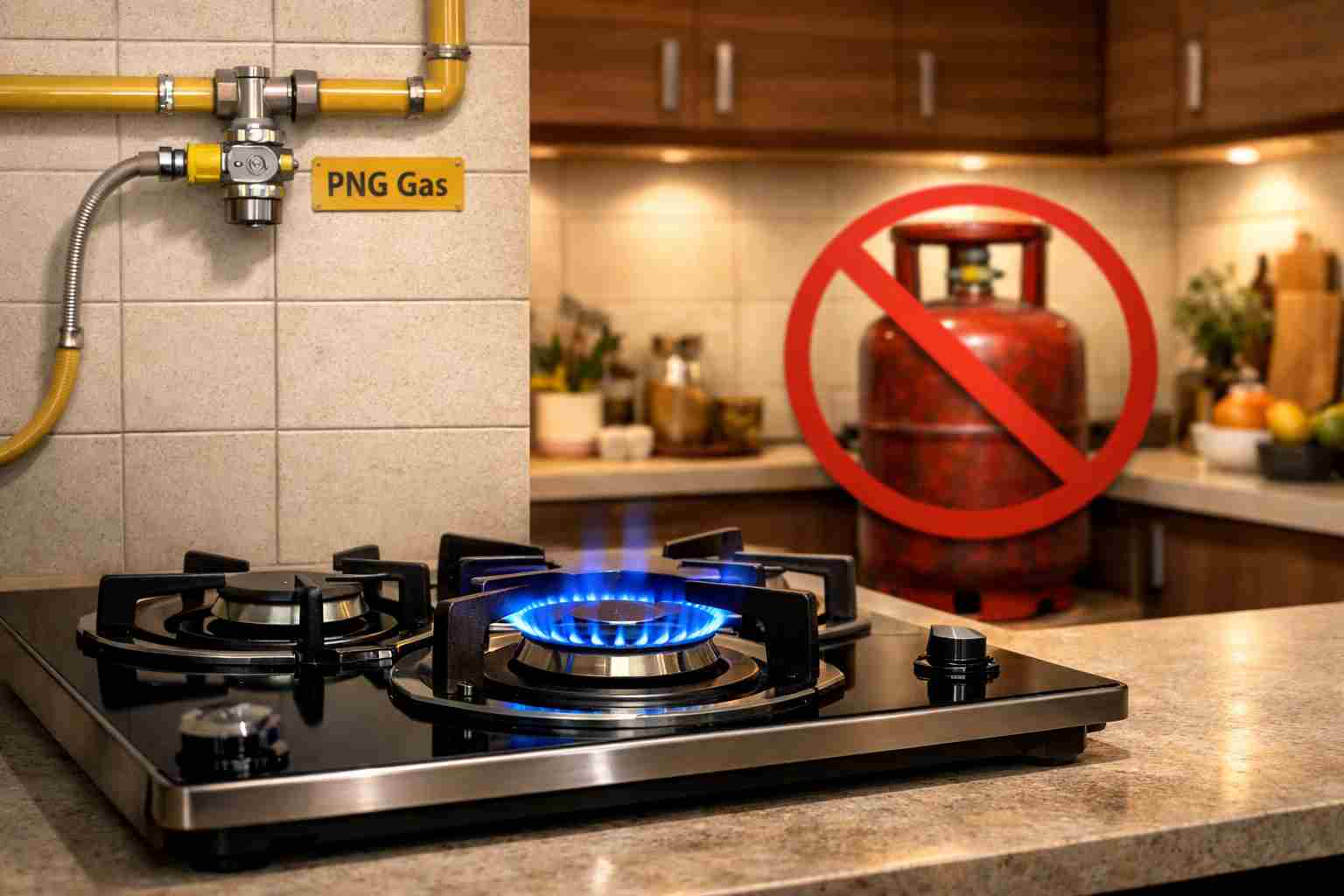
The central government issued the Natural Gas and Petroleum Products Distribution Order, 2026 on March 24, 2026 — enforced under the Essential Commodities Act, which grants the government sweeping powers over energy distribution. In plain terms, where PNG gas pipeline infrastructure already exists, LPG cylinder supply can be cut off.
Why This Decision? The Real Reasons
This order comes against the backdrop of an energy crisis triggered by the ongoing West Asia conflict. Iran has effectively blocked the Strait of Hormuz for international shipping, and roughly 20% of the world’s petroleum supply passes through this single maritime route.
India imports nearly 60% of its LPG requirements, with 90% of that coming through Gulf routes — meaning this geopolitical crisis is landing directly in Indian kitchens.
But there is a longer-term domestic goal too: India has invested heavily in building its City Gas Distribution (CGD) network over the past decade, and millions of households connected to that grid are still choosing LPG out of habit. This order is designed to change that.
What Do You Need to Do? — 5 Key Facts
1. You Get 90 Days After Notice Once an authorised gas company formally notifies you of PNG availability in your area, you have 90 days to apply for a connection. If you do not act within this window, your LPG cylinder supply will be automatically discontinued.
2. Technical Impossibility Gets You an Exemption If a gas company certifies that laying a pipeline to your home is technically not feasible — due to building structure, access issues, or other constraints — a No-Objection Certificate (NOC) will be issued and LPG supply will continue. However, this NOC is not permanent. The moment the technical barrier is resolved, the PNG connection becomes mandatory again.
3. Housing Societies Cannot Block You Residential Welfare Associations (RWAs) and housing societies are legally required to grant pipeline access permission within 3 working days. The government has also mandated that last-mile PNG gas connectivity must be completed within 48 hours of approval — removing the long delays that previously frustrated residents.
4. Government Offices Cannot Sit on Approvals Public authorities must grant Right of Way permissions within a defined window ranging from 10 to 60 days, depending on the type of land. If they fail to respond by the deadline, permission is deemed approved — a powerful clause that prevents bureaucratic bottlenecks.
5. Gas Companies Face Penalties Too This is not just about consumers. If a developer receives approval but fails to begin work within 4 months, they face financial penalties. They can even lose their exclusivity rights in that geographical area — pushing companies to act quickly rather than sit on authorizations.
How Many Households Are Still on LPG Unnecessarily?
This is perhaps the most striking data point in the entire story. Currently, 60 lakh (6 million) households already have PNG infrastructure available right outside their homes — yet they continue to use LPG cylinders out of inertia or lack of awareness.
In March 2026 alone, 2.5 lakh new PNG connections were given, and 2.2 lakh LPG consumers successfully transitioned to piped gas. The government aims to accelerate this number dramatically through this new order.
PNG vs LPG: What’s Actually Better for You?
| Feature | PNG (Piped Gas) | LPG (Cylinder) |
|---|---|---|
| Supply | 24×7, uninterrupted | Depends on booking & delivery |
| Safety | Disperses quickly in the air | Heavier than air, it accumulates |
| Convenience | No booking, no waiting | Cylinder booking, waiting period |
| Billing | Monthly meter-based bill | Per-cylinder payment |
| Storage | No cylinder storage needed | Requires dedicated space |
| Environment | Lower carbon footprint | Higher transport emissions |
Experts consistently note that PNG is safer than LPG because natural gas is lighter than air — in the event of a leak, it disperses upward and dissipates rapidly, significantly reducing the risk of explosion compared to LPG, which sinks and pools.
Who Is Watching Over All of This?
The PNGRB (Petroleum and Natural Gas Regulatory Board) has been designated as the nodal agency overseeing the entire rollout. It will track all permissions granted and denied, monitor compliance timelines, and act as the enforcement authority if gas companies or local bodies fail to meet their obligations.
The Bigger Picture: India’s Energy Security Gamble
This mandate is not just about convenience — it is a strategic move. India’s heavy dependence on imported LPG has long been a vulnerability. Every geopolitical shock in the Middle East sends ripples through Indian household energy costs.
By pushing consumers toward domestic pipeline infrastructure, the government is effectively trying to insulate Indian kitchens from global oil market volatility. The CGD network currently covers hundreds of districts, but expanding into smaller towns and rural areas remains the critical unfinished challenge.
The policy is bold. The intent is sound. The real test will be in execution — particularly whether gas companies can actually deliver connections within the promised timelines, and whether the exemption NOC process is handled fairly and transparently.
Is PNG gas available in your city? Contact your nearest authorised gas distributor or check the MGL, IGL, or Mahanagar Gas websites to find out whether the 90-day clock has started — or is about to — for your address.