The European Space Agency (ESA) has released new images of asteroid Dimorphos captured by its Hera spacecraft, revealing the enormous crater created when NASA’s DART spacecraft deliberately struck the asteroid in 2022.
The images provide scientists with a closer look at how the asteroid changed after the impact. The crater appears to cover almost the entire impacted side of Dimorphos, offering new information about the effectiveness of asteroid-deflection technology.
The discovery is an important step in understanding how humanity could protect Earth from potentially dangerous asteroids in the future.
Hera Captures the DART Impact Crater
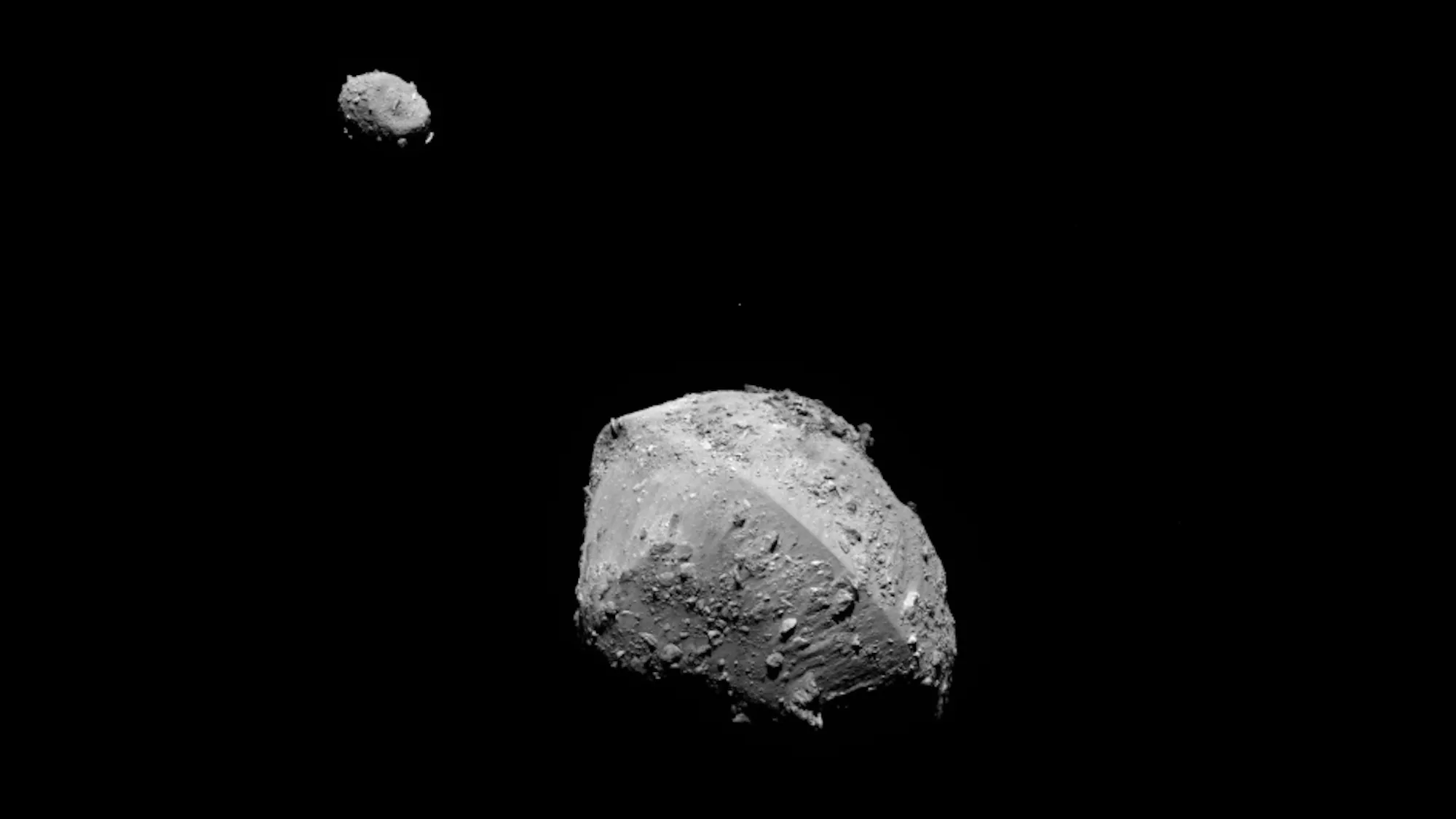
The images were captured by Hera’s Asteroid Framing Camera (AFC) during its observations of the Didymos asteroid system. One image, taken on November 7, 2026, shows Dimorphos alongside its larger companion, Didymos.
The photograph was taken from about 29 kilometres away, with a spatial resolution of about 2.7 metres per pixel.
Scientists can clearly see the impact crater created by NASA’s DART mission. The impact appears to have flattened a large section of Dimorphos, with the crater extending across nearly the entire width of the affected side.
The images also reveal unusual structures within the crater, including an elongated feature described as cigar-shaped.
According to ESA, the crater is approximately stadium-sized, making it much larger than scientists might expect from simply looking at the asteroid before the impact.
Dimorphos is a small asteroid moonlet that orbits a larger asteroid called Didymos. The two objects form a binary asteroid system located in space, and they were selected for planetary-defence experiments because they do not pose a threat to Earth.
Dimorphos measures approximately 151 metres in diameter, while Didymos is around 730 metres across. Dimorphos orbits its larger companion at a distance of roughly one kilometre.
NASA selected Dimorphos as the target of its DART mission because scientists wanted to test whether a spacecraft impact could change an asteroid’s movement.
The mission was designed to demonstrate a potential planetary-defence technique known as the kinetic impactor method.
NASA’s DART Mission Changed the Asteroid’s Orbit
In September 2022, NASA’s Double Asteroid Redirection Test (DART) spacecraft deliberately collided with Dimorphos.
The mission was the first full-scale demonstration of using a spacecraft impact to change the motion of an asteroid. The collision successfully altered Dimorphos’s orbit around Didymos, proving that a kinetic impact could influence the movement of a celestial object.
However, the impact raised several scientific questions.
Scientists wanted to understand how much material was ejected from the asteroid, how the impact changed its physical shape, how much energy was transferred, and what type of crater was formed.
The DART mission successfully demonstrated asteroid deflection, but it could not fully examine the impact site because the spacecraft was destroyed during the collision.
That is where ESA’s Hera mission becomes important.
How Hera Will Help Scientists Understand the Impact
The Hera spacecraft was developed to conduct a detailed investigation of the Didymos and Dimorphos asteroid system after the DART collision.
After travelling through space for more than two years, Hera reached the asteroid system in 2026 and began examining the objects using its scientific instruments.
Its investigation includes studying the crater, mapping the asteroid surfaces, measuring their physical properties, and helping scientists understand how the impact changed Dimorphos.
Hera is equipped with several instruments, including:
-
Asteroid Framing Camera (AFC): Captures detailed images of the asteroid surfaces.
-
Hyperscout H: Examines the asteroids using multiple wavelengths of light.
-
Thermal Infrared Imager (TIRI): Measures surface temperatures and helps scientists study the physical properties of the asteroid material.
These observations will help researchers develop a clearer picture of how the DART collision affected Dimorphos.
Scientists will combine the new observations with information collected during the original DART mission to improve their understanding of asteroid-impact physics.
The Impact Changed Dimorphos More Than Expected
The new observations have revealed that the DART collision caused significant changes to the impacted side of Dimorphos.
While the crater is the most visible feature, scientists are also examining the asteroid’s movement and surrounding environment. ESA reports that Dimorphos is now tumbling chaotically, while hundreds of small boulders have also been observed around the asteroid system.
These findings could help scientists understand how asteroids respond to collisions, particularly objects made of loosely connected rocks and debris rather than solid material.
The larger asteroid Didymos, meanwhile, does not appear to have experienced major changes from the DART impact. Its visible boulder fields and equatorial ridge remain largely similar to earlier observations.
The contrast between the two objects is particularly valuable because it allows scientists to study the impact effects on the smaller asteroid without seeing major changes to its larger companion.
Hera Mission’s Next Steps
The first images mark the beginning of Hera’s detailed investigation rather than the end of the mission.
ESA plans to bring the spacecraft closer to the asteroid system to obtain higher-resolution observations. The mission is also expected to deploy two CubeSats, named Milani and Juventas, to investigate Dimorphos from closer distances.
These smaller spacecraft will help examine the asteroid’s surface composition and internal structure. One of the mission’s important objectives is to study the interior of Dimorphos, providing scientists with information that cannot be obtained from images alone.
By combining surface observations, internal measurements, and orbital data, researchers hope to better understand how the DART impact changed the asteroid.
Why This Discovery Matters for Planetary Defence
The Hera mission is helping turn asteroid deflection from a successful experiment into a better-understood scientific technique.
The DART mission proved that a spacecraft can alter an asteroid’s motion. Hera’s observations will help scientists understand exactly how the collision changed the asteroid, how much material was displaced, and how the physical structure of the asteroid influenced the result.
This information could become important if scientists ever identify an asteroid that poses a genuine threat to Earth. Understanding the size, structure, and composition of an asteroid could help determine the best strategy for changing its trajectory.
The new images of Dimorphos are therefore more than a scientific discovery. They provide evidence that humanity is developing technologies and knowledge that could one day help prevent a dangerous asteroid impact.