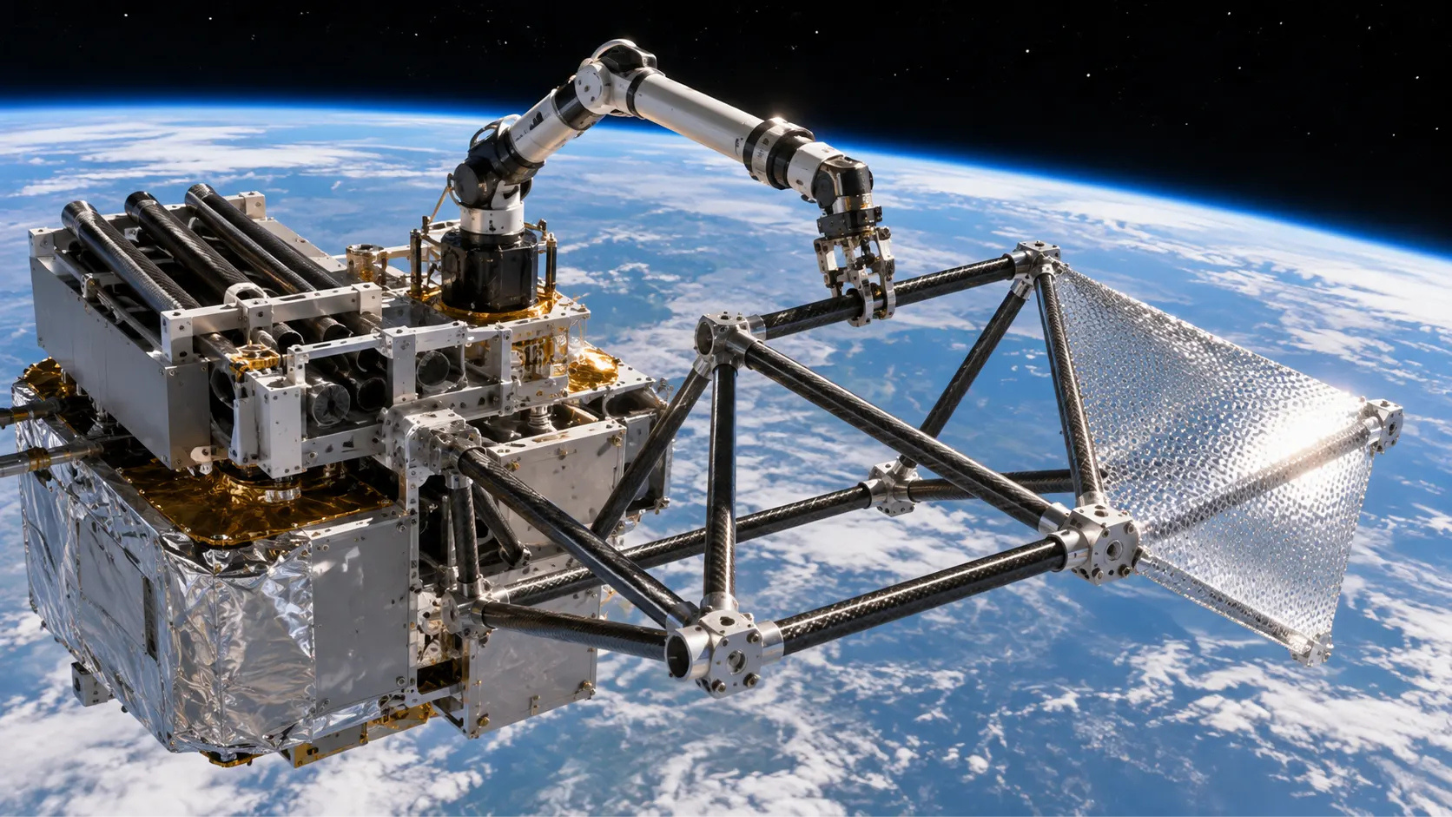
Researchers at the California Institute of Technology (Caltech) have demonstrated a major step forward in space construction. Their robotic system, called ASTRA (Autonomous In-Space Tensioned Reflector Assembly), has successfully assembled part of a structure in orbit without astronauts performing the construction.
The project is funded by the US Defense Advanced Research Projects Agency (DARPA) through its NOM4D program. The demonstration shows how robots could one day build large antennas, space telescopes, and other structures directly in orbit.
How Caltech’s ASTRA Robot Builds Structures in Space
ASTRA uses a robotic manipulator to collect structural components from nearby storage units. It then connects these parts to create sections of a larger framework called a truss.
The system works with composite fiber tubes and aluminium joints. It assembles these components into repeating sections known as bays.
The process is similar to building with construction toys. However, the robot must perform every movement carefully in the difficult conditions of space.
The system also attaches a lightweight reflective material to the structure. This material helps form the surface of a reflector antenna.
Unlike traditional space construction, ASTRA can carry out these assembly steps without astronauts manually connecting the parts.
What Structure Did the Robot Build?
The Caltech team designed ASTRA to construct a reflector antenna measuring approximately 1.4 metres in diameter.
The planned structure uses three main components:
- Composite fiber tubes for the supporting framework.
- Aluminium joints to connect the structural sections.
- A thin reflective film made from Kapton material.
The complete antenna design requires 11 connected truss sections, or bays.
During the orbital demonstration, the robot successfully assembled a third bay after two sections had been prebuilt on Earth and deployed in space.
However, the team did not complete the entire antenna. Technical challenges and time limitations affected the mission. Even so, the successful assembly demonstrated that robotic construction in orbit is possible.
How Did ASTRA Reach Space?
ASTRA began its journey on March 30, 2026. It launched from Vandenberg Space Force Base in California aboard the SpaceX Transporter-16 mission.
The payload travelled on Momentus’s Vigoride 7 orbital vehicle. It occupied approximately one cubic metre of space and carried the robotic assembly equipment, two prebuilt truss sections, and the components needed for further construction.
After reaching low Earth orbit, the Caltech team began sending commands to the onboard computer through the Vigoride spacecraft.
The robot released its launch restraints, deployed the prebuilt sections, and started assembling the next section.
The demonstration remained in orbit for around six months. Researchers monitored its progress through images captured by cameras installed on the payload.
Why Is Building Structures in Space Important?
One major challenge in space exploration is the limited size of rocket payload compartments.
Large structures such as space telescopes, antennas, and solar arrays must fit inside a rocket during launch. Engineers usually solve this problem by folding structures into smaller packages or launching separate components for later assembly.
Both methods have practical limits.
Robotic construction offers another option. Instead of launching a complete structure, engineers could send the required materials and allow robots to assemble them after reaching orbit.
This approach could support the development of much larger structures than current launch systems can carry in one piece.
Potential applications include:
Large space telescopes: Robots could assemble bigger reflective surfaces that collect more light and help scientists observe distant objects.
Advanced communication antennas: Larger antennas could improve communication capabilities for satellites and future space missions.
Space-based solar power: Large structures could support solar panels designed to collect energy in orbit and potentially transmit it to Earth.
These applications remain future possibilities. ASTRA is an early technology demonstration, not a completed construction system for large operational spacecraft.
DARPA’s NOM4D Program Aims for Larger Space Structures
ASTRA is part of DARPA’s Novel Orbital and Moon Manufacturing, Materials, and Mass-efficient Design (NOM4D) program.
DARPA started the program in 2022 to explore ways to manufacture and assemble large structures beyond Earth.
The long-term goal is to develop systems capable of constructing structures hundreds of metres or even kilometres in size.
Caltech’s project is one of two efforts selected for the program’s third phase, which focuses on demonstrations in space.
The other project, led by the University of Illinois Urbana-Champaign, is studying a method for hardening carbon tubes in space. It will use a module attached to the International Space Station for its experiment.
Together, these projects explore different ways to manufacture and assemble structural materials in orbit.
Challenges of Autonomous Construction in Orbit
Building structures in space is more difficult than performing the same task in a laboratory.
Robots must operate in microgravity and handle components without the support of a stable ground surface. Small alignment errors or unexpected movements can affect the assembly process.
Communication with ASTRA also presented challenges. The research team had only around seven or eight communication windows each day, with each window lasting approximately 15 minutes.
To solve unexpected problems, engineers used a second version of ASTRA in their laboratory. They recreated issues on the ground, tested possible solutions, and then sent updated instructions to the system in orbit.
This process helped researchers understand the practical challenges of robotic construction beyond Earth.
What Happens Next?
The ASTRA demonstration is an important starting point for future research. The Caltech team has shown that a robot can assemble part of a structure in orbit without astronauts manually performing the construction.
However, the experiment also revealed areas that need improvement. Researchers plan to simplify and refine the design to make future systems more reliable and scalable.
The current mission is not expected to complete the full 11-bay antenna before its planned conclusion in December 2026.
Future versions could build larger structures and support new applications in astronomy, communications, and space-based energy systems.
Conclusion
Caltech’s ASTRA project has demonstrated a new approach to building structures in space. Its robotic system successfully assembled a section of a reflector antenna using individual components while operating in orbit.
Although the experiment did not complete the full antenna, it provides valuable evidence that autonomous space construction can work.
With further development, this technology could help scientists build larger telescopes, powerful antennas, and other structures that are difficult to launch from Earth as complete units.