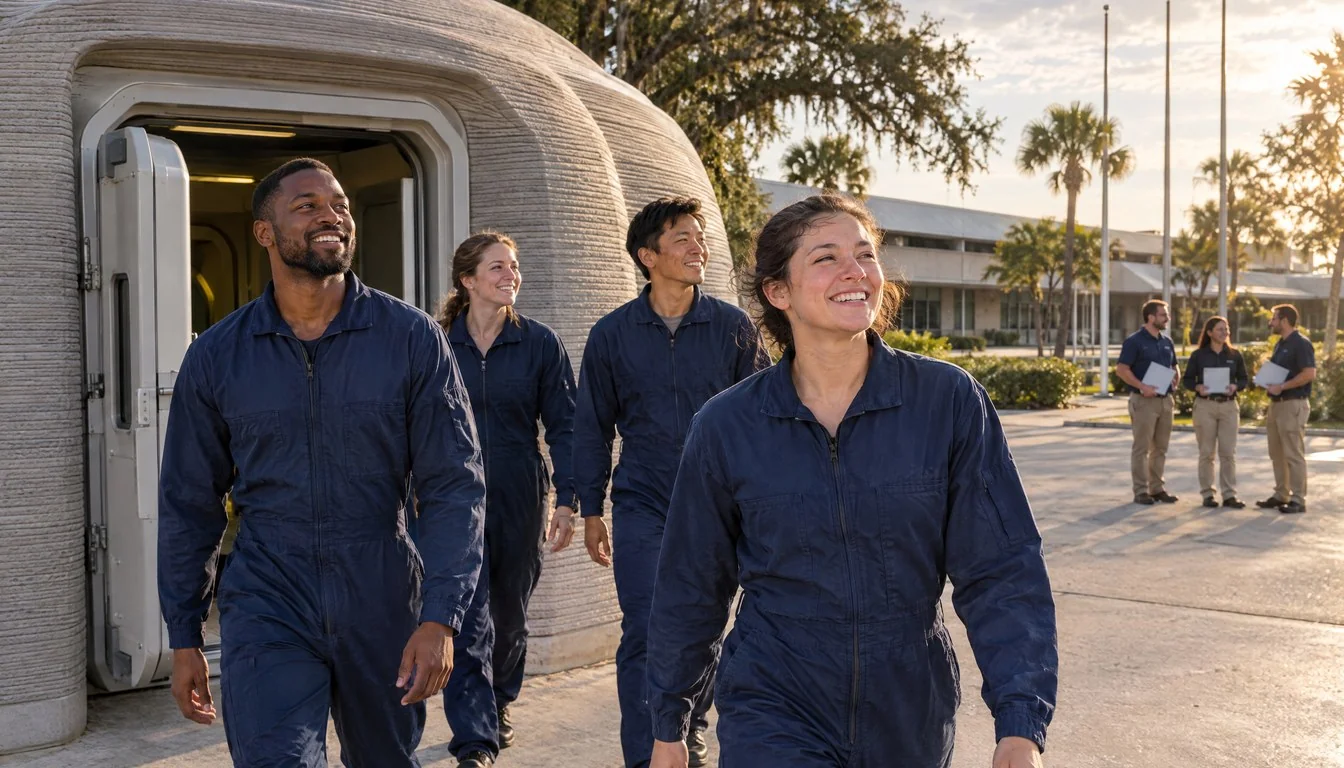
Four volunteers have completed NASA’s second year-long simulated Mars mission after spending 378 days inside an isolated habitat. The crew exited the facility at NASA’s Johnson Space Center in Houston on October 31, 2026.
The mission was part of NASA’s Crew Health and Performance Exploration Analog (CHAPEA) program. It aimed to recreate some of the challenges astronauts may face during a real mission to Mars.
The four crew members lived in a specially designed 3D-printed habitat. They managed limited resources, grew plants, conducted simulated spacewalks, and followed schedules similar to those planned for future Mars explorers.
Meet the Four Volunteers Who Completed the Mission
NASA selected four volunteers for the second CHAPEA mission. Each person had a specific role inside the simulated Mars habitat.
The crew members were:
- Ross Elder: Mission commander
- Ellen Ellis: Medical officer
- Matthew Montgomery: Science officer
- James Spicer: Flight engineer
They entered the habitat on October 19, 2025. Their mission lasted 378 days and ended with their exit on October 31, 2026.
During their stay, the crew worked together to manage daily activities and respond to challenges. Their experience will help NASA understand how people can live and work during long missions far from Earth.
Inside NASA’s Mars Dune Alpha Habitat
The volunteers lived inside a 1,700-square-foot facility called Mars Dune Alpha. NASA built this habitat at the Johnson Space Center to recreate important parts of life on Mars.
The facility included private sleeping areas, a kitchen, a medical station, a fitness area, workspaces, and a section for growing crops.
Its design helped researchers study how people respond to long periods in a confined environment. The crew had to manage their living space, complete work assignments, exercise, and maintain a routine.
Although the habitat was on Earth, NASA designed the experience to reflect some conditions of a future Mars mission.
What Challenges Did the Crew Face?
Living on Mars would involve more than travelling through space. Astronauts would need to manage limited supplies, communication delays, equipment problems, and long periods away from family.
NASA included similar challenges in the CHAPEA experiment.
1. Communication Delays
Mars is far from Earth, so messages between astronauts and mission control can take several minutes to travel in either direction.
The volunteers experienced simulated communication delays of up to 22 minutes. This meant they could not always expect immediate answers from the ground team.
They had to plan their activities carefully and make decisions with greater independence.
2. Limited Resources
A real Mars mission would require astronauts to use supplies carefully. Transporting food, water, and equipment from Earth would be expensive and difficult.
The crew therefore worked under resource limitations. They also practised growing crops and managing their supplies.
These activities helped NASA study how future explorers might use available resources more efficiently.
3. Isolation and Confinement
The volunteers spent more than a year in a restricted environment. They had limited contact with the outside world and followed a demanding daily schedule.
This helped researchers examine the psychological effects of isolation, confinement, and separation from family.
The data can support better planning for crew health and mental well-being during future space missions.
Why NASA Conducts Mars Simulation Missions
NASA cannot recreate every condition of Mars on Earth. However, ground-based simulations can help scientists study several important human challenges before sending astronauts on long space journeys.
The CHAPEA program focuses on physical health, mental health, teamwork, and daily performance.
Researchers collect information about how crew members sleep, exercise, complete tasks, manage stress, and work together. They can use this information to improve future mission plans.
The findings may also help NASA make decisions about food systems, habitat design, communication tools, and medical support.
These lessons are important because a crewed mission to Mars would take much longer than a typical trip to the International Space Station. Astronauts would need to remain healthy and productive for an extended period.
What Happens After the Volunteers Leave?
The mission did not end when the crew stepped outside the habitat. NASA planned further health evaluations and detailed discussions with the volunteers.
The crew will take part in post-mission assessments and debriefings over approximately two weeks.
Researchers will review the data collected during the experiment. They will also ask the volunteers about their experiences, including challenges they faced and changes they noticed during their long stay.
This information can help scientists understand which conditions affected the crew and what support future astronauts may need.
NASA’s Long-Term Plan for Human Mars Exploration
NASA sees the Moon as an important step towards sending humans to Mars. Through its Artemis program, the agency plans to develop technologies and operational experience for future deep-space exploration.
Lessons from CHAPEA can support these efforts. They may help NASA design better habitats, prepare astronauts for isolation, and improve systems that support long-duration missions.
The agency hopes to send humans to Mars in the future, but many technical and health challenges remain.
The completion of the second CHAPEA mission provides another valuable set of research data. It brings NASA closer to understanding what astronauts may need to live and work safely on the Red Planet.