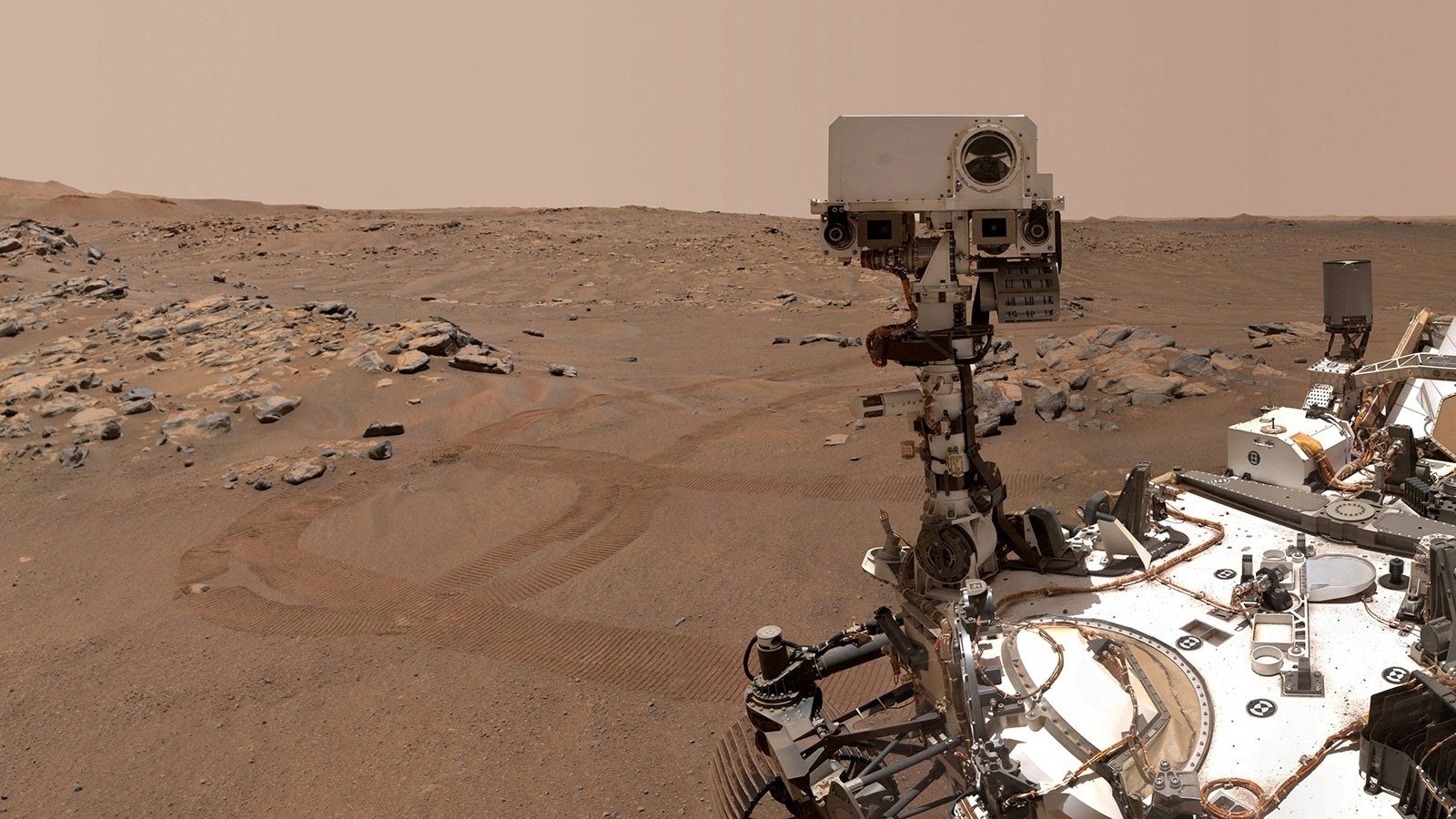
NASA’s Perseverance rover has achieved a major milestone in space exploration by driving farther on another world than any other vehicle before it. The robotic explorer has surpassed the long-standing Mars driving record held by NASA’s Opportunity rover, marking an important step forward in robotic exploration.
According to NASA’s Jet Propulsion Laboratory (JPL), Perseverance reached a total driving distance of 28.10 miles (45.22 kilometres) on October 11, 2026. This passed the previous record of 28.06 miles (45.16 kilometres), which Opportunity established during its mission on Mars.
The achievement is especially important because Perseverance reached this distance in about five and a half years, while Opportunity took nearly 15 years to cover a similar distance.
The rover’s success highlights improvements in autonomous navigation, robotic engineering, and planetary science. Its journey is not only about travelling farther but also about exploring ancient Martian landscapes, studying rocks and searching for possible evidence of past microbial life.
NASA Perseverance Rover Driving Record: What Happened?
NASA confirmed that Perseverance became the farthest-travelling vehicle on the surface of another world when it passed Opportunity’s previous record on October 11, 2026.
The milestone came during the rover’s 2,006th Martian day, also known as a sol. During that day’s drive, Perseverance travelled approximately 299.6 feet (91.31 metres), pushing its total distance beyond Opportunity’s achievement.
Although the difference between the two records is small, the achievement represents years of engineering work and scientific exploration.
Driving on Mars is not as simple as driving a vehicle on Earth. The planet has rocky ground, loose sand, steep slopes, and other obstacles that can damage wheels or trap a rover. Engineers must carefully plan routes to protect the vehicle while allowing it to reach important scientific locations.
Perseverance uses advanced cameras, onboard computers, and autonomous navigation software to understand its surroundings. These systems help the rover travel across the planet while avoiding dangerous terrain.
The new record shows how far robotic mobility technology has advanced since NASA first began sending wheeled vehicles to explore Mars.
Why Is the Perseverance Rover Exploring Mars?
Perseverance landed on Mars on February 18, 2021, as part of NASA’s Mars 2020 mission.
Its main goal is to study whether Mars could have supported microbial life in the distant past. Scientists believe that ancient Mars had a warmer and wetter environment than the cold, dry planet seen today.
The rover is exploring Jezero Crater, an area that scientists believe once contained a lake and a river delta. Such environments could have provided water and other conditions needed for microbial life.
Perseverance carries scientific instruments that help researchers study rocks, minerals, soil, and the surrounding atmosphere. It also collects and seals selected rock and soil samples for possible return to Earth through a future sample-return effort.
These samples could help scientists understand the planet’s ancient climate, geological history, and potential habitability.
However, finding rocks that formed in water does not automatically mean that life existed there. Scientists need detailed evidence before concluding ancient life on Mars.
The rover’s long-distance driving capability allows it to visit more locations and investigate different types of geological formations.
How Perseverance Surpassed Opportunity’s Record
NASA’s Opportunity rover landed on Mars in January 2004. Its original mission was planned to last only 90 Martian days, but the rover continued operating for nearly 15 years.
Opportunity travelled 28.06 miles (45.16 kilometres) before its mission ended in 2018. During its long journey, it studied rocks, examined the planet’s surface and provided important evidence that liquid water had once affected parts of Mars.
Perseverance surpassed that distance in less than six years.
One of the biggest reasons for this improvement is its advanced autonomous navigation system, called AutoNav. This technology allows the rover to analyse nearby terrain and select a safe route without requiring engineers on Earth to guide every movement.
NASA reports that AutoNav has supported more than 90% of Perseverance’s total driving distance. By comparison, autonomous navigation accounted for about 5% of the driving distance of the earlier Mars rovers Spirit and Opportunity.
This difference demonstrates how advances in onboard computing and navigation have changed the way robotic missions operate.
What Is AutoNav and How Does It Work?
AutoNav is one of the key technologies behind Perseverance’s driving achievement.
Because Mars is millions of kilometres away from Earth, communication between the rover and mission control takes time. Engineers cannot operate the vehicle in real time as they would control a remote car.
Instead, rover planners on Earth usually study images, identify hazards, and prepare driving instructions. The rover then follows those instructions on Mars.
AutoNav reduces the need for constant human planning.
The system uses navigation cameras to capture images of the surrounding terrain. Its onboard computers process the images and build a three-dimensional understanding of nearby obstacles. The rover can then select a route between planned destinations while avoiding rocks, slopes, and other hazards.
NASA says Perseverance can process around 600,000 terrain measurement points with each look, compared with just 20 used by the first Mars rover, Sojourner. Perseverance can also cover as much as 1,351 feet (412 metres) in a single Martian day under suitable conditions.
These capabilities allow the rover to travel more efficiently while giving scientists more opportunities to investigate the planet.
Autonomous navigation does not mean the rover operates without human oversight. Engineers and scientists continue to plan the mission, review data, and decide which destinations are worth exploring.
Perseverance Is Exploring Ancient Terrain Near Jezero Crater
The record-breaking drive occurred while Perseverance was travelling through an area near the western rim of Jezero Crater known as Lac de Charmes.
The rover was heading towards a location called Idubi, where scientists hope to investigate rocks that may preserve evidence of ancient hydrothermal systems.
Hydrothermal systems form when heated water interacts with rocks and minerals. On Earth, these environments can support microbial communities, making them interesting places to study when searching for signs of past life.
If similar environments existed on ancient Mars, they could help scientists understand whether the planet once had conditions suitable for life.
The region is also scientifically valuable because its ancient rocks may preserve information that is difficult to find on Earth. On our planet, erosion and plate tectonics have changed or destroyed many very old geological formations.
Mars does not have Earth’s active system of moving tectonic plates, which means some ancient surface features may remain preserved for much longer.
By driving across these landscapes, Perseverance can examine different rock formations and help researchers decide where to focus their scientific investigations.
What Has Perseverance Discovered So Far?
Perseverance has made important contributions to the study of Mars since arriving in 2021.
One of its major tasks is to identify rocks that may preserve signs of ancient microbial activity. Scientists analyse the minerals, chemical composition and physical structure of these rocks to understand how they formed.
The rover also studies the environment around it, including the atmosphere, surface conditions and dust activity.
In addition, Perseverance collects samples from carefully selected locations. These samples are sealed in special tubes so they may be studied in laboratories on Earth in the future.
Laboratories on Earth can use larger and more advanced scientific instruments than those that can be carried aboard a rover. Examining returned samples could therefore provide more detailed information about the history of Mars.
NASA and its partners have also reported a rock sample containing features and chemical signals that scientists consider a possible biosignature. A biosignature is a feature that could be associated with past life, but it can also form through non-biological processes.
Therefore, a possible biosignature is not proof that life existed on Mars. Researchers need additional analysis to determine what produced the observed features.
The rover’s record-breaking journey creates more opportunities to explore different environments and identify samples that could help answer this question.
Artificial Intelligence Is Changing Mars Exploration
Autonomous navigation is not the only technology changing robotic exploration.
In January 2026, NASA announced that Perseverance had completed experimental drives planned using generative artificial intelligence. The demonstration used AI to help analyse terrain data and create driving waypoints that are normally prepared by human rover planners.
The demonstration showed how AI could support the planning process for future planetary missions.
AI-assisted systems can help analyse large amounts of imagery, identify obstacles, and suggest routes through difficult landscapes. These capabilities may reduce the workload for mission teams and allow robotic explorers to cover more ground.
However, using AI for space exploration requires strict safety checks. A mistake in route planning could damage the rover or prevent it from reaching its destination.
NASA’s demonstration included checks using a digital model of the rover before the driving instructions were sent to Mars.
Future missions could combine autonomous navigation, AI-assisted planning, and scientific data analysis to explore more remote regions of the solar system.
What Does the Record Mean for Future Space Missions?
Perseverance’s achievement is important because mobility determines how much of a planet a rover can explore.
A rover that can safely travel longer distances has access to a wider range of geological formations and scientific targets. It may also be able to move between locations more efficiently.
NASA has approved the first extension of Perseverance’s mission, which began in October 2026 and is expected to support exploration of the Jezero Crater rim through approximately the end of 2028. The agency says the rover’s mobility systems remain operational and that it expects the driving record to continue growing.
This extended mission could give scientists more time to investigate ancient rocks and search for evidence of past environmental conditions.
The technology may also inform the design of future robotic explorers. Improved navigation and autonomous decision-making could help missions operate in locations where communication delays make frequent human intervention difficult.
Such capabilities will be especially valuable when exploring more distant destinations or preparing for human missions to the Moon and Mars.
Perseverance vs Opportunity: Key Differences
| Feature | Perseverance | Opportunity |
|---|---|---|
| Mars landing | February 18, 2021 | January 25, 2004 |
| Record distance milestone | October 11, 2026 | Held record until October 2026 |
| Distance at record milestone | 28.10 miles (45.22 km) | 28.06 miles (45.16 km) |
| Mission duration before record | About 5.5 years | Nearly 15 years |
| Autonomous navigation | AutoNav used for more than 90% of driving distance | Autonomous navigation used for about 5% |
| Main scientific focus | Ancient habitability, rock samples and possible signs of past life | Geological history and evidence of past water |
The comparison highlights the progress made in rover design and navigation technology. The opportunity demonstrated that robotic vehicles could survive and explore Mars far beyond their original mission plans. Perseverance is building on that achievement with more advanced systems and a different scientific mission.
Conclusion
NASA’s Perseverance rover has set a new milestone in planetary exploration by surpassing Opportunity’s long-standing Mars driving record. By October 11, 2026, it had travelled 28.10 miles (45.22 kilometres), achieving in about five and a half years what took Opportunity nearly 15 years.
The achievement reflects improvements in autonomous navigation, computing and robotic engineering. More importantly, it supports Perseverance’s scientific mission to explore ancient landscapes, study rocks and search for possible evidence of past microbial life.
As the rover continues exploring Jezero Crater and its surrounding terrain, each additional kilometre could lead scientists to new geological discoveries.
The record is not simply about how far a machine can travel. It is about how advanced technology can help humanity explore another planet, study its past and better understand whether life may once have existed beyond Earth.